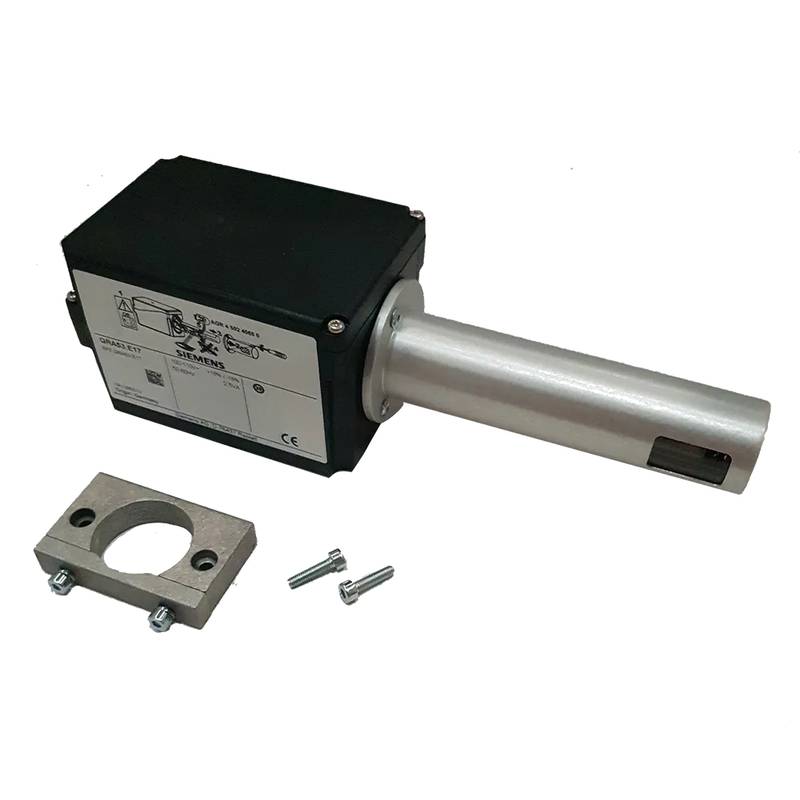
SIEMENS QRA53.E27 Ultraviolet Flame Sensor QRA53


The Siemens QRA53.E27 Ultraviolet Flame Sensor is a critical component for reliable flame detection in industrial combustion processes. Engineered for continuous operation, this self-checking UV flame detector offers robust performance and ensures safety across a wide range of applications. Its core advantage lies in its ability to detect the ultraviolet radiation emitted by flames, providing rapid and accurate monitoring. Key technical parameters include a normal sensitivity setting, a detector tube length of 125mm, and a mains voltage requirement of AC 230V. The sensor boasts a substantial average UV cell life of 10,000 hours under optimal conditions and an IP65 degree of protection, ensuring durability in demanding industrial environments.
Product Specifications
| Specification | Value |
| :------------------- | :-------------------------------------- |
| Product Type | UV Flame Detector |
| Manufacturer | Siemens |
| Model Number | QRA53.E27 |
| Sensitivity | Normal |
| Detector Tube Length | 125 mm |
| Mains Voltage | AC 230V / 220–240 V AC |
| Operating Mode | Continuous |
| Flame Detection | UV radiation in 190–270 nm band |
| Degree of Protection | IP65 |
| Weight (approx.) | 0.7 kg – 0.84 kg |
| Average UV Cell Life | 10,000 hours (below 50°C) |
| Housing Material | Die-cast aluminum |
| Max Ambient Temp. | 60 °C |
| Electrical Connector | AGM19 plug and cable (2 m) |
| Mounting | 1 in. threaded coupling with bayonet fitting |
| Window Material | Quartz-glass front |
| Certifications | ISO 9001, ISO 14001 |
| Compatible Controllers | Siemens LGK16, LGI16 |
Core Features & Market Positioning
The Siemens QRA53.E27 distinguishes itself in the market through its inherent reliability and Siemens' reputation for industrial automation excellence. This UV flame detector is specifically designed for the demanding requirements of continuous flame monitoring, a crucial aspect for safety and operational efficiency in combustion systems. Its self-checking capability enhances its market position by providing an additional layer of assurance against system failures. The integration of a stepper motor for shutter control and sophisticated electronics within the housing signifies advanced engineering, positioning it as a technically superior choice for discerning engineers and plant managers. Its robust build, including a die-cast aluminum housing and quartz-glass protection, underscores its suitability for harsh industrial settings where equipment longevity is paramount.
Key Application Scenarios
The Siemens QRA53.E27 Ultraviolet Flame Sensor is indispensable in a variety of industrial combustion applications. Its primary use is in the continuous monitoring of flames within oil and gas burner systems, ensuring immediate detection of flame loss or instability. This makes it a vital safety component in industrial boilers, furnaces, and process heaters across sectors such as power generation, chemical processing, and manufacturing. The detector is also suitable for supervising gas flames, yellow or blue oil flames, and for ignition spark proving, offering versatile protection. Its compatibility with Siemens LGK16 and LGI16 burner controls further solidifies its role in integrated burner management systems.
Practical System Integration Guidance
Integrating the Siemens QRA53.E27 into an existing system requires careful attention to mounting and electrical connections. The detector can be mounted directly on the burner, a viewing tube, or a combustion chamber viewing hole, often utilizing a 1-inch threaded coupling with a bayonet fitting. An AGG16.C adapter can facilitate various mounting configurations. For electrical connections, a Siemens AGM19 plug and cable is typically used, with a standard length of 2 meters. Installation notes indicate a requirement for separation from ignition wiring to prevent interference. It is crucial that qualified personnel perform all mounting and installation work, observing relevant legislation and ensuring electrical safety by disconnecting mains supply before any wiring changes.
Operation and Risk Mitigation
The QRA53.E27 operates by detecting ultraviolet radiation emitted by a flame. Its UV cell is protected by a swiveling shutter and a quartz-glass window, which shields against dirt. To ensure operational integrity, the detector's performance is continuously checked. The average life of the UV cell is rated at 10,000 hours when operated below 50°C; exceeding this temperature significantly reduces its lifespan. Risk mitigation involves adhering to installation guidelines, such as maintaining separation from ignition wiring, and ensuring the detector is not exposed to condensation, ice, or water ingress. Regular inspection and maintenance by qualified personnel are essential for safe and reliable operation.
Scalability & Long-Term Value
While the QRA53.E27 is a robust standalone component, its long-term value is amplified by its integration within the broader Siemens industrial automation ecosystem. Its compatibility with established Siemens burner controls like the LGK16 and LGI16 ensures seamless integration into existing infrastructure. For systems requiring advanced digital connectivity, the QRA53.E27 can be part of a larger control strategy that interfaces with SCADA systems or IIoT platforms, enabling remote monitoring, data logging, and predictive maintenance. This positions the sensor not just as a safety device but as a data-contributing element in the evolution towards smart industrial operations, offering sustained relevance and value.
Frequently Asked Questions
What is the primary function of the Siemens QRA53.E27?
The Siemens QRA53.E27 is an ultraviolet (UV) flame detector. Its main purpose is to continuously monitor flames in industrial burners. It detects the UV radiation emitted by a flame to ensure safe and efficient combustion.
This UV flame sensor is crucial for safety systems. It provides rapid detection of flame presence or absence. This prevents dangerous conditions arising from uncontrolled combustion.
It is designed for use with Siemens burner control units. This ensures seamless integration into existing control architectures. The detector plays a vital role in automated combustion processes.
How is the QRA53.E27 installed and connected?
Installation involves mounting the detector to the burner or viewing port. It typically uses a 1-inch threaded coupling with a bayonet fitting. An AGG16.C adapter can also be used for flexible mounting.
Electrical connection is usually made via an AGM19 plug and cable. Standard cable lengths are often 2 meters. It's important to separate ignition wiring during installation.
Qualified personnel must perform installation. Always ensure the plant is isolated from mains power before wiring. Follow all local regulations and safety guidelines.
What are the key technical specifications of the QRA53.E27?
This UV flame sensor operates on AC 230V or 220-240V mains voltage. It features normal sensitivity and a detector tube length of 125mm. The operating mode is continuous.
The detector housing is made of die-cast aluminum and offers IP65 protection. Its weight is approximately 0.7 to 0.84 kg. The average UV cell life is about 10,000 hours if kept below 50°C.
It detects UV radiation in the 190-270 nm band. The sensor is certified to ISO 9001 and ISO 14001 standards. It is compatible with Siemens LGK16 and LGI16 burner controls.
What are the main advantages of using the QRA53.E27?
A key advantage is its reliable UV flame detection capability. This ensures rapid and accurate monitoring of combustion processes. Its self-checking function enhances operational safety and system integrity.
The sensor is built for durability with a die-cast aluminum housing and IP65 rating. This makes it suitable for harsh industrial environments. The long average UV cell life also contributes to reduced maintenance.
Its compatibility with Siemens burner controls streamlines integration. This simplifies system design and commissioning for end-users. It offers a robust solution for continuous flame monitoring needs.
What kind of flames can the QRA53.E27 detect?
The QRA53.E27 is designed to detect flames that emit ultraviolet (UV) radiation. This includes common industrial fuel sources like natural gas and oil. It is effective for both yellow and blue oil flames.
It can also be used for ignition spark proving. This ensures the ignition system is functioning correctly before fuel is introduced. The sensor's UV sensitivity is in the 190-270 nm range.
Its application is primarily for supervising gas and oil flames in industrial burners. This ensures safe and efficient operation of combustion equipment.
What is the typical lifespan of the UV cell in the QRA53.E27?
The average lifespan of the UV cell in the QRA53.E27 is approximately 10,000 hours. This rating is valid when the sensor is operated below 50°C. Higher operating temperatures can significantly reduce this lifespan.
To maximize the UV cell's life, it's important to maintain optimal operating temperatures. Proper installation and avoiding excessive heat exposure are crucial. This ensures consistent performance over time.
Adhering to the manufacturer's specifications for temperature and operating conditions is key. This will help ensure the sensor performs reliably for its expected service life.
Is the QRA53.E27 suitable for hazardous environments?
The QRA53.E27 features an IP65 degree of protection. This indicates it is protected against dust ingress and low-pressure water jets. This rating makes it suitable for many industrial environments.
However, specific hazardous area classifications (e.g., ATEX, IECEx) are not explicitly detailed in general product descriptions. For hazardous locations, users must verify its suitability and any required certifications.
Always consult the official product datasheet and relevant safety standards for hazardous area applications. Ensure compliance with all local regulations.
What are common troubleshooting issues with UV flame detectors like the QRA53.E27?
A common issue is flame failure detection when a flame is present, often due to contamination on the quartz window or UV cell. Lens cleaning might resolve this. Another issue can be a false flame signal from other UV sources.
Intermittent operation or failure to ignite could stem from electrical connection problems or an aging UV cell. Checking wiring integrity and considering UV cell replacement after extended use (around 10,000 hours) is advisable.
Environmental factors like excessive heat or moisture can also lead to malfunctions. Ensuring the sensor operates within its specified temperature range and protection rating is vital for reliable performance.
How does the self-checking feature of the QRA53.E27 enhance safety?
The self-checking feature performs automatic diagnostics. It verifies the functionality of the UV cell and internal electronics. This ensures the detector is operational before and during burner firing.
If the self-check detects an anomaly, it signals a fault. This prevents the burner from operating with a compromised flame detection system. It effectively mitigates the risk of unsafe combustion conditions.
This continuous monitoring provides an added layer of safety assurance. It helps prevent unexpected flame-out detection failures, crucial for industrial process safety.
Can the QRA53.E27 be integrated with IIoT platforms?
While the QRA53.E27 is primarily a field device for direct flame monitoring, its integration into IIoT platforms is possible. This is typically achieved through its connection to compatible Siemens burner controls or other PLCs.
These control systems can then relay data from the flame detector to SCADA or IIoT gateways. This allows for remote monitoring, data logging, and analysis of combustion performance.
This integration enables advanced features like predictive maintenance. It contributes to a more connected and intelligent industrial operation.