











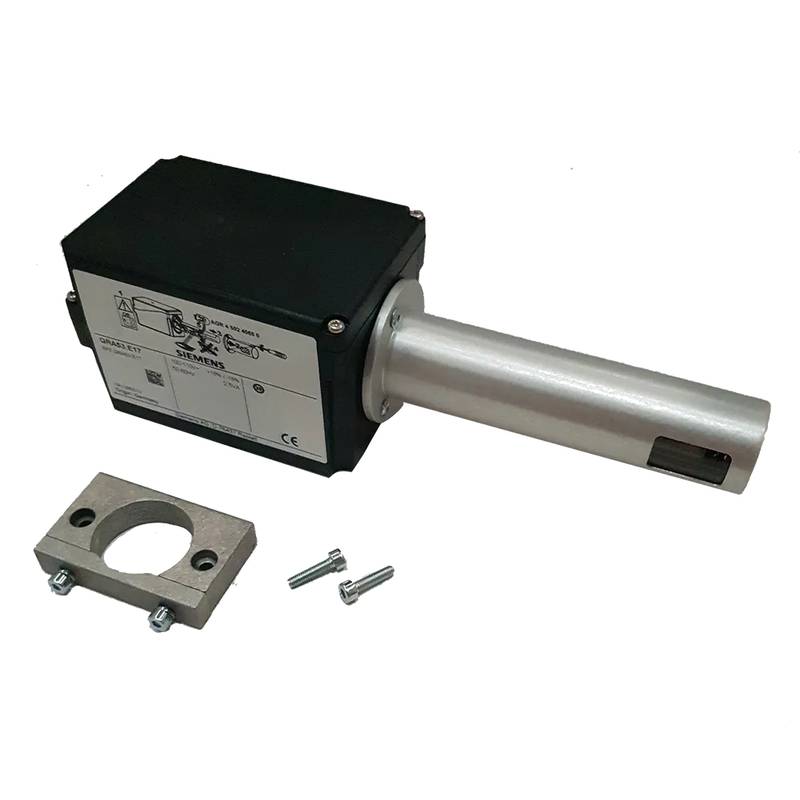
SIEMENS QRA53.G17 UV Flame Detector QRA53 Gas Fired


The SIEMENS QRA53.G17 UV Flame Detector is a critical component for ensuring safe and reliable operation in gas-fired industrial combustion systems. This advanced flame detector offers exceptional responsiveness and robust performance, making it a preferred choice for demanding applications. Its core advantages lie in its high sensitivity to UV radiation emitted by flames, rapid detection capabilities, and a durable design built for harsh industrial environments. Key technical parameters include its operating voltage range of 20-250 V AC, a frequency of 50/60 Hz, and an ambient temperature range of -40 to +60 °C. The detector's sensitivity is optimized for detecting gas flames, and its connection type is typically a 4-pin connection.
Product Specifications
| Feature | Specification |
| :------------------ | :------------------------------------------ |
| Product Type | UV Flame Detector |
| Model | QRA53.G17 |
| Brand | Siemens |
| Application | Gas-fired combustion systems |
| Operating Voltage | 20-250 V AC |
| Frequency | 50/60 Hz |
| Ambient Temperature | -40 to +60 °C |
| Flame Type | Gas |
| Connection | 4-pin |
| IP Rating | IP65 (typically, depending on housing) |
| Output Signal | Typically a relay contact for flame signal |
Core Features & Market Positioning
The SIEMENS QRA53.G17 distinguishes itself through its solid-state design, which eliminates moving parts and enhances reliability and longevity. Its sensitivity to the ultraviolet spectrum allows for early and accurate detection of flame presence, crucial for preventing dangerous combustion events and ensuring process continuity. In the competitive landscape of flame detection technology, the QRA53.G17 is positioned as a high-performance, dependable solution for industrial burners, boilers, and furnaces, offering a balance of advanced sensing capabilities and robust construction. Its integration into Siemens' broader combustion control portfolio further solidifies its market standing as a trusted component within comprehensive safety systems.
Key Application Scenarios
This UV flame detector is extensively deployed in industrial settings where precise and rapid flame monitoring is paramount. Common applications include natural gas burners in industrial boilers, process heaters, and large-scale ovens. It is also vital in applications involving gas turbines and specialized combustion equipment requiring continuous flame verification. The QRA53.G17's suitability for gas-fired systems makes it an indispensable component for manufacturers and operators in the chemical, petrochemical, power generation, and food processing industries, where uninterrupted and safe combustion is critical to operations.
Practical System Integration Guidance
Integrating the SIEMENS QRA53.G17 typically involves careful consideration of its mounting location relative to the flame and the burner nozzle. The detector should be positioned to have an unobstructed view of the flame while minimizing exposure to excessive heat and contaminants. Wiring connections are made to the 4-pin base, requiring adherence to the manufacturer's specifications for power supply (20-250 V AC) and the output signal, which usually interfaces with a burner control unit. Proper grounding and shielding of the signal cable are essential to prevent electromagnetic interference and ensure accurate flame signal transmission. Installation should always be performed by qualified personnel following safety regulations and the specific Siemens installation manual for the QRA53.G17.
Operation and Risk Mitigation
The QRA53.G17 operates by continuously monitoring the ultraviolet radiation emitted by a flame. When sufficient UV light is detected, it signals the presence of a flame to the connected combustion control system. This signal is crucial for maintaining the operational status of the burner or for initiating shutdown sequences if the flame is lost. Risk mitigation is inherent in its design, preventing unburned fuel from accumulating and potentially causing an explosion. Common troubleshooting involves checking power supply, signal wiring integrity, and ensuring the detector's lens is clean and free from obstruction. While specific fault codes are managed by the interconnected control system, a lack of a flame signal when a flame is expected typically indicates a detection issue or a problem with the burner itself.
Scalability & Long-Term Value
The SIEMENS QRA53.G17 offers significant long-term value due to its robust construction and compatibility with a wide range of Siemens combustion control systems, such as the LMV series. This compatibility allows for seamless integration into existing or new plant infrastructure, facilitating scalability as operational needs evolve. Its solid-state design contributes to a low maintenance requirement, reducing operational costs over the product's lifecycle. Furthermore, its integration with modern control platforms enables its participation in the Industrial Internet of Things (IIoT) ecosystem, allowing for remote monitoring, data analytics, and predictive maintenance strategies when coupled with appropriate gateways and software.
FAQs
What is the primary function of the SIEMENS QRA53.G17?
Its main role is to detect the UV radiation emitted by a gas flame. This detection is vital for safe burner operation. It signals the burner control system about the flame's presence.
The detector ensures that combustion is stable and controlled. It prevents hazards from unlit fuel. This contributes to overall industrial safety.
By providing a reliable flame signal, it allows for efficient fuel combustion. This optimizes energy usage in gas-fired systems.
What types of flames can the QRA53.G17 detect?
This model is specifically designed for gas-fired flames. It is optimized for the UV spectrum characteristic of gas combustion. It may not be suitable for all types of flames.
Its sensitivity is tuned for the UV output of typical industrial gas burners. This ensures accurate detection in its intended applications. Consult specifications for other fuel types.
The detector relies on UV emissions, which are common in burning natural gas and propane. It is a specialized tool for gas combustion monitoring.
What is the operating voltage and frequency for the QRA53.G17?
The detector operates on a wide AC voltage range of 20 to 250 Volts. This flexibility simplifies integration into various power systems. It accommodates diverse electrical infrastructures.
It is designed to function with standard industrial power frequencies of 50 or 60 Hertz. This ensures compatibility across global power grids. It supports both common frequency standards.
Always ensure the supplied voltage is within the specified 20-250 V AC range. Incorrect voltage can damage the unit. Verify power source before installation.
What is the ambient temperature range for this flame detector?
The QRA53.G17 can operate reliably in extreme temperatures. Its ambient operating range is from -40°C to +60°C. This makes it suitable for harsh industrial environments.
This broad temperature tolerance ensures consistent performance. It is designed for applications with significant temperature fluctuations. It is built for demanding conditions.
Ensure the detector is installed within this specified range. Exceeding these limits can affect performance or cause failure. Check surrounding temperature during installation.
How is the QRA53.G17 typically connected into a system?
It utilizes a standard 4-pin connection for electrical interfacing. This connection typically links to a burner control unit or flame safeguard. Proper wiring is crucial for signal transmission.
The pins are designated for power input and the flame signal output. Following the Siemens wiring diagram is essential for correct setup. Ensure secure and insulated connections.
Always refer to the specific installation manual for pin assignments. Incorrect wiring can lead to system malfunction or safety hazards. Professional installation is recommended.
What is the IP rating of the SIEMENS QRA53.G17 UV Flame Detector?
While the specific IP rating can vary with external housing, the detector itself is typically designed for robust environmental protection. Many configurations achieve an IP65 rating. This signifies protection against dust and water jets.
An IP65 rating means the detector can withstand challenging conditions. It is suitable for environments where dust ingress or water spray is a concern. It offers a high level of protection.
This protection ensures reliable operation even in dusty or washdown areas. Always confirm the IP rating of the complete assembly, including any protective enclosure used.
What are the main advantages of using a UV flame detector like the QRA53.G17?
UV detectors offer rapid response times to flame ignition. They are sensitive to the ultraviolet spectrum emitted by flames. This allows for quick verification of flame presence.
Their solid-state design means no moving parts, leading to high reliability and long service life. They are generally compact and easy to install. They provide a robust sensing solution.
UV detection is particularly effective for gas flames. It distinguishes flame signals from other heat sources. This reduces nuisance shutdowns.
Can the QRA53.G17 be used with oil-fired burners?
The SIEMENS QRA53.G17.G17 is primarily optimized and specified for gas-fired applications. Its sensitivity is tuned for the UV radiation characteristics of gas flames. It may not be suitable for oil flames.
Oil flames often emit different radiation spectra, including more infrared. While some UV might be present, a detector specifically designed for oil flames (e.g., an IR or dual-flame detector) might be more appropriate. Using it with oil could lead to unreliable detection.
For oil-fired systems, it is crucial to select a flame detector designed for that specific fuel type. Siemens offers a range of flame detectors; consult their catalog for oil-specific models.
What maintenance is typically required for the QRA53.G17?
Maintenance for the QRA53.G17 is generally minimal due to its solid-state design. Periodic visual inspection of the detector lens for dirt or obstructions is recommended. Ensuring the lens is clean is vital for accurate readings.
Regular checks of wiring connections for security and integrity are advisable. Depending on the operating environment, cleaning the lens may be necessary to maintain optimal performance. Refer to the operating manual for specific intervals.
The primary goal is to ensure an unobstructed view of the flame. Avoid using harsh chemicals to clean the lens; use only approved methods and materials. This proactive approach prevents premature failure.
How does the QRA53.G17 integrate with Siemens control systems?
The QRA53.G17 is designed to interface with Siemens burner control units, such as those in the LMV series. It provides a simple flame signal output to these controllers. These systems then interpret the signal for combustion management.
The integration allows the control system to make decisions based on flame status. This includes initiating ignition, maintaining flame, or shutting down the burner if the flame is lost. It's a key part of a Siemens combustion safety chain.
This interoperability ensures a cohesive and reliable combustion solution. It leverages Siemens' expertise in integrated industrial automation and safety. The detector becomes a node in a larger control network.