











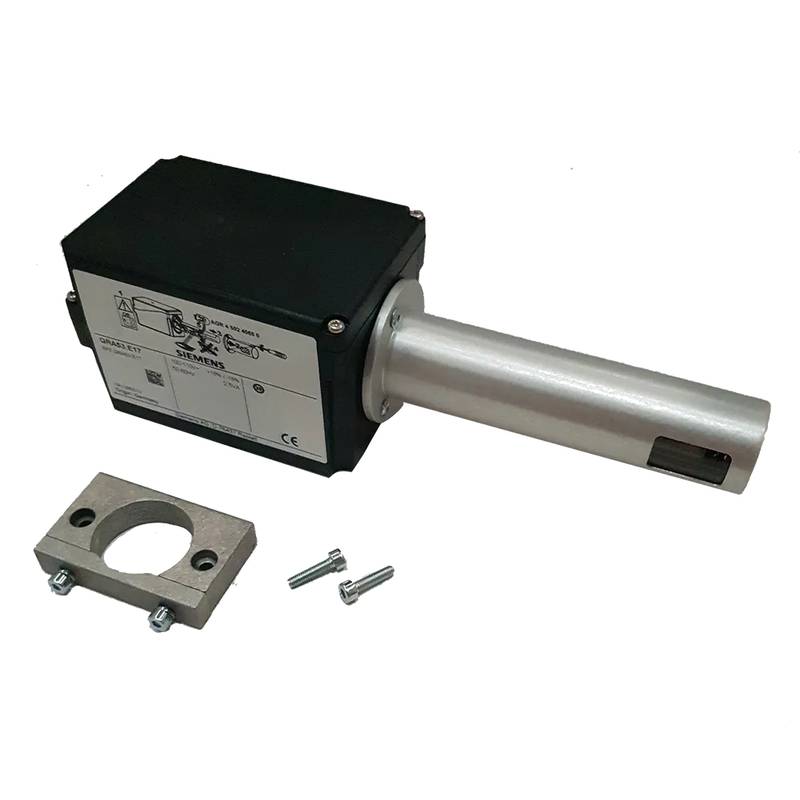
SIEMENS QRA55.G17 UV Flame Detector QRA55 Gas Fired


The SIEMENS QRA55.G17 UV Flame Detector is a critical component for ensuring safe and efficient operation in gas-fired industrial combustion systems. This advanced flame detector offers robust performance with key advantages including rapid flame detection, high immunity to interference, and a compact, durable design. Core features include a UV sensor for reliable flame monitoring, a wide operating temperature range, and straightforward integration into existing control systems. Important technical parameters, such as its response time and ingress protection rating, make it suitable for demanding industrial environments.
SIEMENS QRA55.G17 UV Flame Detector: Product Specifications
| Feature | Specification |
| :---------------------- | :------------------------------------------ |
| Detector Type | UV (Ultraviolet) |
| Model | QRA55.G17 |
| Application | Gas-fired combustion systems |
| Flame Signal Detection | Ultraviolet radiation |
| Operating Voltage | 20 to 30 VDC |
| Current Consumption | Max. 5 mA |
| Response Time | < 1 second |
| Operating Temperature | -40 to +60 °C (-40 to +140 °F) |
| Storage Temperature | -50 to +80 °C (-58 to +176 °F) |
| Ingress Protection | IP65 |
| Connection Type | Terminal block |
| Housing Material | Die-cast aluminum |
| Dimensions (W x H x D) | 50 x 50 x 75 mm |
| Weight | Approx. 180 g |
Core Features & Market Positioning
The SIEMENS QRA55.G17 stands out in the market due to its sophisticated UV flame sensing technology, which provides a high degree of reliability in detecting flame presence across a variety of gas-fired applications. Its design prioritizes swift response times, ensuring that combustion anomalies are identified almost instantaneously, thereby enhancing safety protocols and preventing potential operational disruptions. This detector is engineered for robust performance, offering superior immunity to electromagnetic interference and false signals, a common challenge in complex industrial settings. Its market positioning is firmly established as a dependable, high-performance flame detection solution for gas burners, boiler controls, and other combustion equipment where unwavering safety and operational integrity are paramount. The QRA55.G17 is recognized for its straightforward integration capabilities and its ability to withstand harsh environmental conditions, making it a preferred choice for plant engineers and system integrators seeking a long-term, maintenance-friendly solution.
Key Application Scenarios
The versatility of the SIEMENS QRA55.G17 UV Flame Detector makes it an indispensable component in a wide array of industrial gas-fired combustion applications. It is extensively utilized in industrial furnaces and ovens, where precise flame monitoring is crucial for maintaining process temperatures and ensuring energy efficiency. In the power generation sector, it plays a vital role in boiler control systems, safeguarding against flame failure and ensuring continuous, safe operation. Furthermore, the QRA55.G17 is a standard in the petrochemical industry for process heaters and flares, environments that demand high reliability and rapid response to flame conditions. Its compatibility with various burner management systems also facilitates its use in commercial heating systems and incinerators, wherever controlled gas combustion is employed and a robust flame supervision solution is required.
Practical System Integration Guidance
Integrating the SIEMENS QRA55.G17 UV Flame Detector into your combustion control system is designed for efficiency. The detector connects to the burner management system via a two-wire connection, typically using a shielded cable to minimize electrical noise. Power is supplied via the control system, with the detector drawing minimal current (max. 5 mA) within a 20-30 VDC range. Ensuring proper grounding of the detector and control system is essential for optimal performance and interference rejection. The QRA55.G17’s IP65 rating means it can withstand dust and water jets, allowing for installation in challenging environments, though direct, prolonged exposure to high-pressure water should still be avoided. For optimal flame signal reception, the detector should be positioned so its viewing angle is clear of obstructions and directly targets the flame, typically within a specified distance and angle as per the burner design.
Operation and Risk Mitigation
Proper operation of the SIEMENS QRA55.G17 UV Flame Detector is paramount for safety. The detector continuously monitors for ultraviolet radiation emitted by the flame. Upon detecting this radiation within its operational parameters, it sends a signal to the burner management system, indicating flame presence. If the flame is lost or the UV signal is absent for a predetermined period, the control system will initiate a safe shutdown sequence, preventing the accumulation of unburned fuel. Critical fault conditions, such as a lack of signal or internal malfunction, are typically signaled by the control system, often triggering alarm relays or error codes. Regular visual inspection of the detector's lens for dirt or damage, and periodic functional testing as part of a scheduled maintenance program, are key to mitigating operational risks and ensuring the continuous reliability of the flame detection system.
Scalability & Long-Term Value
The SIEMENS QRA55.G17 UV Flame Detector offers excellent long-term value and integration potential within modern industrial automation architectures. Its design is compatible with a wide range of Siemens burner control systems and other third-party combustion management platforms, facilitating seamless upgrades or expansions of existing installations. For facilities moving towards digital transformation and the Industrial Internet of Things (IIoT), the QRA55.G17 can be integrated with supervisory control and data acquisition (SCADA) systems or programmable logic controllers (PLCs) that feature data logging and remote monitoring capabilities. This allows for advanced performance analytics, predictive maintenance scheduling, and remote diagnostics, thereby enhancing operational efficiency and reducing downtime. The detector’s robust construction and Siemens’ commitment to product longevity ensure it remains a reliable component for many years, supporting evolving operational requirements and technological advancements.
FAQs
1. What is the primary function of the SIEMENS QRA55.G17 UV Flame Detector?
The QRA55.G17's main role is to detect the presence of a flame in gas-fired combustion systems. It achieves this by sensing the ultraviolet (UV) radiation emitted by a flame. This detection is crucial for safe burner operation.
It ensures that the burner management system knows when a flame is established and stable. If the flame is lost, the detector signals this to the control system. This signal initiates safety procedures to prevent hazardous conditions.
The detector's rapid response time (< 1 second) is vital for immediate feedback to the control system. This ensures prompt action in case of flame failure, enhancing overall safety and reliability.
2. How does the SIEMENS QRA55.G17 detect a flame?
This detector utilizes a specialized ultraviolet (UV) sensor to monitor for flame presence. The sensor is sensitive to the specific wavelengths of UV light that a burning gas flame emits. It is designed to ignore other light sources.
When a stable flame is present, it continuously emits UV radiation. The QRA55.G17 captures this radiation and converts it into an electrical signal. This signal is then transmitted to the connected burner management system.
The detector's sensitivity to UV light makes it highly effective for gas flames. Its design provides robust detection while minimizing false alarms from other thermal sources.
3. What are the operating voltage and current requirements for the QRA55.G17?
The SIEMENS QRA55.G17 operates on a DC voltage supply. It requires a power input ranging from 20 to 30 Volts Direct Current (VDC). This provides a stable operating window.
The current consumption of the detector is quite low. It draws a maximum of 5 milliamperes (mA), making it energy-efficient. This low power draw is advantageous for system design.
This specification ensures compatibility with most standard burner management systems. It also contributes to reduced overall energy usage in industrial setups.
4. Can the SIEMENS QRA55.G17 be used in harsh industrial environments?
Yes, the QRA55.G17 is engineered for demanding industrial settings. It features a robust die-cast aluminum housing for durability. This material offers excellent protection against physical impacts.
The detector has an Ingress Protection (IP) rating of IP65. This means it is protected against dust ingress and low-pressure water jets. It can withstand challenging environmental conditions.
Its wide operating temperature range, from -40 to +60 °C, further confirms its suitability for harsh environments. This allows for reliable performance in extreme heat or cold.
5. What is the response time of the SIEMENS QRA55.G17 UV Flame Detector?
The SIEMENS QRA55.G17 boasts a very fast response time. It can detect a flame and signal its presence in less than one second. This rapid detection is critical for safety.
This swift acknowledgment of flame presence allows the burner management system to react immediately. It helps prevent dangerous situations like fuel buildup. It ensures timely control actions.
A fast response time is a key feature for reliable burner supervision. It minimizes the risk of operational failures and enhances system safety margins significantly.
6. What is the meaning of the IP65 rating for the QRA55.G17?
The IP65 rating indicates the level of protection provided by the detector's enclosure. The '6' signifies complete protection against dust ingress. It is totally dust-tight.
The '5' indicates protection against water jets. The detector can withstand low-pressure water streams from any direction. This makes it suitable for washdown areas.
This rating ensures the detector can operate reliably in dusty or humid industrial environments. It protects the sensitive internal components from environmental contaminants.
7. What is the typical application for the SIEMENS QRA55.G17?
The QRA55.G17 is specifically designed for gas-fired combustion systems. This includes industrial furnaces, ovens, and boilers. It is a key component in burner control.
It is widely used in sectors like power generation and petrochemicals. Applications include process heaters, incinerators, and other equipment using natural gas or similar fuels.
Its primary purpose is to ensure safe and continuous flame monitoring during combustion processes. This prevents hazardous conditions and optimizes performance.
8. How is the SIEMENS QRA55.G17 installed and connected?
Installation involves mounting the detector so its viewing port is aligned with the flame. It connects to the burner management system via a two-wire connection. This typically uses shielded cable.
The wiring consists of a positive and negative terminal for power and signal transmission. It requires a DC power supply within the 20-30 VDC range. Proper grounding is important for signal integrity.
Ensure the viewing window is clean and free from obstructions for optimal flame detection. Follow specific mounting guidelines based on burner design and manufacturer recommendations.
9. What are the temperature limitations for the QRA55.G17?
The SIEMENS QRA55.G17 can operate reliably within a broad temperature range. Its operational temperature is specified from -40 °C to +60 °C. This covers most industrial applications.
For storage, the temperature limits are even wider. The detector can be stored between -50 °C and +80 °C. This offers flexibility during transport and warehousing.
These specifications highlight the detector's robustness. It is built to perform in extreme environmental conditions often found in industrial settings.
10. Can the QRA55.G17 be integrated into IIoT or SCADA systems?
Yes, the QRA55.G17 can be integrated into modern digital systems. Its output signal can be interfaced with PLCs or SCADA systems. This allows for data acquisition.
By connecting to these platforms, users can monitor flame status remotely. It also enables advanced diagnostics and performance analysis. This supports IIoT applications and smart manufacturing.
This integration facilitates predictive maintenance and operational optimization. It allows for better management of combustion processes in a connected industrial environment.