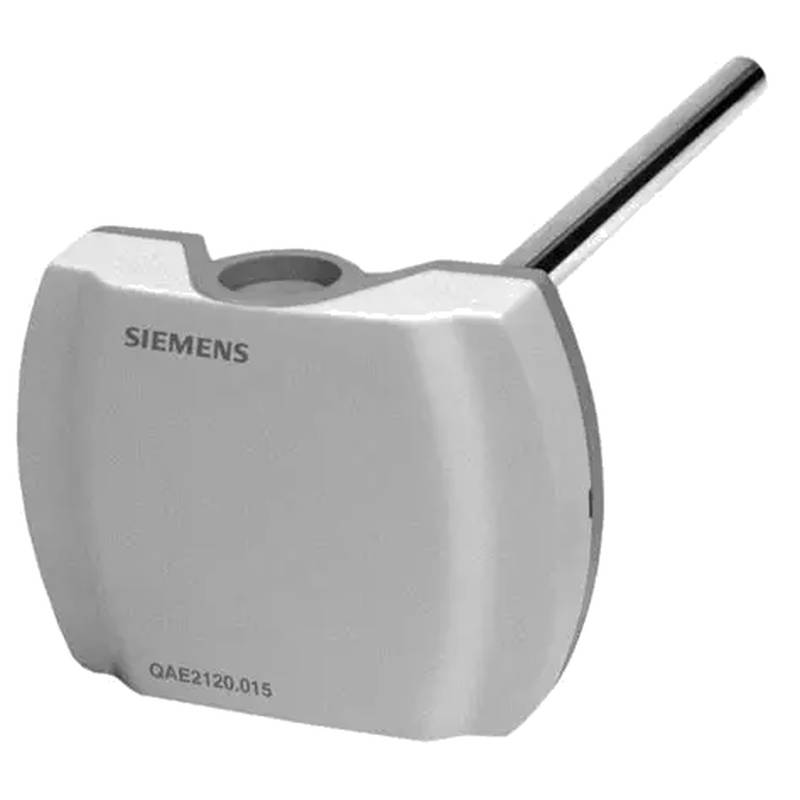
SIEMENS QAE2112.010 Immersion Temperature Sensor 1.0m Cable


The SIEMENS QAE2112.010 Immersion Temperature Sensor, featuring a 1.0m cable, is a vital component for precise temperature measurement in hydronic systems. Its key advantages include robust construction for demanding industrial environments and accurate, reliable sensing capabilities. Core features encompass a wide operating temperature range, rapid response time, and high accuracy, making it a superior choice for critical HVAC and building automation applications. The sensor boasts a NTC 10 kΩ sensing element and a protection tube made of stainless steel (1.4404) for durability. Its technical parameters include a measuring range of -50…+150 °C, an IP rating of IP65, and a connection type that facilitates straightforward integration.
Product Specifications
| Specification | Value |
| :------------ | :---- |
| Product Type | Immersion Temperature Sensor |
| Model Number | QAE2112.010 |
| Cable Length | 1.0 m |
| Sensing Element | NTC 10 kΩ |
| Measuring Range | -50…+150 °C |
| Protection Tube Material | Stainless steel (1.4404) |
| Ingress Protection | IP65 |
| Dimensions (L x Ø) | 100 mm x 6 mm (Immersion depth x Diameter) |
| Connection | Plug connector |
| Application | Hydronic systems, HVAC |
Core Features & Market Positioning
The SIEMENS QAE2112.010 stands out due to its advanced NTC (Negative Temperature Coefficient) sensing technology, which offers superior linearity and accuracy compared to older technologies, positioning it as a high-performance solution for demanding temperature monitoring tasks. Its market strength lies in its seamless integration within the broader Siemens building automation ecosystem, providing users with a trusted and reliable sensor backed by extensive industrial expertise. The sensor's IP65 rating ensures resilience against dust ingress and water jets, a crucial differentiator for applications in potentially harsh or humid environments. This robust design minimizes downtime and maintenance needs, reflecting Siemens' commitment to durable and dependable industrial instrumentation.
Key Application Scenarios
This immersion temperature sensor is optimally suited for continuous temperature measurement in flow and return lines within hydronic heating and cooling systems. It finds critical application in building management systems (BMS) for monitoring boiler water temperature, chiller fluid temperatures, and district heating networks. Its accuracy also makes it indispensable for process control in industrial water treatment and for ensuring optimal performance in renewable energy systems, such as solar thermal or geothermal installations. Facilities managers and system integrators widely deploy the QAE2112.010 to maintain precise temperature setpoints, enhance energy efficiency, and prevent system damage caused by temperature fluctuations.
Practical System Integration Guidance
Integrating the SIEMENS QAE2112.010 into existing systems is streamlined due to its standard plug connector interface, simplifying wiring and reducing installation time. For optimal performance, the sensor’s immersion sleeve should be fully submerged in the fluid medium to ensure accurate temperature readings, typically installed in a suitable immersion well. When connecting to a Siemens controller, such as a Desigo system, the sensor's NTC 10 kΩ characteristic will be recognized and calibrated through the controller's input configuration. Ensure proper sealing of the immersion well to prevent leaks and maintain system integrity. Regular checks of the cable connection for any signs of wear or damage are recommended.
Operation and Risk Mitigation
Proper operation of the SIEMENS QAE2112.010 requires adherence to its specified temperature and environmental limits. Avoid exposing the sensor or its cable to extreme temperatures outside the -50 to +150 °C range, or to aggressive chemicals not compatible with stainless steel and the sensor’s encapsulation. Potential risks include inaccurate readings due to poor immersion depth or inadequate contact with the fluid, or physical damage to the cable or sensor head. To mitigate these risks, always ensure the sensor is correctly installed and fully immersed, protect the cable from mechanical stress or abrasion, and regularly inspect the sensor for any signs of corrosion or damage. Faulty readings, if suspected, should be cross-referenced with another calibrated sensor or instrument.
Scalability & Long-Term Value
The SIEMENS QAE2112.010 offers excellent scalability and long-term value, particularly within the Siemens Desigo platform and other compatible building automation systems. Its modular design allows for easy replacement if maintenance is required, ensuring minimal disruption to system operations. The sensor's robust construction and high-quality components contribute to a long service life, reducing the total cost of ownership. For integration into IIoT (Industrial Internet of Things) strategies, data from the QAE2112.010 can be fed into digital platforms for advanced analytics, predictive maintenance, and remote monitoring, enhancing operational efficiency and intelligent building management.
Frequently Asked Questions (FAQs)
What is the typical accuracy of the SIEMENS QAE2112.010?
This sensor provides highly accurate temperature measurements suitable for critical hydronic applications. Its NTC 10 kΩ element ensures precise readings within its operational range.
Accuracy is vital for maintaining optimal system performance and energy efficiency. It allows for tighter control loops and prevents issues arising from temperature deviations.
The NTC technology offers inherent advantages in linearity and responsiveness, contributing to the sensor's reliable and consistent performance over its lifespan.
How do I install the SIEMENS QAE2112.010 immersion sensor?
Installation involves inserting the sensor into a compatible immersion well within the pipe. Ensure full submersion for accurate readings.
Connect the sensor's plug connector to the designated input on your controller or terminal block. Follow wiring diagrams for correct polarity.
Prior to final assembly, confirm the immersion well is correctly sealed to prevent fluid leakage and maintain system pressure.
Can the SIEMENS QAE2112.010 be used in outdoor applications?
With its IP65 rating, the sensor is protected against dust and low-pressure water jets. This allows for some outdoor use in sheltered locations.
However, prolonged direct exposure to harsh weather conditions or extreme temperatures beyond its specification may affect its longevity. Consider additional protection if necessary.
Always consult the full product documentation for specific environmental limitations and recommended installation practices for outdoor scenarios.
What is the resistance value of the NTC 10 kΩ sensor at different temperatures?
The "10 kΩ" designation refers to the sensor's resistance at 25°C. Resistance changes significantly with temperature.
Lower temperatures increase resistance, while higher temperatures decrease it. This characteristic is fundamental to its function.
Specific resistance-temperature curves are available in the detailed technical documentation for precise calibration and data interpretation.
What type of controller is compatible with the SIEMENS QAE2112.010?
This sensor is designed to work with controllers that support NTC 10 kΩ temperature inputs. Siemens' own Desigo systems are a prime example.
Many third-party building automation and HVAC controllers also accommodate this standard sensor type. Check your controller’s input specifications.
Ensure the controller is configured to recognize the NTC 10 kΩ sensor type for correct temperature scaling and accurate readings.
What is the maximum immersion depth for the SIEMENS QAE2112.010?
The sensor itself has an immersion depth of 100 mm. It is crucial that this entire length is submerged in the fluid.
For optimal performance, it should be installed in an immersion well that accommodates this length, ensuring good thermal contact.
Using an immersion well slightly longer than the sensor, or ensuring the sensor extends fully to the well's bottom, guarantees accurate temperature detection.
How often should the SIEMENS QAE2112.010 be calibrated?
Calibration frequency depends on the criticality of the application and environmental conditions. For most HVAC uses, annual checks suffice.
In highly sensitive industrial processes or where drift is a concern, more frequent calibration, such as biannual or quarterly, may be required.
Always follow site-specific maintenance schedules and regulatory requirements for temperature sensor calibration to ensure ongoing accuracy.
What troubleshooting steps can I take if the sensor provides no reading?
First, verify the electrical connections at both the sensor and the controller for looseness or damage. Check for continuity on the cable.
Inspect the sensor itself for any physical damage and ensure it is properly immersed in the fluid. Verify the controller input is correctly configured for NTC 10 kΩ.
If a reading is still absent, try substituting with a known working sensor or test the controller input with a known resistor value to isolate the issue.
Does the SIEMENS QAE2112.010 require external power to operate?
The sensor itself is passive; it does not require a separate power supply. It generates a resistance signal.
The controller or monitoring system provides a small current or voltage to measure the sensor's resistance change. This is a characteristic of NTC sensors.
Ensure the controller's input is powered and configured correctly to allow for resistance measurement, not a direct voltage input.
What are the main advantages of using an NTC 10 kΩ sensor like the QAE2112.010?
NTC sensors offer high sensitivity and good accuracy, especially within specific temperature ranges. They are cost-effective.
Their resistance change is significant with temperature, allowing for precise measurement. They are generally robust and reliable.
Compared to some other sensor types, NTCs are simpler in design and typically easier to integrate into standard control systems.