











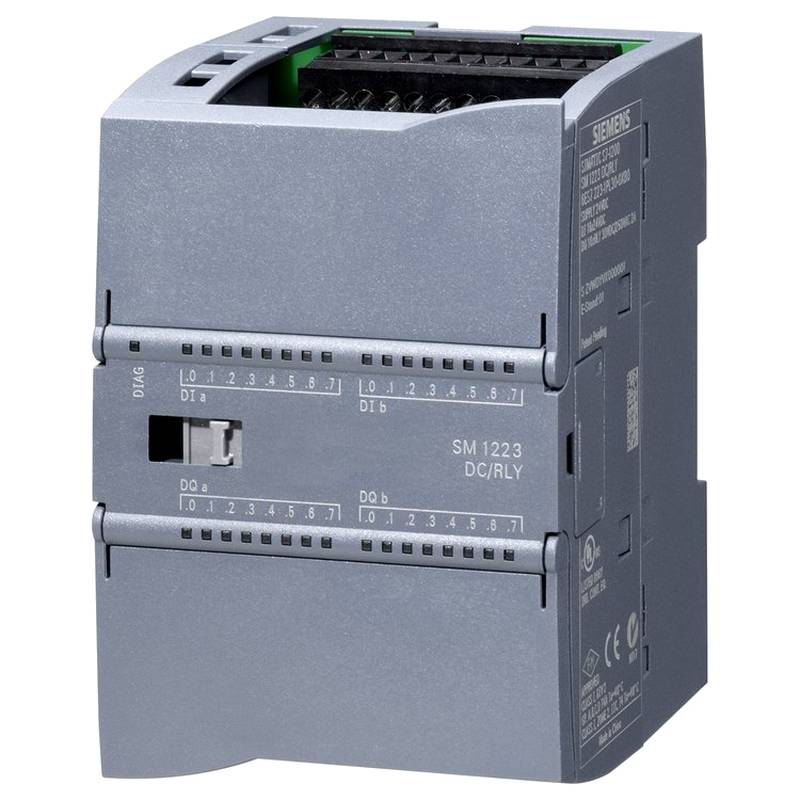
Siemens 6ES7231-5QF32-0XB0 SM 1231 RTD 8x16-bit Input Expansion Module


The Siemens 6ES7231-5QF32-0XB0 SM 1231 RTD 8x16-bit Input Expansion Module is a high-performance analog input module designed for precise temperature measurement in demanding industrial automation environments. This module offers significant advantages, including its 16-bit resolution for highly accurate readings, eight individual RTD input channels, and robust Siemens S7-1200 compatibility for seamless integration. Key technical parameters include a wide operating temperature range, fast signal acquisition, and built-in diagnostic capabilities, making it a cornerstone for critical process monitoring.
Product Specifications
| Feature | Specification |
| :----------------------- | :------------------------------------------- |
| Product Type | Analog Input Expansion Module |
| Siemens Part Number | 6ES7231-5QF32-0XB0 |
| Module Name | SM 1231 RTD |
| Number of Inputs | 8 RTD inputs |
| Resolution | 16-bit |
| Supported RTD Types | Pt100, Pt200, Pt500, Pt1000, Ni100, Ni120, Ni200, Ni1000 |
| Measuring Range (Pt100) | -200 °C to +850 °C |
| Accuracy | Typically ±0.1% of full scale |
| Sampling Time | Approximately 220 ms per channel |
| Interface | For S7-1200 CPU |
| Supply Voltage | 24 V DC (from backplane) |
| Operating Temperature | -20 °C to +60 °C |
| Dimensions (W x H x D) | 45 mm x 100 mm x 75 mm |
| Protection Class | IP20 |
Core Features & Market Positioning
The Siemens 6ES7231-5QF32-0XB0 stands out due to its exceptional accuracy, driven by its 16-bit analog-to-digital converter, which provides detailed temperature data crucial for advanced process control. Its support for a wide array of RTD types and resistance ranges allows for flexibility across diverse applications and sensor choices, reducing the need for specialized hardware. This module is positioned as a premium solution within the S7-1200 ecosystem, emphasizing reliability, precision, and ease of integration for users already invested in Siemens automation platforms. The built-in diagnostics enhance operational uptime by enabling early detection of potential issues, a key differentiator in competitive industrial markets.
Key Application Scenarios
This expansion module is ideally suited for applications demanding precise temperature monitoring, such as chemical processing, pharmaceuticals, food and beverage production, and environmental monitoring systems. Industries requiring stringent temperature control for product quality, safety, or regulatory compliance will benefit significantly from the 8x16-bit RTD inputs. It is particularly valuable in scenarios involving multiple temperature measurement points within a compact footprint, like reactor vessel monitoring, HVAC systems, or complex machinery diagnostics where subtle temperature variations are critical indicators of performance or impending faults.
Practical System Integration Guidance
Integrating the Siemens 6ES7231-5QF32-0XB0 into an S7-1200 system is streamlined through the TIA Portal software. Installation involves physically slotting the module into an available I/O slot on the S7-1200 CPU. Wiring requires connecting the RTD sensors to the module's terminal block, paying close attention to the specific pin assignments for each RTD type and ensuring correct polarity for 2-wire, 3-wire, or 4-wire configurations to maintain accuracy. In TIA Portal, the module must be configured by adding it to the device I/O, setting the input type for each channel (e.g., Pt100, Ni100), and defining scaling or linearization parameters as needed.
Operation and Risk Mitigation
Operating the SM 1231 RTD module involves configuring measurement ranges and diagnostic settings within the TIA Portal software. The module provides diagnostic information regarding open circuits, short circuits, and out-of-range conditions for each input, which can be accessed through system data blocks and used to trigger alarms or control logic. To mitigate risks, ensure proper grounding, adhere to wiring specifications to prevent signal noise or interference, and perform regular calibration checks on connected RTD sensors. Avoid operating the module outside its specified environmental conditions to prevent hardware damage and ensure reliable data acquisition.
Scalability & Long-Term Value
The Siemens 6ES7231-5QF32-0XB0 offers excellent scalability within the S7-1200 platform. Users can expand their system's analog input capacity by adding multiple SM 1231 modules, up to the maximum supported by the CPU. Its compatibility with existing Siemens S7-1200 CPUs ensures that investments in the automation infrastructure are protected. Furthermore, as industries move towards IIoT and Industry 4.0, the precise data provided by this module can be leveraged for advanced analytics, predictive maintenance, and integration into cloud-based monitoring solutions, enhancing the long-term value and operational intelligence of the automated system.
FAQs
1. What types of RTD sensors are compatible with the Siemens 6ES7231-5QF32-0XB0?
This module supports a broad range of common RTD sensor types, including various Pt and Ni configurations. It is specifically designed for Pt100, Pt200, Pt500, Pt1000, Ni100, Ni120, Ni200, and Ni1000 sensors.
This versatility ensures users can select the most appropriate sensor for their specific application needs and environmental conditions without requiring specialized hardware interfaces. Compatibility extends to 2, 3, and 4-wire RTD configurations, offering flexibility in wiring and accuracy adjustments.
By supporting these diverse sensor types, the 6ES7231-5QF32-0XB0 minimizes integration costs and complexities, allowing for straightforward sensor replacement or system upgrades.
2. How is the Siemens 6ES7231-5QF32-0XB0 configured for use in TIA Portal?
Configuration begins by adding the module to your project hardware catalog in TIA Portal. You then assign the module to a free I/O slot on your S7-1200 CPU within the device configuration.
Next, for each of the eight input channels, you must select the specific RTD sensor type (e.g., Pt100) and the wiring configuration (2, 3, or 4-wire). You can also define scaling, linearization, and diagnostic settings for each channel.
Once configured and downloaded to the PLC, the module's input data becomes accessible as standard I/O tags within your PLC program for use in control and monitoring logic.
3. What are the typical applications for the SM 1231 RTD module?
This module is ideal for any process requiring precise temperature monitoring with high accuracy. Key applications include chemical reactors, pharmaceutical batch processes, and food/beverage pasteurization where exact temperature control is critical for product quality and safety.
It is also widely used in HVAC systems for building automation, industrial ovens and furnaces for precise temperature management, and in various machinery monitoring scenarios to detect overheating or performance deviations.
The module's ability to handle multiple RTD inputs simultaneously makes it efficient for monitoring complex systems with numerous temperature points.
4. What is the accuracy and resolution of the 6ES7231-5QF32-0XB0?
The Siemens 6ES7231-5QF32-0XB0 offers a 16-bit resolution for its analog-to-digital conversion. This high resolution translates to very fine temperature measurements, typically achieving an accuracy of ±0.1% of the full measurement scale.
This level of precision is crucial for applications where even minor temperature fluctuations can significantly impact product quality, process efficiency, or safety. The 16-bit resolution means the module can differentiate between a large number of discrete temperature levels within its range.
The combination of 16-bit resolution and high accuracy ensures that users receive reliable and detailed temperature data, enabling sophisticated control strategies and effective process monitoring.
5. How do I connect RTD sensors to the Siemens 6ES7231-5QF32-0XB0?
Connecting RTD sensors involves securely attaching the sensor leads to the designated terminals on the module's front connector. The module supports 2, 3, and 4-wire RTD configurations, so ensure your wiring matches the sensor type and the module's configuration in TIA Portal.
For 2-wire connections, connect the two leads to the corresponding input terminals. For 3-wire, connect one lead to the common terminal and the other two to separate input terminals. For 4-wire, connect two leads to the common terminals and the remaining two to the separate input terminals for maximum accuracy.
Always refer to the module's manual and your specific RTD sensor's datasheet for precise wiring diagrams to avoid signal degradation or incorrect measurements.
6. What are the benefits of using a 16-bit resolution module for RTD inputs?
A 16-bit resolution allows the module to divide its measurement range into 65,536 discrete steps. This significantly increases the granularity and precision of temperature readings compared to lower-resolution modules.
Higher resolution means the module can detect and report smaller changes in temperature. This is critical for processes that require tight temperature control or for identifying subtle deviations that might indicate a developing issue.
Ultimately, 16-bit resolution provides more detailed and accurate temperature data, enabling more sophisticated control algorithms and improved process optimization.
7. Can the 6ES7231-5QF32-0XB0 module detect sensor faults?
Yes, the SM 1231 RTD module includes built-in diagnostic capabilities to detect common sensor faults. It can identify issues such as open circuits, short circuits, and inputs that are outside the configured measurement range.
These diagnostic alerts are typically accessible via system data blocks in the S7-1200 PLC. This allows you to program specific responses, such as generating alarms, shutting down equipment, or notifying maintenance personnel.
Proactive fault detection significantly improves system reliability and reduces downtime by enabling prompt identification and resolution of sensor-related problems.
8. What is the operating temperature range for the Siemens 6ES7231-5QF32-0XB0?
The module is designed to operate reliably within a standard industrial temperature range of -20 °C to +60 °C. This range is suitable for most typical industrial environments where precise temperature measurements are required.
It's important to ensure that the ambient temperature surrounding the module remains within these specified limits to guarantee accurate performance and prevent potential hardware damage. Exceeding these limits could lead to measurement inaccuracies or component failure.
For applications operating in extreme temperatures outside this range, consider specialized industrial solutions or ensure adequate environmental control measures are in place.
9. How does this module integrate with the Siemens S7-1200 PLC family?
The 6ES7231-5QF32-0XB0 is specifically designed as an expansion module for the Siemens S7-1200 PLC CPU. It connects directly to the PLC's backplane, expanding its analog input capabilities.
Integration is managed seamlessly through the TIA Portal engineering software, where the module is recognized and configured as part of the overall S7-1200 system. This ensures easy setup and programming.
This tight integration leverages the S7-1200's architecture, providing a robust and scalable solution for a wide range of automation tasks requiring precise temperature measurement.
10. What are the dimensions and mounting requirements for this expansion module?
The module has compact dimensions of 45 mm (width) x 100 mm (height) x 75 mm (depth), making it suitable for space-constrained control cabinets. It mounts directly onto the DIN rail within the S7-1200 system's chassis.
Installation involves sliding the module into an available expansion slot on the S7-1200 CPU or a signal board. It is powered by the PLC's backplane, simplifying wiring.
The module's design adheres to standard industrial enclosure practices, offering protection class IP20, which is typical for enclosed industrial environments.