











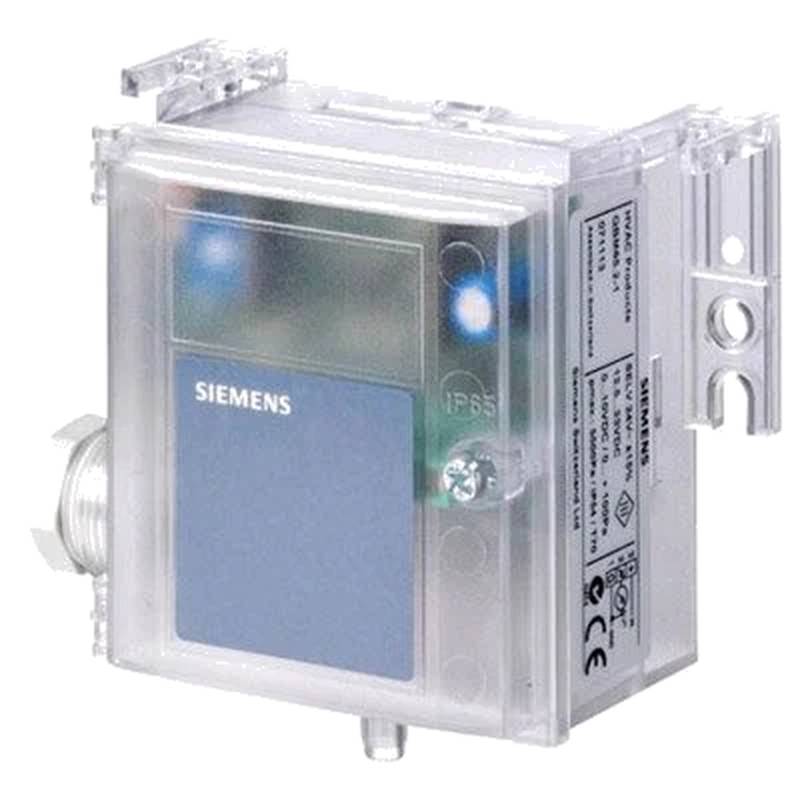
SIEMENS QBM3020-3 Differential Pressure Sensor 300 Pa Duct


The SIEMENS QBM3020-3 Differential Pressure Sensor offers precise and reliable measurement of differential pressure for HVAC and building automation systems. Its core advantage lies in its robust design and advanced sensing technology, ensuring accurate airflow monitoring and control in demanding industrial environments. Key technical parameters include a measuring range of 0 to 300 Pascals and an output signal of 0-10 VDC, making it a versatile component for various applications requiring detailed pressure data.
Product Specifications
| Parameter | Specification |
| :----------------- | :------------------------------------------------- |
| Product Type | Differential Pressure Sensor |
| Model | QBM3020-3 |
| Manufacturer | SIEMENS |
| Measuring Range | 0…300 Pa |
| Output Signal | 0…10 VDC |
| Accuracy | ±1.5 % of full scale |
| Operating Voltage | 13.5…35 VDC (SELV) |
| Media Compatibility| Air, non-aggressive gases |
| Operating Temp. | -20…+50 °C |
| Connection Type | Screw terminals |
| Ingress Protection | IP54 (according to EN 60529) |
| Dimensions | 80 x 71 x 30 mm |
Core Features & Market Positioning
The SIEMENS QBM3020-3 distinguishes itself through its high accuracy and stability, essential for maintaining optimal performance in critical air handling systems. Its compact form factor and IP54 protection rating enable deployment in diverse environmental conditions, from ductwork to cleanrooms. This sensor is positioned as a dependable solution for facility managers and system integrators seeking long-term reliability and precise control over air pressure differentials. Its integration into the broader Siemens Desigo™ building management ecosystem further enhances its value proposition for connected environments.
Key Application Scenarios
This differential pressure sensor is ideally suited for applications such as monitoring filter status in air handling units, ensuring correct airflow in ventilation systems, and maintaining pressure differentials in cleanrooms or laboratories. It plays a crucial role in optimizing energy efficiency by enabling precise fan speed control based on actual system demand. The QBM3020-3 is also frequently specified for fire and smoke damper control systems, where accurate pressure readings are paramount for safety operations.
Practical System Integration Guidance
Installation of the SIEMENS QBM3020-3 typically involves mounting the sensor directly within the air duct using appropriate fittings, ensuring a sealed connection to prevent air leakage. For optimal performance, it's recommended to position the sensor in a location with stable airflow, away from turbulent zones. The sensor connects to the building automation system via its 0-10 VDC output, which can be wired to a compatible controller or I/O module. Power is supplied through a 13.5-35 VDC SELV source. Referencing the Siemens installation manual for specific wiring diagrams is essential for correct commissioning.
Operation and Risk Mitigation
Proper operation of the SIEMENS QBM3020-3 relies on ensuring it is exposed only to air or non-aggressive gases within its specified operating temperature range. Avoid exposing the sensor to excessive moisture or direct water ingress, despite its IP54 rating. If the sensor outputs readings outside the expected range or becomes unresponsive, check the power supply and wiring integrity. Over-pressurization beyond the sensor's limit could lead to damage. Regular calibration, though not typically required due to its inherent stability, can be performed if measurements drift significantly over time.
Scalability & Long-Term Value
The SIEMENS QBM3020-3 integrates seamlessly with Siemens' extensive portfolio of HVAC controls and building management systems, offering a scalable solution for facilities of all sizes. Its compatibility with standard analog inputs on most modern building automation controllers ensures straightforward integration into new or existing installations. For smart building initiatives, the sensor's data can be leveraged within IoT platforms, contributing to predictive maintenance strategies and enhanced energy management through continuous monitoring and analysis.
FAQs
What is the primary function of the SIEMENS QBM3020-3?
The SIEMENS QBM3020-3 measures the difference in air pressure between two points.
This is critical for controlling airflow and monitoring the performance of ventilation systems.
It ensures precise adjustments in HVAC systems for optimal comfort and efficiency.
What are the main advantages of using this differential pressure sensor?
It offers high accuracy and stable readings, crucial for sensitive control loops.
The robust IP54 rating allows for installation in challenging environmental conditions.
Its compatibility with Siemens Desigo™ facilitates integration into advanced building management.
Can the SIEMENS QBM3020-3 measure other gases besides air?
This sensor is designed specifically for air and non-aggressive gases only.
Using it with other media could damage the sensor or lead to inaccurate readings.
Always verify media compatibility before installation to prevent operational issues.
What is the typical accuracy of the QBM3020-3 sensor?
The SIEMENS QBM3020-3 provides an accuracy of ±1.5% of its full scale.
This level of precision is sufficient for most demanding HVAC control applications.
Consistent accuracy ensures reliable operation and effective system management.
What is the operating voltage range for the SIEMENS QBM3020-3?
The sensor operates on a DC voltage between 13.5 and 35 volts.
This voltage range is classified as SELV (Safety Extra Low Voltage).
Ensure a stable and compliant power supply for optimal sensor performance.
How is the SIEMENS QBM3020-3 typically installed in an HVAC system?
It's mounted directly into air ducts, requiring a secure, leak-free connection.
Proper placement in an area with stable airflow is recommended for accurate readings.
Installation guides from Siemens provide detailed wiring and mounting instructions.
What kind of output signal does the SIEMENS QBM3020-3 provide?
The sensor outputs an analog signal ranging from 0 to 10 volts DC.
This signal directly corresponds to the measured differential pressure.
This standard output is easily integrated into most building automation controllers.
What environmental conditions can the QBM3020-3 withstand?
It is rated IP54, offering protection against dust and splashing water.
The operating temperature range is between -20 and +50 degrees Celsius.
This makes it suitable for many indoor and protected outdoor HVAC applications.
How does this sensor contribute to energy efficiency in buildings?
By providing accurate pressure data, it enables precise fan speed control.
This optimizes airflow, reducing unnecessary energy consumption by fans.
It also helps maintain ideal conditions, preventing over-conditioning of spaces.
Is the SIEMENS QBM3020-3 compatible with non-Siemens building automation systems?
Yes, its standard 0-10 VDC output signal is widely compatible with most controllers.
Integration with third-party systems is generally straightforward.
However, consulting system documentation for specific compatibility is advised.