











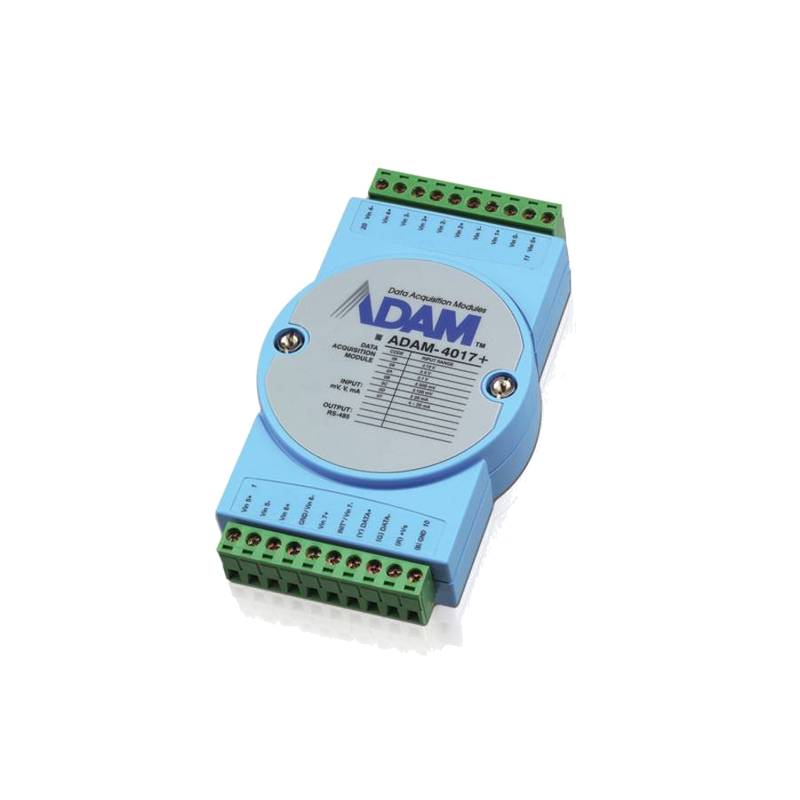
Advantech ADAM-4050-F Industrial Control Digital I/O Module


The Advantech ADAM-4050-F is a robust industrial control digital I/O module designed for demanding automation environments. This module offers 16 digital input and 16 digital output channels, providing a high channel density for efficient system expansion. Its key advantages lie in its reliable operation, wide operating temperature range (-25°C to +70°C), and flexible power input (10-30 VDC), making it suitable for a diverse array of industrial applications. The ADAM-4050-F is built with durable components, ensuring longevity and consistent performance even under harsh conditions. With its RS-485 communication interface, it seamlessly integrates into existing SCADA and HMI systems, facilitating remote monitoring and control.
Advantech ADAM-4050-F Product Specifications
| Feature | Specification |
| :----------------------- | :------------------------------------------ |
| Digital Input Channels | 16 |
| Digital Output Channels | 16 |
| Input Voltage Range | 0-50 VDC (wet/dry contact) |
| Output Voltage | Sink/Source, 5VDC (internal pull-up) |
| Output Current | 50 mA maximum per channel |
| Communication Interface | RS-485 |
| Communication Protocol | Modbus RTU |
| Baud Rate | 1200 bps to 115200 bps |
| Power Input | 10-30 VDC |
| Power Consumption | 1.5W |
| Operating Temperature | -25°C to +70°C |
| Storage Temperature | -40°C to +85°C |
| Humidity | 5% to 95% RH (non-condensing) |
| Isolation | 3000 VDC |
| Dimensions | 146 mm x 70 mm x 37 mm |
| Mounting | DIN-rail |
Core Features & Market Positioning
The Advantech ADAM-4050-F stands out in the industrial automation market due to its exceptional channel density, offering 16 inputs and 16 outputs within a compact form factor. This high channel count significantly reduces the need for multiple I/O modules, leading to cost savings and simplified wiring in complex control systems. The module's inherent reliability, coupled with a wide operating temperature range of -25°C to +70°C, positions it as a dependable choice for critical applications in sectors like manufacturing, building automation, and environmental monitoring, where consistent performance under adverse conditions is paramount. Its robust design and industrial-grade components ensure a long service life, minimizing downtime and maintenance costs for end-users.
Key Application Scenarios
The Advantech ADAM-4050-F is ideally suited for a wide range of industrial applications requiring discrete digital signal monitoring and control. In manufacturing environments, it can be employed to monitor the status of machinery, such as conveyor belts, limit switches, and safety interlocks, while simultaneously controlling actuators, indicator lights, and signaling devices. For building automation, the ADAM-4050-F is instrumental in managing lighting systems, HVAC fan control, and security alarm inputs. Furthermore, its robust design makes it a suitable component for environmental monitoring systems, enabling the collection of data from rain sensors, wind speed indicators, and the control of pumps or ventilation fans in remote or challenging locations.
Practical System Integration Guidance
Integrating the Advantech ADAM-4050-F into an industrial control system is streamlined through its standard Modbus RTU protocol over an RS-485 interface. For wiring, digital inputs can be configured as dry or wet contacts, with support for voltages up to 50 VDC, and typically require connection to sensors or switches. Digital outputs are rated for 50 mA maximum and can be used to drive relays, indicator LEDs, or small loads; care must be taken not to exceed this current limit, and for higher power loads, external relays or contactors are necessary. Configuration typically involves setting the module's unique Modbus address and baud rate using a configuration utility or directly through the communication bus, ensuring no address conflicts within the network.
Operation and Risk Mitigation
Operating the Advantech ADAM-4050-F requires adherence to standard industrial safety practices. Ensure power is disconnected before making any wiring changes to prevent electrical hazards. The module's 3000 VDC isolation protects connected devices and personnel from voltage transients and ground loops. When troubleshooting, common issues often relate to incorrect Modbus communication settings (address, baud rate, parity) or faulty wiring. For example, if digital outputs fail to activate, verify the output current is within the 50 mA limit and that the output state is correctly commanded by the master device. Conversely, input signal issues might stem from loose connections or sensor malfunctions, requiring a systematic check of each point.
Scalability & Long-Term Value
The Advantech ADAM-4050-F offers significant scalability, allowing users to expand their I/O capabilities by simply adding more ADAM modules to the RS-485 network. This modular approach is cost-effective, as it avoids the need to replace entire controllers. Its compatibility with the Modbus RTU protocol ensures seamless integration with a vast array of existing industrial hardware and software platforms, from PLCs and SCADA systems to HMIs. Moreover, Advantech's commitment to industrial automation solutions means the ADAM-4000 series is designed for long-term value, supporting future upgrades and the integration into emerging Industrial Internet of Things (IIoT) architectures through standard communication protocols.
Frequently Asked Questions
What are the wiring requirements for the Advantech ADAM-4050-F digital inputs?
Digital inputs on the ADAM-4050-F support both dry and wet contact configurations, accommodating voltages up to 50 VDC. For dry contacts, you typically connect one side of a switch or sensor to the input terminal and the other to a common (COM) terminal. For wet contacts, a voltage source is applied to the input terminal, and the sensor or switch connects to ground. Ensure proper grounding and insulation to prevent signal interference or damage.
How can I configure the Modbus address and communication settings for the ADAM-4050-F?
The Modbus address and communication parameters, such as baud rate, data bits, parity, and stop bits, are typically set using Advantech's ADAM Utility software or can be configured programmatically. Each ADAM module on an RS-485 bus must have a unique Modbus address to ensure proper communication. The default settings can be found in the product manual, and it's crucial to ensure these settings match those of the master controller or SCADA system.
What is the maximum current that the digital outputs of the ADAM-4050-F can handle?
The digital outputs of the ADAM-4050-F are designed to sink or source up to 50 mA maximum per channel. This current rating is suitable for driving low-power devices like LEDs, small relays, or input terminals of other industrial equipment. For applications requiring the control of higher current loads, such as large contactors or motors, it is essential to use an external relay or solid-state relay (SSR) driven by the ADAM-4050-F's output.