











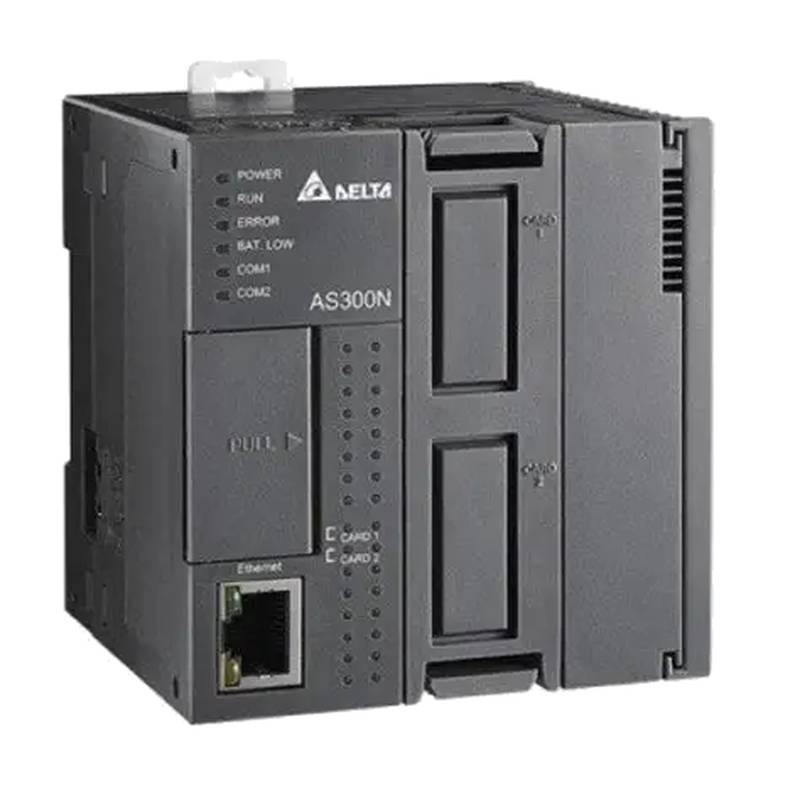
Delta AS300N-A Industrial Ethernet Network Communication Module


The Delta AS300N-A Industrial Ethernet Network Communication Module stands as a robust solution for modern industrial automation, offering seamless connectivity and enhanced control capabilities. This module boasts critical advantages such as high-speed data transfer, advanced network redundancy options, and broad protocol compatibility, making it indispensable for complex manufacturing environments. Its core features include support for various Ethernet/IP and Modbus TCP protocols, a compact design for efficient panel mounting, and robust diagnostic tools for simplified troubleshooting. Key technical parameters include a wide operating temperature range of -20°C to +60°C, 24VDC power input, and a maximum data transfer rate of 100 Mbps, ensuring reliable performance under demanding conditions.
| Feature | Specification |
| :-------------------- | :----------------------------------------------- |
| Model | AS300N-A |
| Communication Protocol| Ethernet/IP, Modbus TCP |
| Data Transfer Rate | 100 Mbps |
| Power Supply | 24VDC |
| Operating Temperature | -20°C to +60°C |
| Dimensions (H x W x D)| 90mm x 25mm x 60mm |
| Mounting Type | DIN Rail |
| Network Ports | 2 x RJ45 |
| Ingress Protection | IP20 |
Core Features & Market Positioning
The AS300N-A distinguishes itself through its superior network redundancy capabilities, offering ring and dual-ring topologies that ensure continuous operation even in the event of a single network link failure. This inherent reliability is a significant differentiator in markets where downtime translates directly to substantial financial losses. Furthermore, its support for both Ethernet/IP and Modbus TCP protocols allows for flexible integration into diverse automation architectures, bridging communication gaps between disparate systems and devices. Delta's reputation for producing high-quality, cost-effective industrial automation components solidifies the AS300N-A's market position as a premier choice for system integrators and plant managers seeking dependable and versatile network solutions.
Key Application Scenarios
This communication module is ideally suited for demanding applications within the manufacturing sector, including high-speed packaging lines where precise synchronization and real-time data exchange are paramount. In the automotive industry, the AS300N-A facilitates seamless integration of robotic cells and automated guided vehicles (AGVs), ensuring efficient production flow and agile response to design changes. Its robustness and support for industrial protocols also make it a strong contender for process control in chemical plants and water treatment facilities, enabling reliable monitoring and control of critical operations over an Ethernet network.
Practical System Integration Guidance
Integrating the Delta AS300N-A into an existing control system is straightforward, typically involving DIN rail mounting within a control cabinet. The module utilizes standard RJ45 connectors for its dual Ethernet ports, allowing for easy daisy-chain or ring network configurations. For programming, users will typically configure the AS300N-A through Delta's proprietary software or directly via its web interface, defining IP addresses, network masks, and communication parameters relevant to the chosen protocol (Ethernet/IP or Modbus TCP). Wiring connections for power are made to the designated terminals, ensuring a stable 24VDC supply is provided.
Operation and Risk Mitigation
Safe operation of the AS300N-A requires adherence to standard industrial electrical safety practices, including proper grounding and ensuring the power supply is within the specified 24VDC range. While the module is designed for high reliability, common troubleshooting steps involve verifying network cable integrity, checking IP address conflicts, and ensuring correct configuration of communication parameters in both the AS300N-A and connected devices. Error codes, if displayed through diagnostic LEDs or logged via software, often point to network connectivity issues or incorrect protocol settings, guiding technicians toward rapid resolution.
Scalability & Long-Term Value
The AS300N-A offers significant long-term value through its inherent scalability and compatibility with Delta's broader automation product ecosystem. Its standard Ethernet communication protocols ensure interoperability with a wide range of third-party PLCs, HMIs, and SCADA systems, providing flexibility for future system expansions or upgrades. As industries move towards Industry 4.0 and the Industrial Internet of Things (IIoT), the AS300N-A's robust networking capabilities lay a strong foundation for data acquisition, remote monitoring, and integration with cloud-based analytics platforms, enhancing operational efficiency and predictive maintenance strategies.
Frequently Asked Questions
What are the primary communication protocols supported by the Delta AS300N-A?
The Delta AS300N-A primarily supports two widely adopted industrial Ethernet protocols: Ethernet/IP and Modbus TCP. These protocols are foundational for robust machine-to-machine communication in automated environments.
They enable seamless data exchange between controllers, sensors, actuators, and higher-level supervisory systems. This dual support ensures broad compatibility with various automation devices and platforms.
How does the AS300N-A enhance network reliability in industrial settings?
The AS300N-A significantly enhances network reliability through its support for network redundancy protocols, such as ring and dual-ring topologies. This design ensures that if one network link fails, communication can continue uninterrupted through an alternative path. Such resilience is critical for continuous manufacturing processes where downtime is costly.
This feature minimizes production interruptions and maintains operational continuity in the face of potential network disturbances. It provides a critical safeguard for mission-critical applications.
Can the AS300N-A be integrated into existing automation systems?
Yes, the AS300N-A is designed for seamless integration into existing automation systems due to its standard communication protocols and versatile mounting options. Its support for Ethernet/IP and Modbus TCP ensures compatibility with a wide range of PLCs, HMIs, and SCADA systems from various manufacturers.
The module's DIN rail mountability and standard RJ45 connectors simplify physical installation within control cabinets. Configuration is typically managed through user-friendly software or web interfaces, further easing integration efforts.
What are the key technical specifications for the AS300N-A?
The Delta AS300N-A operates with a 24VDC power supply and supports a data transfer rate of up to 100 Mbps. It is designed to function within a wide operating temperature range of -20°C to +60°C, making it suitable for diverse industrial environments.
The module features dual RJ45 Ethernet ports for network connectivity and is housed in a compact form factor (90mm x 25mm x 60mm) for efficient panel space utilization. It also adheres to IP20 ingress protection standards.
Its technical specifications are engineered for robust performance and reliability in demanding industrial applications, ensuring stable and efficient network communication. This focus on essential parameters guarantees dependable operation.
What are common troubleshooting steps for the AS300N-A?
Common troubleshooting for the AS300N-A involves checking the integrity of network cables and verifying that IP addresses are correctly assigned and unique within the network. Ensuring that communication parameters are accurately configured on both the AS300N-A and connected devices is also crucial.
Technicians should also inspect the module's diagnostic LEDs for any error indicators, which can provide immediate clues to the nature of the problem. Referencing the product manual for specific error code interpretations is highly recommended.
A systematic approach, starting with physical connections and progressing to logical configurations, is key to resolving most operational issues efficiently. Power supply stability should also be confirmed.
How does the AS300N-A contribute to Industry 4.0 initiatives?
The AS300N-A serves as a vital enabler for Industry 4.0 by providing a robust and reliable Ethernet communication backbone. Its ability to facilitate high-speed data exchange and support standard protocols allows for seamless integration with IIoT platforms and cloud-based services.
This module enables the collection of real-time operational data, crucial for advanced analytics, predictive maintenance, and the implementation of smart manufacturing strategies. It bridges the gap between operational technology (OT) and information technology (IT) systems.
By offering dependable connectivity, the AS300N-A empowers manufacturers to gain deeper insights into their processes, optimize performance, and build more agile and responsive production environments. This is fundamental to achieving the goals of digital transformation.
What is the significance of the AS300N-A's compact design?
The AS300N-A's compact dimensions (90mm x 25mm x 60mm) are significant as they allow for space-saving installation in industrial control panels. In environments where cabinet space is at a premium, such a design is highly advantageous for system integrators.
This compact form factor enables higher component density within control cabinets, potentially reducing the overall footprint of automation solutions. It also simplifies the planning and layout of electrical enclosures.
Efficient use of space can lead to cost savings in terms of enclosure size and associated materials, making the AS300N-A a practical choice for a wide range of applications. This design consideration impacts both initial build and future expansion.
What are the power requirements for the Delta AS300N-A?
The Delta AS300N-A requires a stable 24VDC power supply for its operation. It is essential to ensure that the power source meets these specifications to guarantee the module's optimal performance and longevity.
Proper wiring and connection to the designated power terminals are crucial for maintaining a reliable electrical supply. Overvoltage or undervoltage conditions should be avoided as they can lead to malfunction or damage.
Adhering to the specified power input ensures the module functions as intended within the industrial network, supporting its critical communication tasks without interruption. This is a fundamental aspect of its reliable operation.
Does the AS300N-A support any form of network diagnostics?
Yes, the AS300N-A is equipped with diagnostic features to aid in troubleshooting and network monitoring. Diagnostic LEDs on the module itself provide immediate visual feedback on its operational status and network connectivity.
Beyond the hardware indicators, the module's configuration software typically offers more in-depth diagnostic tools. These can include status registers, network traffic monitoring, and error logging functionalities.
These diagnostic capabilities are essential for quickly identifying and resolving network issues, minimizing downtime, and ensuring the overall health and efficiency of the industrial communication system. They empower operators with valuable insights.
What is the typical lifespan and expected reliability of the AS300N-A?
While specific MTBF (Mean Time Between Failures) data is usually proprietary, industrial Ethernet modules like the AS300N-A are engineered for long operational lifespans, often exceeding 10 years in typical industrial environments. Their robust construction and wide operating temperature range contribute to this longevity.
Reliability is further enhanced by features such as network redundancy, which prevents single points of failure from disrupting operations. Delta's reputation for quality in industrial automation components also suggests a high degree of dependability.
To maximize lifespan, it's important to operate the module within its specified environmental parameters and ensure proper installation, including adequate ventilation and power supply stability. Regular maintenance and firmware updates can also contribute to sustained reliability.