











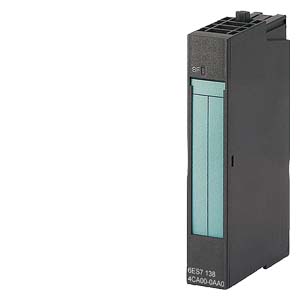
SIEMENS 6ES7134-4LB02-0AB0 ET 200S High-Feature Analog Module


The SIEMENS 6ES7134-4LB02-0AB0 is a high-feature analog input module designed for the ET 200S distributed I/O system, enabling precise measurement and control in industrial automation. This module offers advanced diagnostic capabilities and high resolution for critical analog signal processing.
Product Type Definition
This device is classified as an analog input module within the Siemens SIMATIC ET 200S product family. It serves as a crucial component for interfacing real-world analog signals with programmable logic controllers, offering superior performance for demanding industrial applications.
Key Specifications
Input channels: 4
Resolution: 16 bits
Measuring range: configurable (e.g., 0-10 V, 4-20 mA)
Accuracy: ±0.1% of full scale
Isolation: 2-port isolation
Power consumption: typically 60 mA at 24 V DC
Module width: 40 mm
Operating temperature: 0 to 60 degrees Celsius
Technical Highlights & System Integration
High Resolution: The module provides a 16-bit analog-to-digital converter, ensuring exceptional precision for capturing subtle variations in process variables like temperature, pressure, or flow. This level of detail is critical for advanced control loops and accurate data logging.
Diagnostic Capabilities: Integrated diagnostics monitor channel status, wire break, and short circuits, providing immediate alerts for potential issues. What are the benefits of these diagnostics? Early detection of faults minimizes downtime and prevents process deviations, leading to increased operational efficiency and safety.
Scalability with ET 200S: The module seamlessly integrates into the ET 200S distributed I/O system, allowing for flexible and scalable system configurations. This modularity permits easy expansion or modification of the I/O footprint without extensive rewiring.
Cyclic Data Transfer: Support for cyclic data transfer ensures real-time communication between the analog inputs and the central controller. This rapid data exchange is fundamental for applications requiring prompt responses to changing process conditions.
Key Application Scenarios
Process Control: Enables precise monitoring of analog sensor inputs, such as flow meters and temperature probes, for maintaining optimal process conditions and product quality.
Machine Automation: Facilitates accurate reading of analog feedback signals from actuators and sensors on complex machinery, ensuring precise movement and operational parameters.
Building Management Systems: Integrates environmental sensors for temperature, humidity, and CO2 levels, allowing for efficient and responsive climate control.
Selection Guidance & Operation
Module Compatibility: Verify that the module is compatible with your specific ET 200S base unit and CPU for seamless integration. Consult the Siemens documentation for the latest compatibility matrices.
Configuration Software: Utilize the STEP 7 or TIA Portal software suite for parameterizing the analog input ranges, filtering, and diagnostic settings specific to your application requirements.
Wiring Practices: Adhere strictly to industrial wiring standards and best practices for analog signal integrity, including proper shielding and grounding to prevent noise interference.
FAQ
What is the primary function of the SIEMENS 6ES7134-4LB02-0AB0?
The module's primary function is to convert real-world analog signals into digital data for a PLC. It provides high-resolution input for processes requiring precise measurement of variables like voltage or current.
This device is designed for precise analog signal acquisition in demanding industrial environments. Its technical specifications ensure reliable performance and accurate data representation for control systems.
The module's key role is to bridge the gap between physical process parameters and the digital world of automation. It enables sophisticated control strategies through accurate data interpretation.
What are the typical input signal types supported by this module?
This high-feature analog module typically supports standard industrial analog signal ranges. These commonly include 0-10 VDC for voltage signals and 4-20 mA for current signals.
The configuration software allows for easy selection and adaptation of these input ranges to match the specific sensors being utilized in the application. This flexibility is crucial for diverse automation tasks.
Users can also configure diagnostic settings for these inputs, such as detecting wire breaks or short circuits, to enhance system reliability and operational awareness.
What industrial standards does this module adhere to?
The module adheres to relevant international industrial automation standards, ensuring interoperability and reliability. It is designed in accordance with IEC standards for industrial control systems.
Compliance with these standards signifies a commitment to quality and performance in harsh industrial settings. This also aids in meeting regulatory requirements for automation equipment.
While specific certifications may vary, modules within the ET 200S family are generally built to withstand typical industrial environmental conditions and electromagnetic interference.
How does this module contribute to system diagnostics?
This module offers advanced diagnostic capabilities that continuously monitor the status of its analog input channels. It can detect issues like sensor wire breaks or short circuits.
When a fault is detected, the module can generate diagnostic interrupts or status signals that are communicated to the PLC. This enables prompt troubleshooting and minimizes unplanned downtime.
The integrated diagnostics enhance overall system reliability by providing early warnings of potential problems, allowing for proactive maintenance and operational stability.
What are the key benefits of the 16-bit resolution?
The 16-bit resolution provides a high level of precision for analog signal conversion. This allows for the differentiation of very small changes in the measured analog value.
This increased precision is critical for applications requiring fine-tuned control and accurate data acquisition, such as in chemical processing or high-speed manufacturing. It minimizes signal quantization error.
With 16 bits, the module can represent analog values with up to 65,536 discrete levels, significantly improving the accuracy and responsiveness of control loops dependent on analog inputs.