











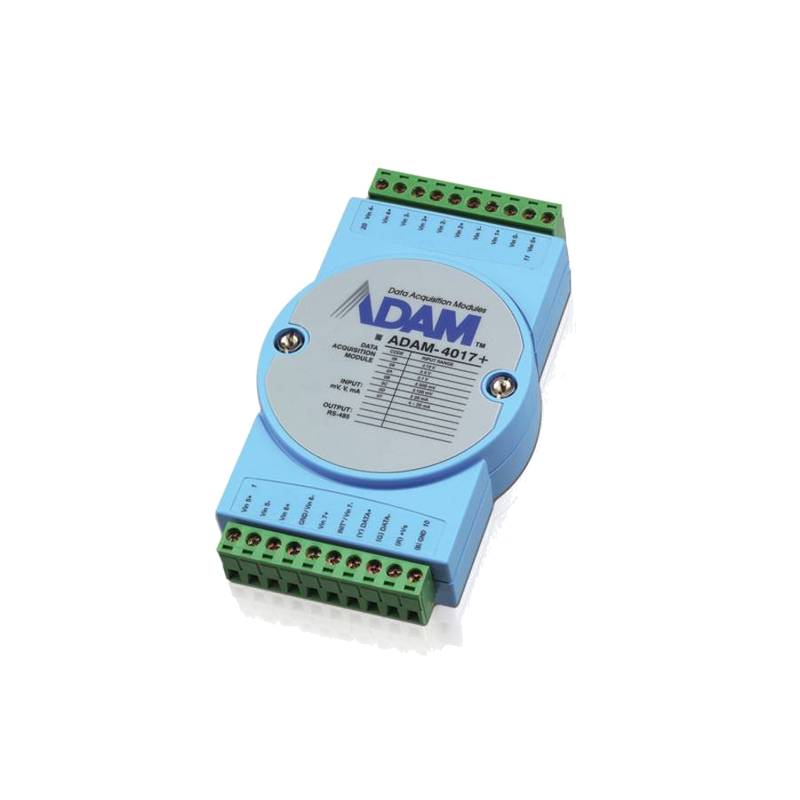
Advantech ADAM-4118-C High Precision Analog Input Acquisition Module


The Advantech ADAM-4118-C stands as a robust high-precision analog input acquisition module, engineered for demanding industrial environments. Its core advantages lie in its exceptional accuracy, wide operating temperature range, and versatile input signal compatibility, making it a cornerstone for reliable data acquisition. Key technical parameters include 16-bit resolution, an impressive input range of ±10 V or ±20 mA, and isolation protection up to 3000 VDC. This module is designed to seamlessly integrate into existing automation systems, providing critical data for monitoring, control, and analysis.
Product Specifications
| Feature | Specification |
| :----------------------- | :------------------------------------------ |
| Analog Input Channels| 8 differential or 16 single-ended |
| Resolution | 16-bit |
| Input Ranges | ±10V, ±5V, ±1V, ±0.5V, ±0.2V, ±0.1V, ±20mA, ±10mA, ±1mA |
| Input Impedance | Voltage: 1 MΩ, Current: 125 Ω |
| Accuracy | ±0.05% of FSR (Full Scale Range) |
| Sampling Rate | 10 samples/second per channel |
| Isolation | 3000 VDC |
| Power Consumption | 1.2 W |
| Operating Temperature| -40°C to 85°C |
| Communication Interface| RS-485 |
| Protocol | Modbus RTU |
Core Features & Market Positioning
The ADAM-4118-C distinguishes itself through its superior 16-bit resolution, offering a finer granularity in measurement compared to many standard 12-bit modules, crucial for applications demanding high accuracy like precision manufacturing or environmental monitoring. Its wide operating temperature range of -40°C to 85°C positions it as a reliable choice for harsh industrial settings where temperature fluctuations are common. The module's robust isolation protection of 3000 VDC is a significant differentiator, safeguarding connected equipment and personnel from voltage surges and ground loops, a critical concern in electrically noisy industrial environments. This combination of precision, ruggedness, and safety makes the ADAM-4118-C a preferred solution for system integrators seeking dependable and high-performance analog input solutions.
Key Application Scenarios
This module excels in a variety of industrial applications requiring precise analog signal acquisition. In manufacturing, it's vital for monitoring process variables such as temperature, pressure, and flow rates with high fidelity, enabling tighter control loops and improved product quality. For environmental monitoring systems, the ADAM-4118-C accurately captures sensor data from remote or challenging locations, supporting compliance and research. Its suitability for SCADA (Supervisory Control and Data Acquisition) systems is evident in its ability to collect data from diverse sources, feeding critical information to central control rooms for operational oversight. Furthermore, in the energy sector, it facilitates precise measurement of power generation and consumption, contributing to grid stability and efficiency.
Practical System Integration Guidance
Integrating the Advantech ADAM-4118-C into an industrial system is streamlined due to its standard Modbus RTU protocol over RS-485 communication. Installation typically involves DIN-rail mounting, a common standard in industrial control panels. Wiring requires careful attention to the differential or single-ended input configuration, ensuring correct connection of sensors to the appropriate terminals. For voltage inputs, ensure the sensor output is within the module's selected range; for current inputs, select the corresponding mA range. Power should be supplied within the specified voltage limits. Configuration and data retrieval are managed via Modbus commands, often implemented using a programmable logic controller (PLC) or an industrial PC with appropriate software libraries. A typical setup might involve connecting the RS-485 bus to a master device, such as an Advantech ADAM-4520 (RS-232 to RS-485 converter) or directly to an industrial computer with an RS-485 port, enabling communication with multiple ADAM modules on the same bus.
Operation and Risk Mitigation
Operating the ADAM-4118-C requires adherence to its specified input voltage and current ranges to prevent damage. The module's inherent 3000 VDC isolation significantly mitigates risks associated with ground loops and electrical noise, which are prevalent in industrial settings and can corrupt data or damage equipment. Ensure proper grounding of the RS-485 bus to prevent signal integrity issues. In case of communication failures, common troubleshooting steps include verifying the RS-485 wiring polarity (A/B lines), checking the Modbus address and baud rate settings against the master device, and ensuring adequate power supply to the module. Over-voltage or incorrect wiring are primary causes of module failure, emphasizing the importance of careful installation and adherence to specifications.
Scalability & Long-Term Value
The ADAM-4118-C offers excellent scalability, a critical factor for evolving industrial automation needs. Its RS-485 interface supports multi-drop configurations, allowing numerous ADAM modules, including other ADAM-4000 series products, to be connected to a single communication bus. This enables system expansion without requiring a complete overhaul of the communication infrastructure. Compatibility with Advantech's broader range of industrial automation products, including gateways and edge computers, facilitates seamless integration into larger IIoT (Industrial Internet of Things) and Industry 4.0 solutions. The robust construction and wide operating temperature range ensure longevity and reliability, providing long-term value and reducing total cost of ownership by minimizing maintenance and replacement cycles.
FAQs
What is the primary function of the Advantech ADAM-4118-C?
The ADAM-4118-C is an analog input module designed for precise data acquisition in industrial settings. It converts real-world analog signals into digital data for monitoring and control systems.
It is crucial for industrial automation, enabling the collection of vital sensor information with high accuracy. This module allows for the integration of various sensors, such as those measuring temperature, pressure, or voltage.
The module's 16-bit resolution and wide input ranges make it suitable for applications requiring detailed and accurate measurement of physical parameters.
What are the key advantages of using the ADAM-4118-C for analog input?
A key advantage is its high 16-bit resolution, providing superior accuracy over standard 12-bit modules. This precision is vital for sensitive industrial processes.
Another significant benefit is its wide operating temperature range (-40°C to 85°C), ensuring reliable performance in harsh industrial environments. This ruggedness is essential for uptime.
The module features robust 3000 VDC isolation, protecting against voltage surges and ground loops, which enhances system reliability and safety.
Can the ADAM-4118-C handle both voltage and current inputs?
Yes, the ADAM-4118-C supports both voltage and current input signals, offering versatility for various sensor types. It can be configured for different input ranges.
It supports a wide array of voltage ranges, including ±10V, ±5V, ±1V, and more, and current ranges like ±20mA and ±1mA, catering to diverse sensor outputs.
This dual capability reduces the need for multiple specialized modules, simplifying inventory and system design for integrators.
What communication protocol does the ADAM-4118-C use, and how does it connect?
The module utilizes the Modbus RTU protocol, a widely adopted standard in industrial automation for robust communication. This ensures compatibility with many existing systems.
Communication is established over an RS-485 interface, which supports multi-drop configurations for connecting multiple devices on a single bus, enhancing scalability.
This serial communication method is known for its noise immunity and long-distance transmission capabilities, making it ideal for industrial environments.
What is the input impedance of the ADAM-4118-C for different signal types?
For voltage inputs, the ADAM-4118-C presents a high input impedance of 1 MΩ. This minimizes the loading effect on voltage-producing sensors.
For current inputs, the module offers an input impedance of 125 Ω. This is a standard value for current loop signal acquisition.
These impedance values are critical for ensuring accurate signal measurement without negatively impacting the sensor's performance.
How does the 3000 VDC isolation benefit an industrial system?
The 3000 VDC isolation prevents ground loops, which can introduce noise and corrupt analog signals in industrial environments. This ensures data integrity.
It protects the module and connected equipment from damaging voltage spikes and surges that may occur on the input lines. This enhances equipment longevity.
This isolation also enhances safety by preventing electrical current from flowing between the input circuitry and the system ground.
What is the accuracy specification for the ADAM-4118-C, and why is it important?
The ADAM-4118-C boasts an accuracy of ±0.05% of Full Scale Range (FSR). This high level of precision is crucial for applications demanding exact measurements.
High accuracy ensures that the digital data collected closely represents the actual physical parameter being measured, enabling better process control.
For industries like pharmaceuticals or precision manufacturing, this accuracy is paramount for quality assurance and regulatory compliance.
Can the ADAM-4118-C be used in extreme temperature conditions?
Yes, the module is designed to operate reliably within a wide temperature range from -40°C to 85°C. This makes it suitable for many challenging industrial environments.
This broad operational temperature capability ensures consistent performance, whether in cold storage facilities or hot manufacturing floors.
The rugged design allows it to withstand thermal stress, reducing the risk of failure due to temperature fluctuations.
What is the sampling rate of the ADAM-4118-C, and is it configurable?
The ADAM-4118-C has a fixed sampling rate of 10 samples per second per channel. This rate is suitable for many common industrial monitoring tasks.
While the rate itself isn't dynamically configurable, the module's design focuses on providing stable and accurate readings for its intended applications.
Users can read data at their desired intervals from the module via Modbus, effectively controlling how frequently they process the sampled information.
How does the scalability of the ADAM-4118-C add long-term value to an industrial setup?
The RS-485 interface allows multiple ADAM modules to be connected in a daisy-chain configuration, enabling easy expansion of input points. This reduces cabling costs.
This multi-drop capability means that as your data acquisition needs grow, you can add more modules without significant changes to your existing communication backbone.
Its compatibility with other Advantech products also facilitates integration into larger IIoT platforms, ensuring the system can evolve with future technology trends.