











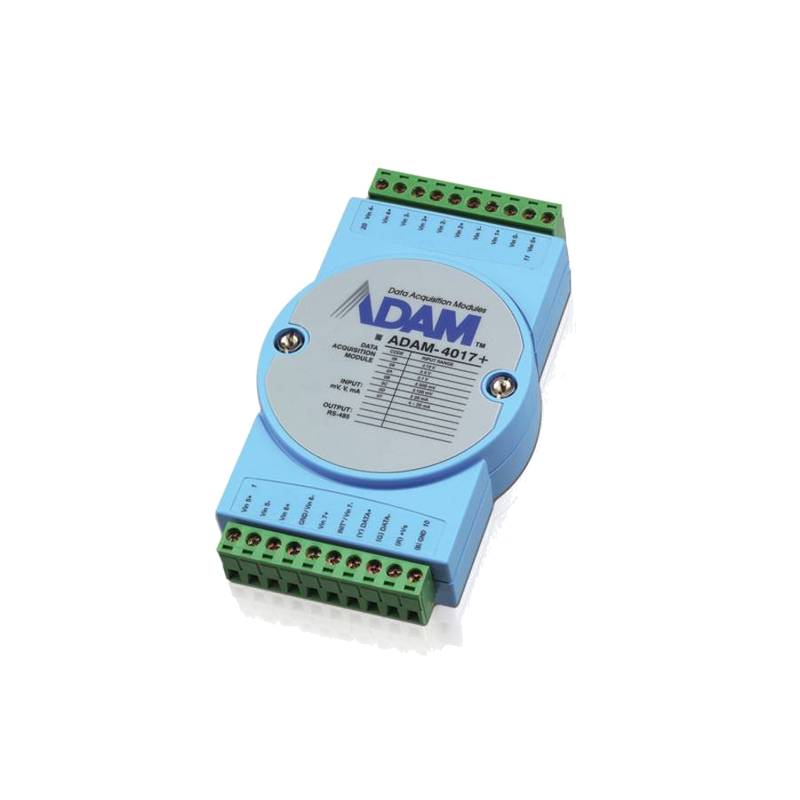
Advantech ADAM-4168-C Relay Control Digital Output Module


The Advantech ADAM-4168-C Relay Control Digital Output Module stands as a robust solution for industrial automation, offering reliable control over a variety of electrical devices. Its key advantages lie in its high channel density, isolated output design, and broad operating temperature range, making it suitable for demanding environments. The module features eight individually isolated Form A relay outputs, capable of handling significant AC/DC loads, and boasts a communication interface that supports Modbus RTU protocol over RS-485. Its specifications include a wide operating voltage range, surge protection, and LED indicators for status monitoring.
Product Specifications
| Feature | Specification |
| :------------------ | :------------------------------------------- |
| Digital Outputs | 8 x Relay Outputs (Form A) |
| Max. Load | 5A @ 250 VAC / 5A @ 30 VDC |
| Isolation Voltage | 2500 VDC |
| Communication | RS-485, Modbus RTU |
| Power Input | 10-30 VDC |
| Operating Temp. | -20 to 70 °C (-4 to 158 °F) |
| Dimensions | 143 x 70 x 27 mm (5.63" x 2.76" x 1.06") |
| Mounting | DIN-rail, Wall-mount |
Core Features & Market Positioning
The ADAM-4168-C distinguishes itself through its high level of output isolation, a critical feature that prevents ground loops and protects sensitive control systems from voltage spikes. This robust isolation, rated at 2500 VDC, ensures operational integrity in electrically noisy industrial settings. The module's eight Form A relays provide independent control over multiple circuits, offering flexibility in managing equipment such as motors, pumps, lights, and actuators. Advantech positions the ADAM-4168-C as a dependable and cost-effective I/O solution for distributed control applications where reliability and simplicity are paramount. Its compact form factor and DIN-rail mounting capability further enhance its appeal for integration into existing control panels.
Key Application Scenarios
Industrial automation projects frequently specify the Advantech ADAM-4168-C for tasks requiring the switching of high-power loads or the isolation of control signals. Common applications include building automation systems for HVAC and lighting control, where its multiple relay outputs can manage various zones and equipment. In manufacturing environments, it is deployed for controlling conveyor belts, robotic arm movements, and process machinery, ensuring safe and precise operation. Furthermore, its use extends to remote monitoring and control systems, such as in water treatment plants or agricultural settings, where it can reliably switch pumps and valves based on commands received over the Modbus RTU protocol.
Practical System Integration Guidance
Integrating the ADAM-4168-C into an industrial control system is straightforward, primarily involving its physical installation and communication setup. The module is designed for easy DIN-rail mounting, allowing for quick deployment in standard control cabinets. Wiring involves connecting the power supply to the designated terminals and then interfacing the relay contacts with the external loads to be controlled. Communication is established via the RS-485 serial interface, requiring careful attention to bus termination and addressing if multiple Modbus devices are present on the network. Users typically employ SCADA software or PLCs supporting the Modbus RTU protocol to read module status and send commands to control the relays, often through simple function code writes.
Operation and Risk Mitigation
Safe operation of the Advantech ADAM-4168-C hinges on adhering to proper wiring practices and understanding its operational limits. Before connecting any power, it is crucial to verify that the voltage and current ratings of the connected loads do not exceed the module's maximum specifications of 5A at 250 VAC or 30 VDC. Ensuring correct polarity for the DC power input prevents damage to the module. During operation, the built-in LEDs provide immediate visual feedback on the status of each relay and communication activity, aiding in rapid troubleshooting. While the module offers output isolation for protection, using appropriate surge suppression on connected loads can further mitigate risks associated with electrical transients.
Scalability & Long-Term Value
The Advantech ADAM-4168-C is designed for scalable automation architectures. Its Modbus RTU interface ensures broad compatibility with a wide range of PLCs, industrial PCs, and SCADA systems, facilitating integration into both new and existing infrastructure without requiring proprietary drivers. As automation needs grow, additional ADAM-4168-C modules, or other modules from Advantech's extensive ADAM series, can be easily added to the RS-485 network to expand the number of control points. This modular approach offers a cost-effective upgrade path, allowing businesses to scale their control capabilities incrementally. Furthermore, its robust design and Advantech's commitment to product longevity provide assurance for long-term system investment.
Frequently Asked Questions
What is the maximum load capacity of the Advantech ADAM-4168-C?
The ADAM-4168-C can handle a maximum load of 5 Amperes at 250 VAC.
It also supports a maximum load of 5 Amperes at 30 VDC. These ratings are crucial for selecting appropriate loads.
Always ensure your connected devices operate within these specified limits for reliable performance.
How do I connect the ADAM-4168-C to my PLC?
Connect the RS-485 A and B lines from your PLC to the corresponding terminals on the module.
Configure the Modbus RTU communication parameters (baud rate, parity, stop bits) on both the PLC and the ADAM-4168-C to match.
Assign a unique Modbus address to the ADAM-4168-C if multiple devices are on the bus.
What are the benefits of isolated outputs on the ADAM-4168-C?
Isolated outputs prevent ground loops, enhancing signal integrity.
They protect your control system from voltage surges from connected loads.
This isolation also simplifies wiring in systems with different voltage references.
Can the ADAM-4168-C be used outdoors?
The module has an operating temperature range of -20 to 70 °C.
This range allows for use in many unconditioned industrial environments.
For extreme conditions, an enclosure providing environmental protection is recommended.
What Modbus function codes are used with the ADAM-4168-C?
Function code 01 (Read Coils) can read the status of the output relays.
Function code 05 (Write Single Coil) is used to control individual relays.
Function code 15 (Write Multiple Coils) allows controlling multiple relays simultaneously.
How do I install the ADAM-4168-C on a DIN rail?
Slide the module onto the desired position on the DIN rail.
Ensure the module's mounting clip engages securely with the rail.
It can also be mounted on a wall using appropriate screws.
What is the power supply requirement for the ADAM-4168-C?
The module requires a DC power supply.
The input voltage range is between 10 and 30 VDC.
Connect the positive and negative terminals to the specified power input on the module.
Does the ADAM-4168-C support Modbus TCP/IP?
No, the ADAM-4168-C specifically supports Modbus RTU over RS-485.
For Modbus TCP/IP, you would need a different Advantech module with Ethernet connectivity.
This module is designed for serial communication networks.
How can I troubleshoot communication issues with the ADAM-4168-C?
Check wiring for correct RS-485 A/B connections and termination.
Verify that the Modbus RTU settings (address, baud rate, parity) match the master device.
Ensure the power supply to the module is stable and within the specified range.
What is the purpose of the LED indicators on the module?
LEDs typically show power status and communication activity.
Some LEDs may indicate the on/off state of individual relays.
Refer to the product manual for the specific meaning of each LED.