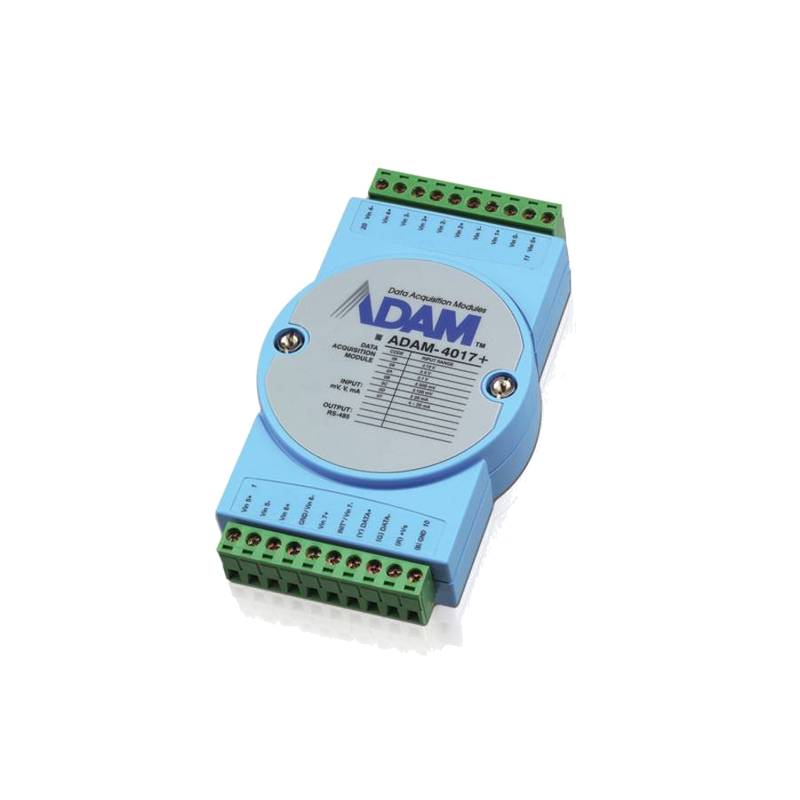
Advantech ADAM-4051-BE 16-Channel Digital I/O (DI/DO) Module


The Advantech ADAM-4051-BE stands as a robust 16-channel digital input/output module, engineered for demanding industrial automation environments. This module offers exceptional reliability and flexibility, boasting 16 isolated digital I/O channels, a wide operating temperature range of -25°C to 70°C, and a power input of 12-30 VDC. Its compact form factor and DIN-rail mounting capability facilitate seamless integration into existing control systems. Designed for industrial applications, the ADAM-4051-BE provides essential I/O expansion, ensuring efficient data acquisition and control for a variety of automation tasks.
Product Specifications
| Feature | Specification |
| :-------------------- | :----------------------------------------------- |
| Digital Channels | 16 (8 DI, 8 DO) |
| Isolation Voltage | 2,500 VDC |
| Input Type | Wet contact, dry contact |
| Output Type | Relay output |
| Input Voltage Range | 0-30 VDC |
| Output Current Rating | 5 A @ 250 VAC/30 VDC |
| Power Consumption | 2 W |
| Power Input | 12-30 VDC |
| Operating Temperature | -25°C to 70°C (-13°F to 158°F) |
| Humidity | 5-95% RH (non-condensing) |
| Dimensions | 148 mm x 88 mm x 39 mm (5.83" x 3.46" x 1.54") |
| Mounting | DIN-rail, Wall-mount |
| Communication Protocol| Modbus RTU |
Core Features & Market Positioning
The Advantech ADAM-4051-BE distinguishes itself through its high channel density and robust isolation, crucial for preventing ground loops and protecting control systems from voltage transients. Its 2,500 VDC isolation rating is a significant advantage in noisy industrial environments. The module's adaptability to both wet and dry contact inputs, coupled with its relay outputs, makes it a versatile solution for a broad spectrum of digital control and monitoring applications. Positioned as a cost-effective yet highly reliable I/O expansion module, the ADAM-4051-BE competes effectively in markets requiring dependable digital signal management without compromising on safety or performance. Advantech's reputation for industrial-grade hardware further solidifies its market standing.
Key Application Scenarios
The ADAM-4051-BE finds extensive use in critical industrial sectors. In manufacturing, it serves to monitor machine status, control conveyor belts, and manage alarm systems. For building automation, it can be integrated for controlling lighting, HVAC systems, and security access. In the energy sector, it's employed for remote monitoring of substations and managing circuit breakers. Furthermore, its application extends to water treatment plants for controlling pumps and monitoring levels, and in the transportation industry for traffic signal control and railway signaling. The module's ability to handle diverse digital signals makes it a go-to component for smart factory initiatives and IIoT deployments requiring reliable digital interfacing.
Practical System Integration Guidance
Integrating the Advantech ADAM-4051-BE into an industrial control system is straightforward, largely due to its standard Modbus RTU communication protocol and user-friendly design. For installation, secure the module onto a 35mm DIN-rail or mount it to a wall using appropriate hardware. Power is supplied via the 12-30 VDC input terminals. Digital inputs can be wired using either wet contact (connecting the signal to ground for a '0' and applying voltage for a '1') or dry contact configurations (utilizing a switch or relay to complete the circuit). Relay outputs are typically wired to control external devices such as contactors, indicator lights, or small motors, ensuring the load does not exceed the 5A rating. Configuration and communication are managed via the Modbus RTU protocol, typically over RS-485, requiring a Modbus master device (like an industrial PC or PLC) and appropriate cabling to establish communication.
Operation and Risk Mitigation
Operating the ADAM-4051-BE involves careful adherence to wiring and power specifications to ensure longevity and safety. Always verify that the input voltage falls within the specified 12-30 VDC range and that the total power draw does not exceed the system's capacity. When wiring relay outputs, ensure that the connected load’s current and voltage ratings are within the module’s 5A @ 250 VAC/30 VDC limits to prevent overloading and potential damage. Proper grounding of the system is essential, especially given the module's isolation features, to mitigate electrical noise and prevent equipment failure. While the module is designed for robustness, understanding common troubleshooting steps, such as checking communication settings and verifying power supply stability, can resolve many operational issues. Specific error codes are typically managed by the host controller and communicated via the Modbus protocol rather than being inherent to the ADAM-4051-BE itself.
Scalability & Long-Term Value
The ADAM-4051-BE offers excellent scalability, particularly when integrated into Advantech's broader automation portfolio. Its Modbus RTU interface ensures compatibility with a vast array of PLCs, SCADA systems, and industrial PCs from various manufacturers. For expanding digital I/O capacity, multiple ADAM-4051-BE modules, or other modules within the ADAM-4000 series, can be daisy-chained over RS-485, allowing for a significant increase in I/O points without requiring extensive rewiring or complex network configurations. This modular approach provides a cost-effective solution for growing automation needs. Furthermore, its integration into IIoT platforms is facilitated by its standard communication protocol, allowing it to serve as a reliable data acquisition node for cloud-based analytics and remote monitoring solutions, ensuring long-term value in an increasingly connected industrial landscape.
Frequently Asked Questions
1. How do I wire the digital inputs on the ADAM-4051-BE?
The ADAM-4051-BE supports both dry contact and wet contact digital inputs. For dry contact, wire a switch or relay to create a closed or open circuit.
For wet contact, connect the signal to ground for a low state and apply a voltage within the specified range for a high state. Ensure correct polarity for voltage inputs.
Always refer to the module's manual for detailed wiring diagrams to avoid configuration errors.
2. What is the maximum load I can connect to the relay outputs?
The relay outputs on the ADAM-4051-BE are rated for a maximum of 5 Amperes at 250 VAC or 30 VDC. Exceeding this rating can damage the module.
Always check the current and voltage requirements of the device you intend to control. Use appropriate external relays or contactors for loads exceeding these limits.
Consider the inrush current of inductive loads, as this can temporarily exceed the steady-state rating.
3. Can I use the ADAM-4051-BE with a PLC that uses Ethernet?
Yes, you can integrate the ADAM-4051-BE with an Ethernet-based PLC. You will need an RS-485 to Ethernet converter or gateway device.
This gateway device will translate Modbus RTU commands over RS-485 into Modbus TCP/IP over Ethernet, enabling communication.
Ensure the gateway is configured correctly to route Modbus traffic between the Ethernet network and the ADAM-4051-BE module.
4. What is the significance of the 2,500 VDC isolation rating?
The 2,500 VDC isolation rating provides robust protection against voltage spikes and ground loop interference. It separates the I/O channels from the main system ground.
This feature is critical in electrically noisy industrial environments, preventing damage to sensitive control equipment. It enhances system reliability and safety by isolating potential faults.
Isolation ensures that signals from different sources do not interfere with each other and that external electrical disturbances are contained.
5. How many ADAM-4051-BE modules can be connected in series?
The number of ADAM-4051-BE modules that can be connected in series depends on the communication bus characteristics and the capabilities of the master device. Typically, a standard RS-485 bus can support many nodes.
The primary limitation is usually the bus length and the required termination resistors. Ensure proper termination at the beginning and end of the RS-485 chain.
Consult the master device's specifications for its maximum Modbus slave ID or node count and the overall RS-485 bus load capacity.
6. What software is used to configure the ADAM-4051-BE?
The ADAM-4051-BE is typically configured using Advantech's proprietary software, such as ADAM Utility or WebAccess/SCADA. These tools allow for setting communication parameters and I/O configurations.
For direct integration into an automation system, the module is programmed as a Modbus RTU slave device. This involves configuring the host PLC or SCADA system to read/write data from/to the module's registers.
When using Modbus TCP/IP gateways, the configuration may also involve setting up the gateway's IP address and Modbus TCP settings.
7. Does the ADAM-4051-BE support Modbus TCP/IP directly?
No, the ADAM-4051-BE module itself natively supports only the Modbus RTU protocol over RS-485 serial communication.
To use it on an Ethernet network, an external Modbus TCP/IP to Modbus RTU gateway or converter is required. This device bridges the two communication protocols.
Advantech offers various gateway solutions that can be paired with the ADAM-4051-BE for seamless integration into TCP/IP networks.
8. What are the power requirements for the ADAM-4051-BE?
The ADAM-4051-BE requires a DC power supply within the range of 12 to 30 VDC. It consumes approximately 2 Watts of power under normal operation.
It's crucial to use a stable and regulated power supply to ensure reliable operation of the module and connected devices.
Ensure the power supply can handle the combined current draw of all connected ADAM modules and any other devices on the same power rail.
9. Can I use the relay outputs to switch AC and DC loads simultaneously?
Yes, the relay outputs are rated for both 250 VAC and 30 VDC, allowing them to switch both AC and DC loads. However, it is best practice to use separate circuits if possible.
When switching different types of loads, ensure that the wiring and isolation between AC and DC circuits are maintained according to safety standards.
Take precautions against potential arcing or interference between AC and DC switching operations if sharing a common power source or enclosure.
10. What is the advantage of using isolated I/O modules like the ADAM-4051-BE?
Isolated I/O modules prevent ground loops, which can cause erroneous readings and system instability in industrial environments. They protect sensitive control systems from voltage surges.
Isolation enhances system safety by preventing the propagation of faults or high voltages between different parts of the system. This is crucial for personnel and equipment protection.
It simplifies wiring and troubleshooting by ensuring that each I/O channel is electrically independent, leading to a more robust and reliable automation solution.