











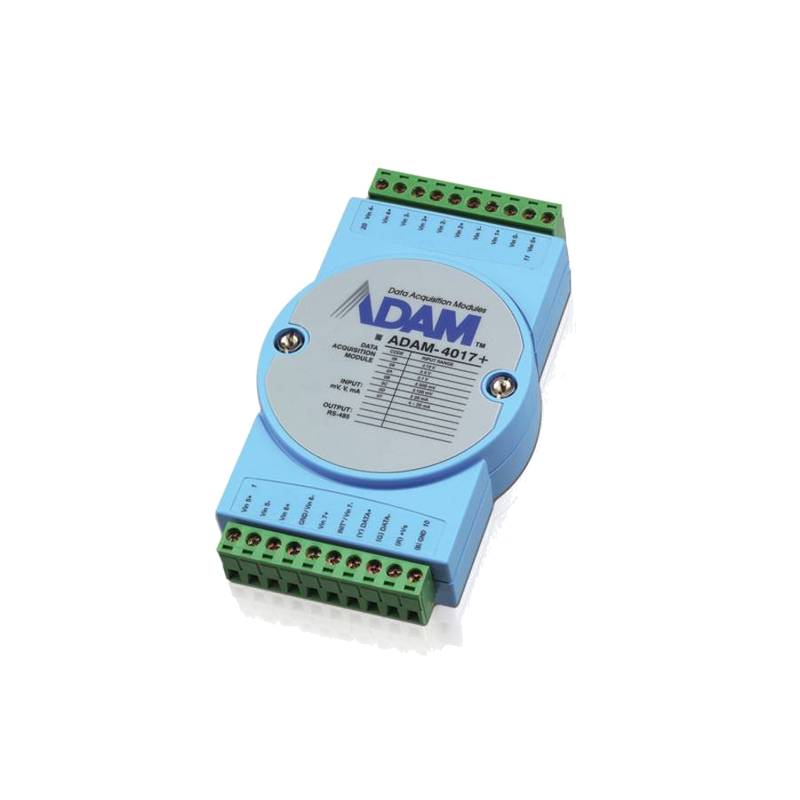
Advantech ADAM-4017+-E 8-Channel Analog Input Module


The Advantech ADAM-4017+-E stands as a robust 8-channel analog input module, engineered for demanding industrial environments where reliable data acquisition is paramount. This module excels in providing precise and stable measurements across a variety of sensors, making it an indispensable component for automation and control systems. Its key advantages lie in its high accuracy, wide operating temperature range, and seamless integration capabilities. The core features include eight independent analog input channels, each configurable for different signal types, ensuring versatility for diverse applications. Technical parameters such as a wide input voltage range, high isolation voltage, and low power consumption underscore its suitability for mission-critical operations.
Product Specifications
| Feature | Specification |
| :-------------------- | :------------------------------------------- |
| Number of Channels | 8 Analog Inputs |
| Input Type | Voltage, Current, Thermocouple, RTD |
| Input Range | Varies by channel configuration (e.g., ±10V, 4-20mA) |
| Resolution | 16-bit Sigma-Delta ADC |
| Sampling Rate | Programmable (up to 10 samples/sec per channel) |
| Accuracy | Typically ±0.1% of span |
| Isolation Voltage | 3000 VDC |
| Power Consumption | < 1.2 W |
| Operating Temp. | -40°C to 85°C |
| Communication | RS-485 |
| Protocol | Modbus RTU |
| Enclosure | IP30, DIN-rail mountable |
Core Features & Market Positioning
The ADAM-4017+-E differentiates itself in the industrial automation market through its exceptional flexibility and rugged design. It supports a broad spectrum of input signals, including voltage, current, thermocouples, and RTDs, eliminating the need for multiple specialized modules. This versatility is a significant competitive advantage, allowing integrators to consolidate hardware and simplify system architecture. The module's high isolation voltage (3000 VDC) provides robust protection against ground loops and electrical noise, a critical factor in industrial settings prone to electrical interference. Advantech's reputation for reliability further solidifies the ADAM-4017+-E's position as a trusted solution for professionals prioritizing data integrity and operational uptime. Its compact DIN-rail mountable form factor and low power consumption contribute to efficient cabinet space utilization and reduced operational costs.
Key Application Scenarios
The Advantech ADAM-4017+-E is ideally suited for a wide array of industrial applications where precise monitoring of physical parameters is essential. It plays a crucial role in environmental monitoring systems, collecting data from various sensors such as temperature, humidity, and pressure transmitters. In process control applications, it enables the accurate measurement of flow rates, levels, and pressures within chemical plants, water treatment facilities, and manufacturing lines. The module is also integral to building automation, facilitating the collection of data from HVAC sensors, energy meters, and occupancy detectors to optimize building performance and energy efficiency. Furthermore, its suitability for machine monitoring allows for the tracking of vibration, temperature, and power consumption on critical machinery, aiding in predictive maintenance strategies and preventing costly downtime.
Practical System Integration Guidance
Integrating the ADAM-4017+-E into an industrial control system is straightforward, primarily leveraging its RS-485 communication interface and Modbus RTU protocol. The module typically connects to a master controller, such as a PLC or industrial PC, using a two-wire RS-485 bus. Proper termination resistors (typically 120 ohms) should be used at the ends of the RS-485 bus to ensure signal integrity, especially over longer distances. Wiring of the analog input channels requires careful attention to the specific sensor type and required input configuration (e.g., connecting current loop sensors to the appropriate terminals and configuring the module accordingly via software). For programming, developers can utilize Advantech's ADAM utility software for initial configuration and diagnostics, or directly implement Modbus RTU commands in their PLC or SCADA system programming. Ensure correct address assignment for each ADAM module on the bus to avoid communication conflicts.
Operation and Risk Mitigation
Operating the ADAM-4017+-E within its specified parameters is key to ensuring reliable performance and longevity. Users must adhere to the defined input voltage and current ranges to prevent module damage. When dealing with high-voltage signals, ensure all connections are properly insulated and grounded according to safety regulations. A common troubleshooting scenario involves communication failures; this is often resolved by verifying RS-485 wiring polarity, checking termination resistors, confirming the correct Modbus address, and ensuring the baud rate and parity settings match between the master and slave devices. Faults related to sensor readings being out of range typically indicate either a sensor malfunction or an incorrect configuration within the ADAM-4017+-E's software settings. Regular inspection of wiring and connections can mitigate risks associated with physical damage or loose connections.
Scalability & Long-Term Value
The Advantech ADAM-4017+-E offers excellent scalability, allowing for the expansion of data acquisition capabilities by simply adding more modules to the existing RS-485 bus. This modular approach means system integrators can start with a few channels and easily increase capacity as their monitoring needs grow, providing a cost-effective long-term solution. Its compatibility with the widely adopted Modbus RTU protocol ensures seamless integration with a vast array of existing industrial hardware and software platforms, including SCADA systems and PLCs from various manufacturers. As industries move towards Industry 4.0 and IIoT, the ADAM-4017+-E can serve as a foundational element for digital transformation, providing reliable sensor data that can be fed into higher-level analytics and cloud platforms for advanced insights and remote management.
Frequently Asked Questions
What are the supported input types for the Advantech ADAM-4017+-E?
The ADAM-4017+-E supports a diverse range of analog input types, offering significant flexibility for various sensor integrations. It is capable of handling standard voltage signals, such as ±10V, and current loop signals like 4-20mA.
Furthermore, it is equipped to interface with thermocouples and Resistance Temperature Detectors (RTDs), enabling precise temperature measurements in industrial settings. This broad compatibility eliminates the need for multiple specialized input modules.
The module's adaptability ensures it can be a central component in systems requiring the acquisition of diverse physical parameters from different sensor technologies.
How do I connect Advantech ADAM-4017+-E modules in a multi-drop RS-485 network?
Connecting multiple ADAM-4017+-E modules on an RS-485 network involves a daisy-chain topology, with each module connected to the next in line. Ensure correct polarity (+ and -) for each connection to maintain proper communication flow.
At the very beginning and end of the RS-485 bus, termination resistors (typically 120 ohms) must be installed to prevent signal reflections and ensure data integrity, especially over longer cable runs.
Each ADAM module must be assigned a unique Modbus address via software configuration to be individually identifiable and addressable by the master controller on the network.
What is the typical accuracy of the Advantech ADAM-4017+-E and how can I ensure it?
The Advantech ADAM-4017+-E typically offers an accuracy of ±0.1% of the span, which is highly competitive for industrial data acquisition modules. This level of precision is crucial for applications demanding exact readings.
To maintain this accuracy, ensure that the input wiring is free from noise and interference by using shielded cables and proper grounding techniques. Also, verify that the module is not subjected to extreme temperatures outside its specified operating range.
Regular calibration checks, following Advantech's guidelines, can further help in preserving the module's accuracy over its operational life, especially in environments with significant environmental fluctuations.