











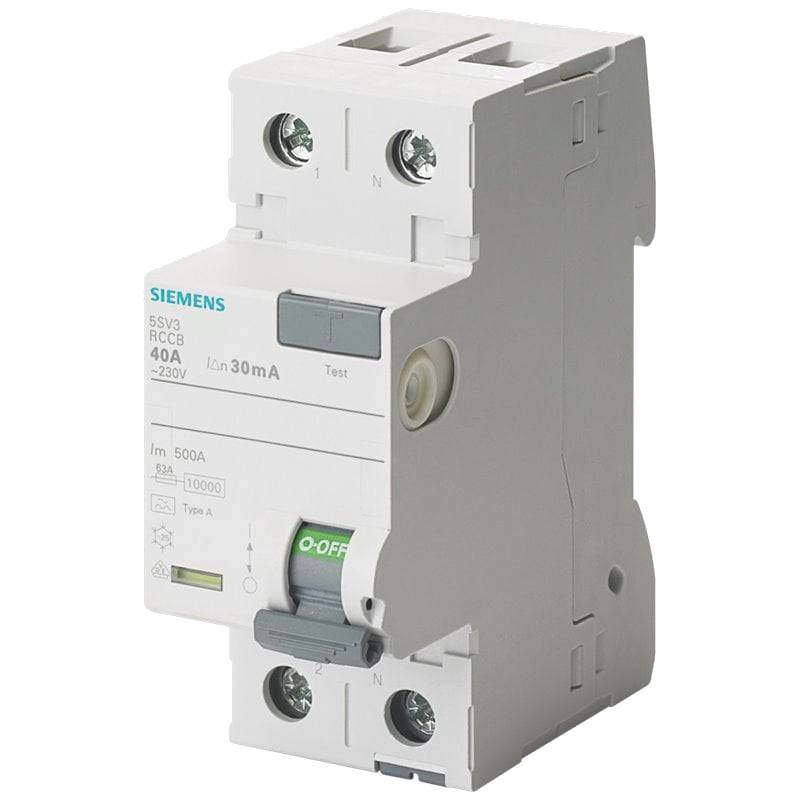
Siemens 5SV3316-6KK12 Industrial RCBO with Terminal Shield 2P 63A 30mA


The Siemens 5SV3316-6KK12 is a robust 2-pole, 63 Amp, 30mA Residual Current Circuit Breaker with Overcurrent Protection (RCBO), engineered for superior safety and reliability in demanding industrial environments. This unit integrates the functions of a residual current device (RCD) and a miniature circuit breaker (MCB) into a single, compact package, offering crucial protection against electric shock, fire hazards due to earth faults, and overcurrents. Its terminal shield ensures enhanced safety during installation and maintenance, making it a preferred choice for safeguarding critical circuits in manufacturing plants, data centers, and heavy industry installations.
Siemens 5SV3316-6KK12: Product Specifications
| Feature | Specification |
| :---------------------------- | :------------------------------------------- |
| Product Type | RCBO (Residual Current Circuit Breaker with Overcurrent Protection) |
| Manufacturer | Siemens |
| Model Number | 5SV3316-6KK12 |
| Number of Poles | 2 |
| Rated Current (In) | 63A |
| Rated Residual Current (IΔn) | 30mA |
| Breaking Capacity (Icn) | 6kA |
| Tripping Characteristic | Type AC (for sinusoidal AC residual currents) |
| Voltage Rating (Ue) | 230/400V AC |
| Frequency | 50/60 Hz |
| Terminal Type | Screw Terminals with Terminal Shield |
| Mounting Type | DIN Rail |
| Ambient Temperature Range | -25°C to +45°C |
| Protection Class (IP) | IP20 (main unit), IP40 (with terminal shield) |
Core Features & Market Positioning
The Siemens 5SV3316-6KK12 distinguishes itself through its high breaking capacity of 6kA, providing robust protection against short circuits. Its integrated design significantly reduces panel space and installation complexity compared to separate RCD and MCB units, a key advantage in space-constrained industrial control cabinets. The Type AC tripping characteristic ensures effective detection of sinusoidal AC residual currents, a common fault type in industrial power systems. This RCBO is positioned as a high-reliability safety device, backed by Siemens' reputation for quality and durability in harsh operational conditions. The inclusion of a terminal shield as standard enhances user safety during wiring and subsequent maintenance, reducing the risk of accidental contact with live terminals.
Key Application Scenarios
This RCBO is ideally suited for protecting individual circuits in a variety of industrial settings. Common applications include safeguarding motor control circuits in manufacturing lines, protecting power distribution circuits in electrical substations, and ensuring safety in HVAC systems for large commercial buildings. It is also deployed in data centers to protect server racks and critical power supply units from earth faults and overloads, minimizing downtime risks. Furthermore, its 30mA residual current sensitivity makes it compliant with regulations for personnel protection, crucial in areas with increased risk of electric shock.
Practical System Integration Guidance
Integrating the Siemens 5SV3316-6KK12 into existing or new electrical systems is straightforward due to its standard DIN rail mounting and common terminal configurations. For installation, ensure the main power supply is de-energized. Connect the incoming live and neutral conductors to the designated upper terminals and the outgoing protected circuit conductors to the lower terminals, respecting the polarity indicated on the device. The integrated terminal shield should be properly secured after wiring to maintain IP20 protection for the internal contacts. For systems requiring higher fault current withstand, ensure the upstream protective devices (e.g., main distribution board breakers) are appropriately rated to protect the 6kA breaking capacity of this RCBO.
Operation and Risk Mitigation
The 5SV3316-6KK12 operates by continuously monitoring the balance of current flowing through the live and neutral conductors. If an imbalance greater than 30mA occurs—indicating current is leaking to earth, potentially through a person—the device rapidly trips, disconnecting the circuit. This significantly mitigates the risk of electric shock and fire caused by insulation failures or accidental contact with live parts. In case of overcurrents or short circuits, the integrated MCB function trips the device, preventing damage to downstream equipment and wiring. If the RCBO trips unexpectedly, common troubleshooting involves checking the connected load for earth faults or excessive current draw. Isolating the circuit and testing for insulation resistance can help identify the fault source.
Scalability & Long-Term Value
While the Siemens 5SV3316-6KK12 is a fixed-specification device, its value lies in its compatibility with the broader Siemens SENTRON system and standard industrial electrical infrastructure. It integrates seamlessly into standard distribution boards and control panels, allowing for straightforward replacement or expansion of protection devices. Its robust construction ensures a long service life, reducing the total cost of ownership. For future upgrades or integration with Industrial Internet of Things (IIoT) solutions, consider utilizing compatible Siemens communication modules or smart metering devices upstream or downstream of the RCBO, allowing for remote monitoring of circuit status and energy consumption data.
---
Frequently Asked Questions (FAQs)
What is the primary function of the Siemens 5SV3316-6KK12?
The Siemens 5SV3316-6KK12 serves as a dual-function protective device. It combines residual current detection with overcurrent protection. This RCBO safeguards against electric shock and fire risks from earth faults. It also protects circuits from overloads and short circuits.
It is designed to ensure personnel safety by rapidly disconnecting power. This happens when it detects an earth leakage current above 30mA. This is critical for compliance and preventing electrical hazards.
The integrated nature of this unit saves panel space and simplifies wiring. It offers comprehensive protection in a single, reliable component. This makes it ideal for industrial and commercial applications.
Can this RCBO be used for single-phase or three-phase applications?
The Siemens 5SV3316-6KK12 is a 2-pole device. It is intended for single-phase AC circuits. This means it is suitable for protecting lines and neutral conductors.
It is not designed for three-phase power systems directly. For three-phase protection, you would typically use 4-pole RCBOs or a combination of 3-pole MCBs and a 2-pole RCD. Consult system requirements for proper selection.
Ensure correct wiring by connecting the line and neutral conductors to the appropriate terminals. Improper connection can lead to malfunction and safety issues. Always follow manufacturer guidelines.
What is the meaning of "Terminal Shield" on the 5SV3316-6KK12?
The terminal shield is a physical barrier covering the electrical connection points. It enhances safety by preventing accidental contact with live terminals. This is especially important during installation or maintenance.
This feature provides an increased level of protection against touch. It helps maintain a safer working environment in electrical panels. The shield contributes to the overall IP rating of the installed unit.
The terminal shield is a crucial safety component. It ensures that even when the device is live, direct contact with live conductors is prevented. This minimizes the risk of electric shock for electricians.
What does a 30mA residual current rating signify?
A 30mA residual current rating signifies high sensitivity. It means the device will trip when a leakage current of 30 milliamperes is detected. This level is generally considered safe for human protection.
This sensitivity is crucial for preventing severe electric shock. It allows for rapid disconnection of power before dangerous current levels can be sustained through the body. It is a standard for personal safety in many regulations.
The 30mA setting is primarily for personnel protection. It's distinct from higher residual current ratings (e.g., 100mA, 300mA) used for equipment or fire protection. This RCBO is therefore ideal for circuits where human exposure is a risk.
What is the breaking capacity (6kA) of this RCBO?
A breaking capacity of 6kA indicates the maximum fault current the device can safely interrupt. This is the highest current that can flow under short-circuit conditions without damaging the RCBO. A higher breaking capacity means greater protection against severe faults.
This 6kA rating is suitable for many standard industrial and commercial distribution circuits. It ensures that the RCBO will not fail catastrophically during a major short circuit. This protects both the device and the surrounding electrical installation.
It is essential to ensure that upstream protective devices have a higher breaking capacity. This ensures selective protection and prevents cascading failures. Always verify that the 6kA rating is adequate for your specific system's fault level calculations.
What type of fault current does the Type AC tripping characteristic detect?
The Type AC tripping characteristic is designed to detect sinusoidal AC residual currents. These are the most common type of fault current generated by AC power systems. It is effective for detecting earth faults that result in such currents.
This characteristic is less sensitive to pulsating DC residual currents. If your application involves equipment that might generate pulsating DC leakage, a Type A or Type B RCBO would be more appropriate. Always check the equipment's output characteristics.
For general industrial and residential applications with standard AC power, the Type AC RCBO provides reliable protection. It is a widely used and cost-effective solution for typical earth fault scenarios.
How do I install the Siemens 5SV3316-6KK12?
Installation requires de-energizing the circuit completely. Mount the RCBO securely onto a standard 35mm DIN rail. Connect the incoming live and neutral wires to the upper terminals and the outgoing wires to the lower terminals.
Ensure proper polarity is observed during wiring. The terminal shield should be in place before energizing the circuit. Use appropriately sized conductors and torque settings as per electrical codes.
Always consult the manufacturer's installation manual and local electrical regulations. If you are not qualified, engage a certified electrician. Incorrect installation can compromise safety and device function.
What does the 63A rating refer to?
The 63A rating indicates the maximum continuous current the RCBO can carry without tripping due to overload. This is its nominal current carrying capacity. It must be selected based on the continuous load of the circuit it protects.
This means the connected equipment should not draw more than 63 amps continuously. If the load exceeds this, the MCB function will trip the device. It is crucial for preventing overheating and damage to wiring.
Ensure the cable size feeding the RCBO is adequately rated for 63A. The chosen circuit breaker must also be protected by an upstream device with a suitable rating. This ensures proper coordination and protection.
Is this RCBO suitable for use in high-temperature environments?
The Siemens 5SV3316-6KK12 has an operating ambient temperature range of -25°C to +45°C. It is designed for typical industrial conditions within this range. Operation outside these limits can affect performance and lifespan.
If your application involves extreme temperatures, consider alternative products or additional cooling measures. Consistent operation at the upper limit of the temperature range can lead to premature aging of components.
Proper ventilation around the RCBO in the electrical panel is essential. Ensure that the device is not installed near heat-generating equipment. This helps maintain its operational integrity and longevity.
What is the difference between an RCBO and an RCD/MCB combination?
An RCBO integrates both residual current and overcurrent protection into a single unit. This saves space and simplifies installation compared to separate devices. It offers a consolidated protection solution for a circuit.
A combination uses two separate devices: an RCD (for earth leakage) and an MCB (for overcurrent/short circuit). This allows for more flexibility in selecting individual protection levels. However, it requires more panel space and wiring.
The primary advantage of an RCBO is its compactness and ease of installation. Both functionalities trip independently within the same device. This ensures comprehensive protection in a unified package.