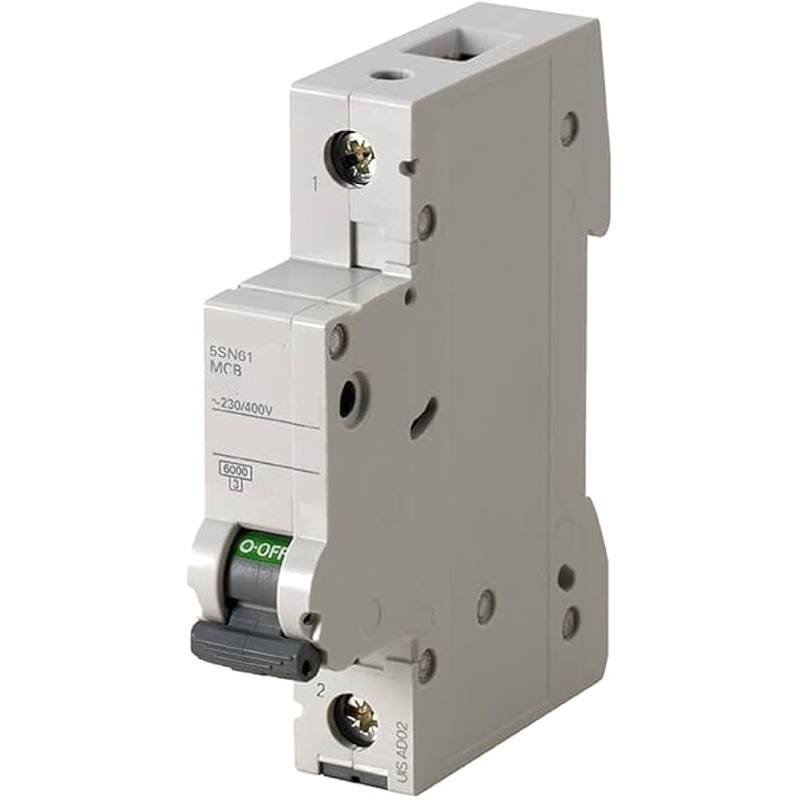












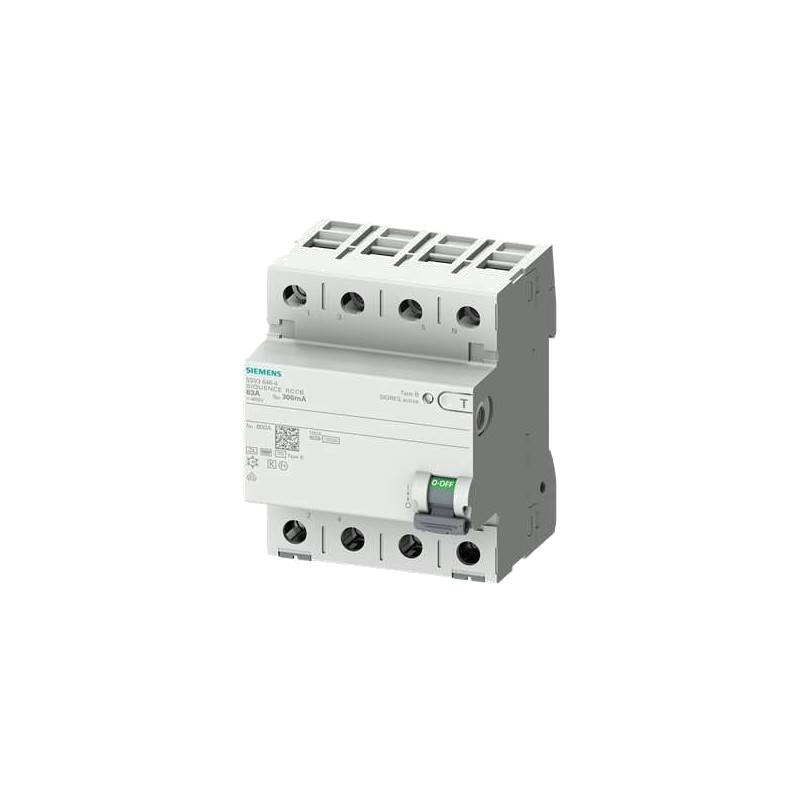
Siemens 5SV3344-6KK01 Residual Current Switch Module MCB 4P 40A 30mA


The Siemens 5SV3344-6KK01 is a highly reliable 4-pole residual current circuit breaker (RCCB) designed for robust protection in industrial and commercial electrical installations. This Type A RCD offers a 40A rated current and a sensitive 30mA tripping current, providing essential safety against electric shock and fire hazards. Its short-time delayed tripping characteristic enhances system stability by preventing nuisance tripping from transient earth leakage currents. Engineered with Siemens' signature quality, the 5SV3344-6KK01 is built for demanding environments, ensuring personnel safety and operational continuity.
Siemens 5SV3344-6KK01: Key Specifications and Features
The Siemens 5SV3344-6KK01 stands out with its combination of advanced features and reliable performance, making it a preferred choice for critical applications.
| Feature | Specification |
| :-------------------------- | :-------------------------------------------------- |
| Product Number | 5SV3344-6KK01 |
| Number of Poles | 4 (3P+N) |
| Rated Current (In) | 40 A |
| Rated Residual Current (IΔn)| 30 mA |
| Rated Voltage (Un AC) | 400 V |
| Tripping Characteristic | Type A (sensitive to AC and pulsating DC currents) |
| Tripping Function | Short-time delayed |
| Breaking Capacity (Icw) | 10 kA |
| Mounting Method | DIN rail |
| Protection Class | IP20 (with connected conductors) |
| Frequency | 50/60 Hz |
| Mechanical Service Life | Typically 10,000 switching cycles |
| Ambient Operating Temperature | -25°C to +45°C |
| Dimensions (H x W x D) | 90 mm x 72 mm x 70 mm |
| Weight | Approx. 377 g |
| Certifications | Compliant with relevant IEC/EN standards |
| Country of Origin | Germany |
Core Features & Market Positioning
The Siemens 5SV3344-6KK01 is positioned as a premium residual current protection device, emphasizing its "super resistant" design and Type A sensitivity. This designation highlights its capability to detect a broader range of fault currents compared to Type AC devices, including pulsating DC components, which are increasingly common with modern electronic equipment. The short-time delayed function is a critical differentiator, offering enhanced immunity to transient leakage currents from sources like capacitor banks or frequency converters, thereby minimizing operational disruptions. Siemens' SENTRON series, to which this RCD belongs, is recognized for its high reliability and quality in electrical installations. Its market positioning is that of a dependable safety component for personnel and property protection, offering optimized technology for enhanced safety.
Key Application Scenarios
The robust design and specific tripping characteristics of the Siemens 5SV3344-6KK01 make it suitable for a wide array of applications where reliable residual current protection is paramount. It is extensively used in industrial facilities for protecting machinery and personnel from electrical hazards. In commercial buildings, it ensures safety in distribution boards and protects circuits feeding sensitive electronic equipment. Its Type A sensitivity makes it ideal for environments with modern appliances, such as those found in residential complexes, hospitals, and data centers, where electronic devices can generate pulsating DC fault currents. The short-time delayed feature is particularly beneficial in installations prone to transient inrush currents, preventing unnecessary shutdowns. Furthermore, it serves as an essential component in meeting stringent electrical safety regulations and standards.
Practical System Integration Guidance
Integrating the Siemens 5SV3344-6KK01 into existing or new electrical systems is straightforward due to its standard DIN rail mounting. The device accommodates solid and stranded conductors ranging from 0.75 mm² to 35 mm², with recommended tightening torques for screw-type terminals between 2.5 and 3 N·m. Its four-pole design (3P+N) ensures comprehensive protection for three-phase circuits. For system expansion and enhanced functionality, the SENTRON protective switching devices, including this RCCB, can be integrated with a modular system of accessories. Siemens provides comprehensive datasheets and technical documentation, facilitating seamless installation and system design. The device can be installed in any mounting position, and its IP20 protection class is maintained when connected within a distribution board.
Operation and Risk Mitigation
The primary function of the Siemens 5SV3344-6KK01 is to provide residual current protection, safeguarding against electric shock, particularly direct contact with live parts, and preventing fires caused by insulation faults. Its Type A characteristic ensures it trips for AC and pulsating DC fault currents, offering a higher level of protection than Type AC devices. The device features touch and reach-around protection as standard, enhancing safety during installation and maintenance. A key operational safety feature is the ability to easily remove the RCCB from the DIN rail using a manual slide, without requiring tools. For troubleshooting, users can access technical data via a Data Matrix code on the device using the Siemens Industry Online Support App. While specific fault codes are not extensively detailed for this particular model, adherence to proper installation and operational guidelines is crucial for risk mitigation. Periodic testing, typically recommended semi-annually, is essential to ensure the continued functionality of the RCD.
Scalability & Long-Term Value
The Siemens 5SV3344-6KK01 is part of Siemens' broader SENTRON portfolio, designed for scalability and integration within intelligent electrical infrastructures. While this specific model is a standalone RCCB, it can be part of larger systems that incorporate communication and measuring functions, enabling advanced monitoring and control. The modular design of SENTRON devices allows for the addition of supplementary devices and accessories, enhancing the system's capabilities over time. For users looking to integrate with digital solutions, Siemens offers various IIoT and digital services that can leverage data from connected protective switching devices for predictive maintenance and energy management. Although the 5SV3344-6KK01 itself doesn't feature direct communication interfaces, its compatibility with broader Siemens ecosystem components ensures long-term value and adaptability to evolving industrial demands. The product's robust construction and typical mechanical service life of 10,000 switching cycles underscore its durability and long-term investment value.
---
Frequently Asked Questions (FAQs)
Q1: What is the primary function of the Siemens 5SV3344-6KK01?
The Siemens 5SV3344-6KK01 is primarily a residual current circuit breaker (RCCB). Its main purpose is to protect against electric shock by rapidly disconnecting power when it detects an imbalance of current flowing through live conductors. This function is crucial for preventing electrocution and reducing the risk of electrical fires.
This device offers comprehensive protection for both personnel and property. It is designed to detect AC and pulsating DC fault currents, thanks to its Type A characteristic, providing enhanced safety compared to simpler Type AC breakers. The unit also offers protection against fire damage resulting from insulation faults.
By quickly interrupting fault currents to earth, the 5SV3344-6KK01 ensures a high level of safety in electrical installations, meeting stringent industry standards for protection against direct and indirect contact.
Q2: What does "Type A" and "short-time delayed" mean for this RCCB?
"Type A" refers to the RCCB's sensitivity to different types of residual currents. It can detect sinusoidal AC fault currents, as well as pulsating DC fault currents. This makes it suitable for modern electrical installations where devices like electronic power supplies or variable speed drives can generate these types of faults.
"Short-time delayed" indicates that the RCD has a time delay before tripping. This feature is designed to prevent nuisance tripping caused by transient earth leakage currents that can occur during normal operation, such as when certain equipment is switched on. This delay allows for stable operation in environments with fluctuating current demands.
The combination of Type A sensitivity and a short-time delay makes the Siemens 5SV3344-6KK01 ideal for demanding industrial and commercial applications where both safety and operational continuity are critical.
Q3: What are the main advantages of using the Siemens 5SV3344-6KK01 over other residual current devices?
A key advantage is its "super resistant" design, which implies enhanced immunity to unwanted tripping, especially from inductive loads or surge currents. This is further bolstered by its short-time delayed tripping characteristic, preventing disruptions from transient earth leakage.
The Type A characteristic provides superior protection against a wider range of fault currents, including pulsating DC, which is essential for modern electronic loads. This makes it more versatile and safer than Type AC devices in many contemporary installations.
Siemens' reputation for quality and reliability is another significant advantage. The SENTRON series, to which this RCD belongs, is known for its durability, extensive testing, and long service life, offering dependable protection for many years.
Q4: Where is the Siemens 5SV3344-6KK01 typically installed?
This RCCB is commonly installed in main distribution boards, sub-distribution boards, and control panels within industrial facilities, commercial buildings, and even advanced residential complexes. Its 40A rating and 4-pole configuration make it suitable for protecting circuits supplying three-phase equipment or multiple single-phase loads.
Its primary role is to provide protection against indirect contact (faults within equipment) and direct contact (accidental touching of live parts). It's often used to protect circuits feeding sensitive electronic equipment, machinery, and areas where personnel are present.
The DIN rail mounting system allows for easy integration into standard enclosures. It is a fundamental component for ensuring electrical safety compliance in a wide variety of applications.
Q5: What is the significance of the 30mA rated residual current?
A rated residual current of 30mA (milliamperes) signifies a high level of sensitivity for personal protection. This value is considered the threshold below which an electric shock is generally not considered dangerous for humans.
When the current flowing out of a circuit does not return through the neutral conductor, and the difference exceeds 30mA, the RCCB will trip. This rapid disconnection is vital for preventing severe injury or fatality from electric shock.
This sensitivity is mandated by many electrical codes for socket outlets and circuits supplying portable equipment, especially in damp environments or areas with increased risk, to provide life-saving protection.
Q6: Can this RCCB be used in both AC and DC systems?
The Siemens 5SV3344-6KK01 is designed primarily for AC (Alternating Current) systems. Its "Type A" characteristic means it can detect both sinusoidal AC fault currents and pulsating DC fault currents. However, it is not designed for use in pure DC (Direct Current) systems.
For pure DC systems, specialized DC circuit breakers or specific types of residual current devices designed for DC operation would be required. The 400V AC rating further confirms its intended application within AC power distribution networks.
Always ensure the power source and the circuit being protected align with the voltage and current type specifications of the RCCB.
Q7: How is the Siemens 5SV3344-6KK01 installed and wired?
Installation involves mounting the unit onto a standard 35mm DIN rail within a distribution board or enclosure. The 4-pole design means there are four terminals for connection. Typically, the incoming power supply lines (L1, L2, L3, and Neutral) are connected to the upper terminals, and the outgoing circuit conductors are connected to the lower terminals.
Conductor cross-sections ranging from 0.75 mm² to 35 mm² (solid or stranded) can be accommodated. It is crucial to use the correct tightening torque for the screw terminals, generally between 2.5 and 3 N·m, to ensure a secure and reliable connection and prevent overheating.
The device can be installed in any orientation, but proper ventilation and accessibility should be considered. Always follow local electrical codes and manufacturer guidelines for safe and compliant installation.
Q8: What does the "short-time delayed" feature prevent?
The short-time delayed tripping characteristic prevents the RCCB from tripping unnecessarily due to temporary, harmless surges of leakage current. Such surges can occur when certain types of equipment, like those with large capacitor banks or variable frequency drives, are switched on.
By introducing a slight delay, the RCCB allows these brief current fluctuations to pass without disconnecting the power. This significantly improves the reliability and operational continuity of the electrical system, reducing downtime and avoiding nuisance trips.
This feature is particularly valuable in industrial automation, motor control, and applications with high inrush currents, ensuring that the protective device only intervenes when a genuine hazardous earth fault occurs.
Q9: What is the difference between a 5SV3344-6KK01 and a 5SV3344-6KL?
The primary difference lies in the tripping delay characteristic. The 5SV3344-6KK01 is designated as "short-time delayed" (often indicated by 'K' or 'G' in some Siemens naming conventions, though 'KK01' specifically denotes this), offering enhanced immunity to transient currents.
The 5SV3344-6KL, on the other hand, is typically an instantaneous tripping RCCB. Instantaneous devices react immediately to fault currents without any intentional delay, providing the fastest possible disconnection. While offering quicker response, this can lead to more nuisance tripping in systems with transient currents.
The choice between the two depends on the specific application requirements, particularly the presence of transient leakage currents that might cause unwanted trips with an instantaneous device.
Q10: How can I ensure the Siemens 5SV3344-6KK01 is functioning correctly?
Regular testing is essential to ensure the continued operational integrity of the RCCB. Most residual current devices, including this Siemens model, are equipped with a built-in test button. Pressing this button simulates a fault condition, and if the device is functioning correctly, it should trip, disconnecting the power.
Siemens recommends performing these tests periodically, typically on a semi-annual basis, as indicated in their installation manuals and datasheets. This manual testing helps verify the mechanical and electrical integrity of the tripping mechanism.
In addition to the button test, professional electrical inspections should be conducted periodically to verify overall system safety and the correct functioning of all protective devices, including the RCCB.