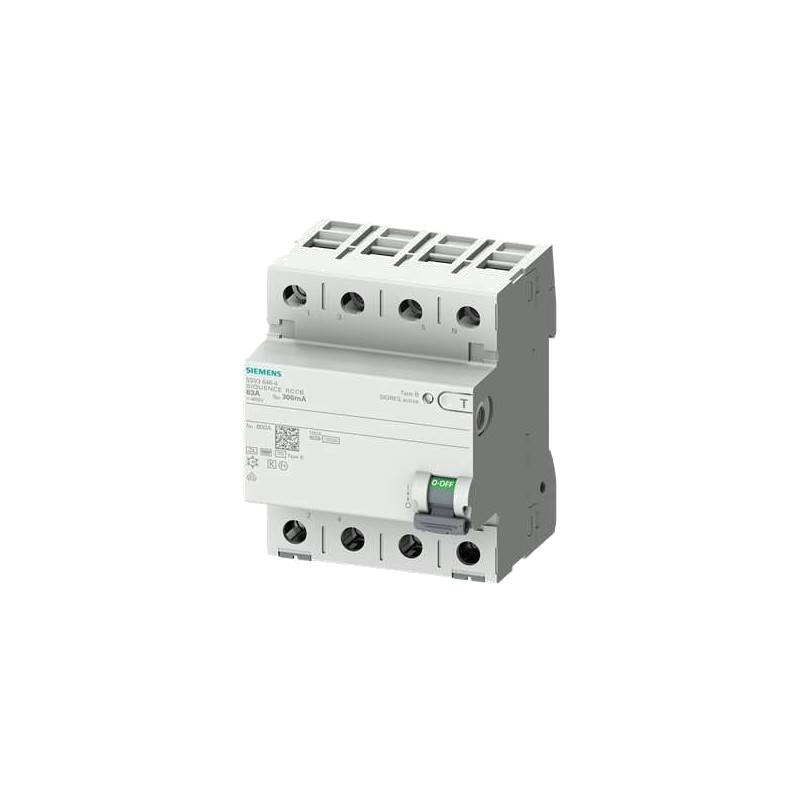
Siemens 5SV3644-6 Miniature Circuit Breaker 4P 40A 300mA


The Siemens 5SV644-6 Miniature Circuit Breaker (MCB) is a robust 4-pole, 40A, 300mA residual current device designed for reliable circuit protection in demanding industrial and commercial environments. Its key advantages include high breaking capacity, superior electrical endurance, and a compact design, ensuring safety and operational continuity. Essential technical parameters encompass its 4-pole configuration, a rated current of 40A, and a rated residual current of 300mA, making it suitable for safeguarding against earth faults and overcurrents.
Product Specifications
| Feature | Specification |
| :---------------------- | :------------------------------------------- |
| Product Type | Miniature Circuit Breaker (MCB) |
| Manufacturer | Siemens |
| Model Number | 5SV644-6 |
| Poles | 4 |
| Rated Current (In) | 40A |
| Rated Residual Current | 300mA |
| Breaking Capacity (Icn) | 10kA |
| Voltage Rating (Ue) | 400V AC |
| Tripping Characteristic | C |
| Frequency | 50/60 Hz |
| Protection Class | IP20 (terminal area) |
| Mounting Type | DIN rail (35mm) |
| Operating Temperature | -25°C to +45°C |
| Electrical Endurance | 10,000 cycles |
| Mechanical Endurance | 20,000 cycles |
| Connection Terminals | Rigid and flexible conductors up to 16 mm² |
Core Features & Market Positioning
The Siemens 5SV644-6 stands out in the market due to its enhanced safety features and Siemens' renowned build quality. Its trip-free mechanism prevents intentional or unintentional holding of the contacts during a fault, ensuring absolute circuit interruption. The C-type tripping characteristic is optimized for inductive loads, providing immunity to nuisance tripping caused by inrush currents, a critical factor in many industrial applications. This combination of reliability, safety, and performance positions it as a preferred choice for engineers and specifiers prioritizing dependable power distribution and protection. Its robust construction and adherence to stringent international standards underscore its premium market standing.
Key Application Scenarios
This 4-pole MCB is exceptionally well-suited for main distribution boards in commercial buildings, industrial facilities, and critical infrastructure where reliable protection against earth faults and overcurrents is paramount. It is frequently deployed in environments with machinery that generates significant inductive loads, such as manufacturing plants with motor-driven equipment, as well as in areas requiring a high degree of safety, like laboratories or healthcare facilities. Its 300mA residual current sensitivity makes it ideal for supplementary protection against indirect contact.
Practical System Integration Guidance
Integrating the Siemens 5SV644-6 into existing or new electrical systems is straightforward due to its standard 35mm DIN rail mounting. Ensure the incoming power supply lines are connected to the designated terminals (typically marked with line/L symbols) and the outgoing protected circuits to the load terminals. For optimal performance and safety, proper conductor termination is crucial; use crimped ferrules for stranded conductors and ensure all connections are tightened to the specified torque to prevent overheating and ensure reliable contact. The 4-pole design necessitates connecting all three phases and the neutral conductor, providing comprehensive protection for three-phase systems.
Operation and Risk Mitigation
The Siemens 5SV644-6 operates by continuously monitoring the current flow. In the event of an overcurrent (overload or short circuit) or an earth fault (where current leaks to ground via the 300mA residual current detection), the internal tripping mechanism is activated, rapidly opening all four poles to de-energize the protected circuit. This swift action minimizes the risk of electrical fires, equipment damage, and electric shock. Regular visual inspection and periodic testing of the residual current function using a dedicated test button or external tester are recommended to ensure continued operational integrity and mitigate potential risks associated with device malfunction.
Scalability & Long-Term Value
While a specific MCB is a discrete protection device, its long-term value lies in its compatibility with the broader Siemens SENTRON system portfolio. This ensures seamless integration with other Siemens switchgear, such as busbars, fuse holders, and distribution boards, allowing for standardized and efficient panel building. The inherent durability and high electrical endurance of the 5SV644-6 contribute to its long service life, reducing the need for premature replacements and supporting the overall cost-effectiveness of the electrical installation. Its robust design also offers a degree of future-proofing for installations that may evolve with increasing power demands.
Frequently Asked Questions
1. What is the primary function of the Siemens 5SV644-6 MCB?
This device serves as a miniature circuit breaker with residual current detection. It protects electrical circuits from overcurrents like overloads and short circuits. Simultaneously, its 300mA residual current sensitivity offers protection against electric shock.
The MCB interrupts the circuit automatically if it detects an abnormal flow of electricity. This prevents damage to wiring and connected equipment. It is a critical safety component in modern electrical installations.
Its four-pole design ensures complete isolation of three-phase systems during fault conditions. This provides comprehensive protection for industrial machinery and commercial power distribution.
2. How does the 300mA residual current protection work?
Residual current detection monitors the balance of current flowing in and out of a circuit. If there's an imbalance of 300mA or more, it signifies current leaking to ground. This leakage could be through a person, causing an electric shock.
The device quickly senses this imbalance and trips the circuit within milliseconds. This rapid response is crucial for preventing severe injury or fatality from electric shock. It acts as a vital safety layer against indirect contact.
This specific sensitivity is often mandated for supplementary protection in commercial and industrial settings. It provides an enhanced level of safety beyond basic overcurrent protection.
3. Can the Siemens 5SV644-6 be used for single-phase applications?
While designed as a 4-pole device, it can be adapted for certain single-phase applications. Typically, one pole would be used for the line and another for the neutral. The remaining two poles would be left unconnected.
However, this is generally not the most efficient or cost-effective solution for pure single-phase circuits. Single-pole or two-pole MCBs are more commonly specified for such uses. Utilizing a 4-pole device for single-phase may be considered if future expansion to three-phase is anticipated.
Always consult the system design specifications and local electrical codes before adapting a 4-pole breaker for single-phase use. Ensure proper terminal connections and unused pole management.
4. What does the "C" in the tripping characteristic "C" mean?
The "C" designation refers to the tripping characteristic of the MCB. It indicates the current level at which the breaker will trip due to a short circuit. A C-curve breaker trips between 5 to 10 times the rated current.
This characteristic makes it suitable for circuits with moderately inductive loads. These loads can have a higher inrush current when switched on, such as motors or transformers. The C-curve provides a delay to prevent nuisance tripping from these surges.
Conversely, B-curve breakers trip at lower multiples of rated current (3-5 times) and are for resistive loads, while D-curve breakers are for highly inductive loads (10-20 times).
5. What is the breaking capacity (Icn) of this MCB?
The Siemens 5SV644-6 has a rated breaking capacity (Icn) of 10kA. This is a critical safety parameter indicating the maximum fault current the MCB can interrupt safely without being damaged.
A 10kA breaking capacity is suitable for many industrial and commercial installations. It means the MCB can safely clear a short circuit fault current of up to 10,000 Amperes. Exceeding this capacity can lead to severe damage or failure of the breaker.
It is essential to ensure that the prospective fault current at the installation point does not exceed the MCB's breaking capacity. This is typically determined during the electrical design phase of a project.
6. How do I install the Siemens 5SV644-6 MCB?
Installation involves mounting the MCB onto a standard 35mm DIN rail within a distribution board or enclosure. Ensure the power supply to the board is completely isolated before commencing any work.
Connect the incoming phase and neutral conductors to the appropriate line-side terminals. Then, connect the outgoing conductors for the protected circuits to the corresponding load-side terminals. For 4-pole devices, all four connections must be made for complete circuit isolation.
Tighten all terminal connections securely to the manufacturer's recommended torque. Use appropriate ferrules for stranded conductors to ensure a reliable connection and prevent conductor fraying.
7. What is the voltage rating and frequency suitability?
The Siemens 5SV644-6 has a rated voltage (Ue) of 400V AC. This makes it suitable for standard industrial and commercial power distribution networks operating at this voltage level. It is also compliant with common frequency ranges of 50Hz and 60Hz.
Using the MCB at voltages significantly above its rating can compromise its insulation and interrupting capabilities. Conversely, using it at lower voltages within its specified range is generally acceptable and does not affect its protective functions.
Always verify that the system's operating voltage and frequency fall within the specified parameters of the MCB to ensure safe and reliable operation.
8. How can I test the residual current function?
Most residual current devices, including this Siemens model, are equipped with a built-in test button. Pressing this button simulates a fault condition by intentionally causing a small current imbalance.
When the test button is pressed, the MCB should trip, indicating that the residual current detection and tripping mechanism are functioning correctly. This test should be performed periodically, typically monthly, to ensure ongoing safety.
If the MCB does not trip when the test button is pressed, it indicates a malfunction. The device should be immediately taken out of service and replaced. External testing devices can also be used for more precise performance verification.
9. What is the environmental operating range for this MCB?
This MCB is designed for operation within an ambient temperature range of -25°C to +45°C. It also has an IP20 protection rating for the terminal area, meaning it is protected against solid objects larger than 12.5mm but not against water.
Operating the device outside these specified environmental conditions can affect its performance and lifespan. Extreme temperatures can impact the tripping characteristics, while exposure to moisture or dust can lead to premature failure or safety hazards.
Ensure the installation environment adheres to these specifications. Proper enclosure and ventilation may be necessary in demanding industrial settings to maintain optimal operating conditions.
10. Is this MCB compatible with smart grid or IIoT applications?
The Siemens 5SV644-6, as a standard mechanical MCB, does not possess inherent digital communication capabilities for direct IIoT integration. Its primary function is mechanical overcurrent and residual current protection.
However, it can be integrated into smart systems by using external communication modules or intelligent monitoring devices. These add-on units can detect the status of the MCB (e.g., tripped or closed) and transmit this information to a building management system or SCADA.
For advanced digital integration, Siemens offers other product lines with built-in communication features. When planning for IIoT, consider specifying breakers with integrated communication or pairing standard breakers with compatible smart accessories.