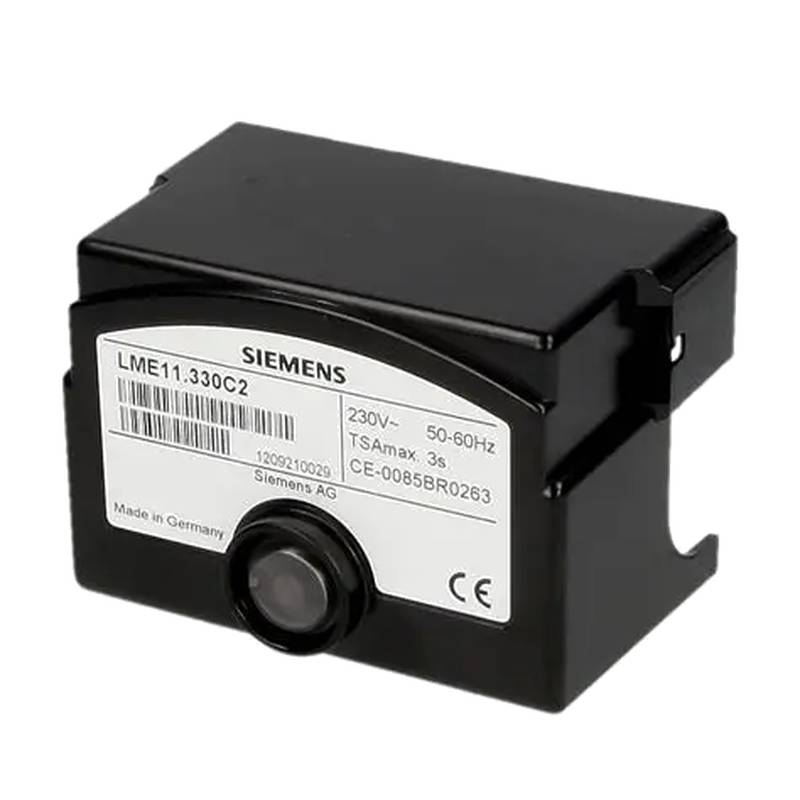
SIEMENS LME21.230C2 Electronic Burner Control LME21 Standard


The SIEMENS LME21.230C2 Electronic Burner Control LME21 Standard offers robust and reliable flame monitoring for single-stage gas burners. Its key advantages lie in its compact design, straightforward integration, and adherence to stringent safety standards, making it a preferred choice for original equipment manufacturers (OEMs) and service technicians. Critical technical parameters include its voltage supply of 200-240V AC, a control signal frequency of 50/60 Hz, and its suitability for operating temperatures ranging from -20 to +60 °C. The LME21.230C2 is designed for applications requiring dependable ignition and flame supervision, ensuring safe and efficient burner operation.
Product Specifications
| Specification | Value |
| :--------------------- | :---------------------------------------- |
| Burner Type | Single-stage gas burners |
| Voltage Supply | 200-240 V AC |
| Control Signal Freq. | 50/60 Hz |
| Operating Temperature | -20 to +60 °C |
| Safety Class | EN 60730-2-5 Class B |
| Protection Class | IP 40 |
| Dimensions (W x H x D) | 120 x 76 x 57 mm |
| Mounting | 35 mm DIN rail |
| Electrical Connections | Plug-in terminals |
Core Features & Market Positioning
The SIEMENS LME21.230C2 distinguishes itself through its inherent reliability and user-friendly interface, crucial for demanding industrial environments. It provides a secure and stable flame monitoring solution, contributing to operational safety and minimizing downtime. Positioned as a standard, yet highly effective, burner control, it appeals to a broad market seeking proven technology without unnecessary complexity. Its integration into a vast array of burner management systems underscores its versatility and market acceptance, often specified by leading boiler and burner manufacturers for its dependable performance.
Key Application Scenarios
This electronic burner control is widely deployed in commercial and light industrial heating applications. It is an ideal component for gas-fired boilers, furnaces, and process air heaters where precise flame detection and control are paramount. The LME21.230C2 is particularly well-suited for single-stage burner applications, ensuring consistent ignition and flame retention. End-users frequently search for solutions for reliable operation in buildings, industrial kitchens, and small manufacturing facilities where safety and energy efficiency are key concerns.
Practical System Integration Guidance
Integrating the SIEMENS LME21.230C2 is facilitated by its plug-in terminal design and DIN rail mounting capabilities. Proper wiring is essential; connect the power supply to terminals 1 and 2, the gas valve to terminals 3 and 4, and the ignition transformer to terminals 5 and 6. The flame sensor, typically a UV detector or flame rod, connects to terminals 7 and 8. Ensure correct polarity and secure connections to prevent operational faults. Commissioning involves verifying the correct sequence of operations and ensuring the flame signal is robust before full system engagement.
Operation and Risk Mitigation
The LME21.230C2 operates by monitoring the flame signal during the burner cycle. Upon ignition, it confirms flame establishment and maintains burner operation. Should the flame be lost, it initiates a safety shutdown sequence, de-energizing the gas valve. Common troubleshooting involves checking power supply stability, ensuring the flame sensor is clean and properly positioned, and verifying the integrity of external wiring. Referencing the official Siemens manual for specific error codes, such as a permanent flame signal upon startup or failure to establish flame, is critical for prompt resolution and risk mitigation.
Scalability & Long-Term Value
While the LME21.230C2 is designed for single-stage burners, its value lies in its proven performance and widespread compatibility. It seamlessly integrates with existing burner management systems and can be part of a larger control architecture. Its robust construction ensures a long service life, minimizing replacement costs. For more complex multi-stage or modulating burner applications, Siemens offers advanced controllers, but the LME21.230C2 serves as a reliable foundation for simpler systems, offering excellent long-term operational value through its dependability.
Frequently Asked Questions
What is the primary function of the SIEMENS LME21.230C2?
The SIEMENS LME21.230C2 acts as an electronic burner control, specifically for single-stage gas burners. It manages the ignition sequence and continuously monitors the flame to ensure safe operation.
Its core responsibility is to detect the presence or absence of a flame during the burner's cycle. If the flame is lost, it immediately shuts off the fuel supply to prevent hazardous situations.
This control unit is crucial for maintaining burner safety and preventing uncontrolled fuel release, making it an essential component in various heating systems.
How do I wire the SIEMENS LME21.230C2 burner control?
Wiring involves connecting the power supply to terminals 1 and 2 (200-240V AC). Terminals 3 and 4 are for the gas valve, and terminals 5 and 6 are for the ignition transformer.
The flame detection sensor, such as a flame rod or UV scanner, connects to terminals 7 and 8. Always ensure correct polarity and secure terminal connections for reliable performance.
Referencing the detailed wiring diagram in the product manual is highly recommended to avoid errors during installation and ensure proper system functionality.
What are the typical applications for the SIEMENS LME21.230C2?
This burner control is commonly used in single-stage gas burners found in commercial and light industrial heating equipment. Examples include boilers, furnaces, and process air heaters.
It is favored in applications requiring a dependable and straightforward flame monitoring solution where precise control of a single burner stage is sufficient.
Its robust design makes it suitable for environments where consistent and safe operation is paramount, such as in various building management systems and small-scale industrial processes.
Can the SIEMENS LME21.230C2 be used with oil burners?
No, the SIEMENS LME21.230C2 is specifically designed for single-stage *gas* burners. It is not suitable for oil burner applications.
Oil burners typically require different types of control units with specific flame detection methods and ignition sequences. Using this unit with an oil burner could lead to system malfunction or safety hazards.
Always ensure that the burner control selected is compatible with the specific type of fuel and burner design you are working with for safe and effective operation.
What is the operating temperature range for this control unit?
The SIEMENS LME21.230C2 electronic burner control operates reliably within a temperature range of -20 to +60 degrees Celsius. This wide range allows for its use in various environmental conditions.
Ensuring the control unit stays within this specified temperature range is vital for its longevity and consistent performance. Extreme temperatures can affect its electronic components.
If the installation environment is expected to exceed these limits, appropriate measures for heating or cooling should be implemented to protect the control unit.
What kind of flame signal does the LME21.230C2 typically use?
The LME21.230C2 can utilize different flame signal types, commonly a flame rod (ionisation) or a UV detector. The choice depends on the burner design and application.
If using a flame rod, it detects the electrical conductivity of the flame. A UV detector senses ultraviolet radiation emitted by the flame.
The correct connection and type of flame sensor must be specified and installed according to the burner manufacturer's guidelines for proper flame detection.
What does the C2 in LME21.230C2 signify?
The 'C2' designation typically refers to a specific configuration or feature set within the LME21 series. It often relates to the type of flame detection or timing characteristics.
While specific meanings can vary by Siemens product line, 'C2' often indicates a standard version suitable for typical single-stage gas burner applications with particular timing sequences.
It's essential to consult the official Siemens product documentation or data sheet for the precise meaning of the 'C2' suffix to understand its exact functional implications.
How do I reset a SIEMENS LME21.230C2 burner control?
Resetting the control is usually achieved by cycling the power off and then on again after a fault has been cleared. This action allows the unit to attempt a restart sequence.
For certain faults, a specific reset procedure or a temporary interruption of the power supply may be required. Always consult the user or service manual for the exact reset steps.
If the burner control repeatedly enters a fault state, it indicates an underlying issue that needs to be diagnosed and resolved before attempting further resets.
What are the dimensions of the SIEMENS LME21.230C2?
The SIEMENS LME21.230C2 has compact dimensions, measuring approximately 120 mm in width, 76 mm in height, and 57 mm in depth. These measurements allow for easy integration into control panels.
Its slender profile is designed for efficient space utilization within electrical enclosures, making it a practical choice for OEMs and panel builders.
The unit is designed for standard 35 mm DIN rail mounting, further simplifying its installation and integration into control cabinets.
Where can I find the official manual for the SIEMENS LME21.230C2?
The official Siemens product manual can typically be downloaded from the Siemens Industry Online Support (SIOS) portal. You will need the exact product number for your search.
Alternatively, many authorized Siemens distributors or specialized industrial automation websites often provide access to product manuals and technical documentation for download.
Always ensure you are downloading the most current version of the manual to have access to the latest specifications, wiring diagrams, and troubleshooting information.