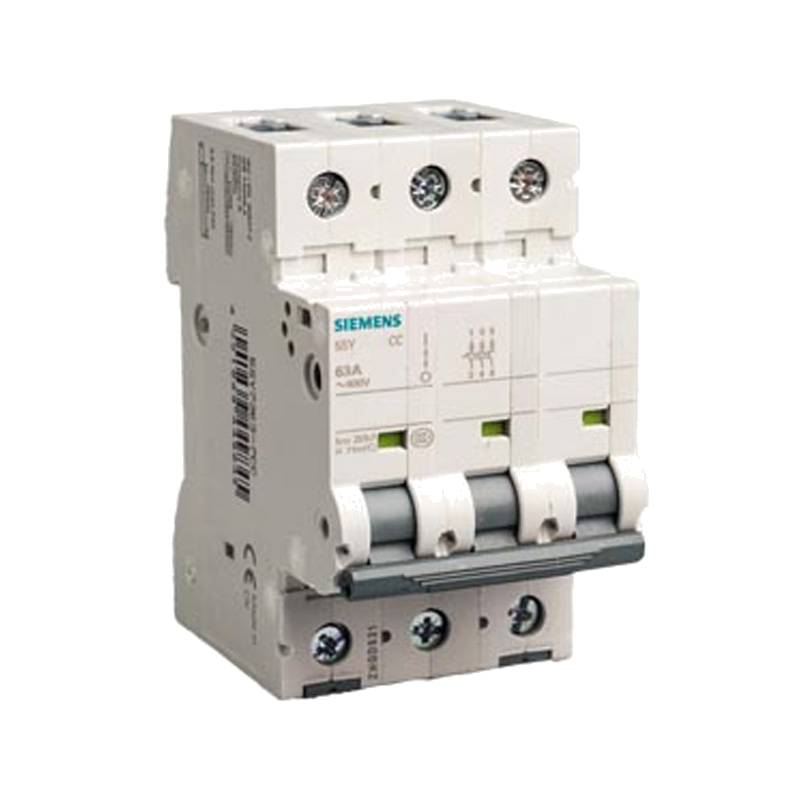












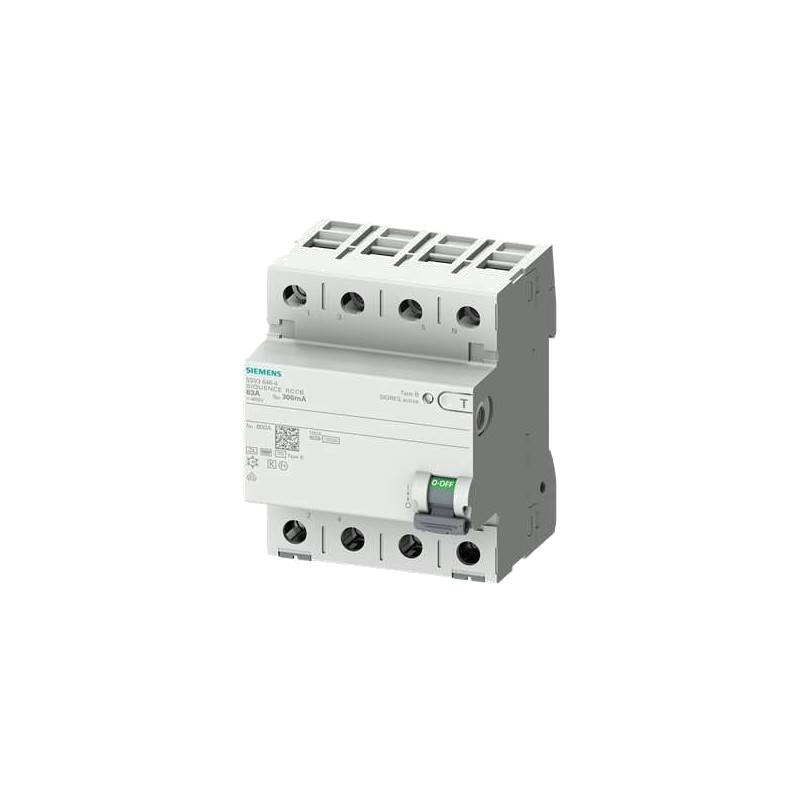
Siemens 5SV3347-6 Miniature Circuit Breaker 4P 80A 30mA


The Siemens 5SV3347-6 Miniature Circuit Breaker (MCB) is a robust four-pole, 80A, 30mA residual current device designed for reliable circuit protection in demanding industrial environments. This MCB offers exceptional performance through its advanced tripping mechanisms and durable construction, ensuring safety and operational continuity. Key advantages include its high breaking capacity, ensuring protection against short circuits and overloads, and its sensitivity to residual currents, preventing electrical fires and personal injury. With a rated voltage of 400V AC and a frequency of 50/60 Hz, the 5SV3347-6 is engineered for superior electrical safety and system integrity.
| Feature | Specification |
| :-------------------------- | :------------------------------------------ |
| Product Type | Miniature Circuit Breaker (MCB) |
| Number of Poles | 4 |
| Rated Current (In) | 80 A |
| Rated Residual Operating Current (IΔn) | 30 mA |
| Rated Voltage (Ue) | 400 V AC |
| Frequency | 50/60 Hz |
| Tripping Characteristic | Type A |
| Breaking Capacity (Icn) | 6 kA |
| Electrical Endurance | 10,000 cycles |
| Mechanical Endurance | 20,000 cycles |
| Operating Temperature | -25 °C to 45 °C |
| Protection Class | IP20 (terminal area), IP40 (enclosure) |
| Mounting Type | DIN rail (35 mm) |
| Conformance | IEC/EN 61009-1 |
Core Features & Market Positioning
The Siemens 5SV3347-6 stands out in the market due to its Type A tripping characteristic, offering enhanced protection against both sinusoidal AC residual currents and pulsating DC residual currents, which are increasingly common with modern electronic equipment. This differentiates it from Type AC devices, providing a higher level of safety. Its robust 6 kA breaking capacity ensures it can safely interrupt fault currents, a critical feature for industrial settings where higher fault levels are anticipated. The device’s design emphasizes reliability and longevity, evidenced by its substantial electrical and mechanical endurance ratings, positioning it as a premium solution for critical infrastructure protection. Siemens' reputation for quality and engineering excellence further bolsters its market appeal, offering users confidence in system safety and performance.
Key Application Scenarios
This Siemens MCB is ideally suited for a wide array of industrial and commercial applications where reliable protection against overcurrents and residual currents is paramount. It is extensively used in power distribution panels for manufacturing plants, ensuring the safety of machinery and personnel. In building management systems, it safeguards electrical installations in commercial complexes, hospitals, and data centers, preventing electrical faults that could lead to costly downtime or hazards. Furthermore, the 5SV3347-6 is an excellent choice for protecting sensitive electronic loads and equipment in areas with a higher risk of earth faults, such as workshops and laboratories, providing a critical layer of defense against electrical fires and shocks.
Practical System Integration Guidance
Integrating the Siemens 5SV3347-6 MCB into existing electrical systems is straightforward due to its standard DIN rail mounting and terminal configurations. For installation, ensure the main power supply is de-energized. The four poles should be connected according to the system's phase and neutral requirements. For 80A circuits, the use of appropriate conductor sizing and termination techniques is critical to prevent overheating and ensure secure connections. Terminals accommodate conductors up to 35 mm², and proper tightening with a torque wrench to the specified value (typically 3.5 Nm) is recommended for optimal electrical contact and mechanical stability. The residual current function requires correct wiring of the neutral conductor through the MCB’s sensing aperture.
Operation and Risk Mitigation
The Siemens 5SV3347-6 operates by continuously monitoring the balance of current between the live and neutral conductors. If an imbalance exceeding 30mA occurs – indicative of a fault current or leakage to earth – the MCB rapidly trips, interrupting the circuit. This prevents potentially hazardous situations such as electric shock and fire. To mitigate risks, regular testing of the residual current function using the integrated test button (typically labeled 'T' or a similar indicator) is essential. Periodic visual inspections for signs of damage or overheating and ensuring proper ventilation around the device will also contribute to safe and reliable operation. In the event of frequent nuisance tripping, a thorough investigation of the protected circuit for insulation degradation or transient earth faults is recommended.
Scalability & Long-Term Value
The 5SV3347-6 MCB offers significant long-term value through its compatibility with the broader Siemens SENTRON system, allowing for seamless integration with other protective and switching devices. This modularity facilitates easy expansion or modification of electrical distribution systems as requirements evolve. Its robust design and adherence to international standards ensure a long operational lifespan, minimizing the need for premature replacements. For facilities adopting Industry 4.0 principles, while this specific model may not have direct digital communication, its reliable performance forms a foundational element of a safe and dependable electrical infrastructure that can be enhanced with smart metering and monitoring devices upstream or downstream in the power distribution chain, providing valuable operational data.
FAQs
What is the primary function of the Siemens 5SV3347-6 MCB?
The Siemens 5SV3347-6 is a residual current device that provides overcurrent and earth fault protection. It safeguards electrical circuits from damage caused by overloads and short circuits. It also protects personnel and equipment from dangerous electrical shocks by detecting small leakage currents.
How does the 30mA sensitivity of the Siemens 5SV3347-6 protect users?
The 30mA residual current detection triggers a rapid disconnection of the power supply. This level of sensitivity is considered sufficient to prevent serious injury or electrocution from direct contact with live conductors. It acts as a crucial safety measure in environments where electrical hazards are present.
What is the breaking capacity of the Siemens 5SV3347-6, and why is it important?
The Siemens 5SV3347-6 has a breaking capacity of 6 kA. This indicates the maximum fault current it can safely interrupt without sustaining damage. A higher breaking capacity is vital in industrial settings where fault currents can be significantly larger, ensuring reliable protection during severe electrical events.
Can the Siemens 5SV3347-6 be used in residential applications?
While primarily designed for industrial use, the 5SV3347-6 can be utilized in residential settings where enhanced safety is desired, particularly in areas like kitchens or bathrooms. Its four-pole design is typically for three-phase applications, so single-phase residential use would require a different configuration or careful application.
What type of residual currents does the Type A tripping characteristic detect?
The Type A tripping characteristic of the Siemens 5SV3347-6 can detect sinusoidal AC residual currents and pulsating DC residual currents. This offers broader protection compared to Type AC devices, which are only sensitive to AC residual currents. It's effective against faults generated by electronic devices.
How is the Siemens 5SV3347-6 installed and wired?
Installation involves mounting the MCB on a standard 35mm DIN rail. The four poles are wired to the incoming power supply and outgoing circuit loads. Proper conductor sizing and terminal torque are critical for safe and efficient operation. Ensure the neutral conductor passes through the sensing aperture.
What are the key technical specifications for the Siemens 5SV3347-6?
Key specifications include a 4-pole configuration, 80A rated current, and 30mA residual operating current. It operates at 400V AC with a frequency of 50/60 Hz and offers a 6 kA breaking capacity. Its tripping characteristic is Type A for enhanced fault detection.
How can I test the residual current protection of the Siemens 5SV3347-6?
Most Siemens MCBs, including the 5SV3347-6, feature a test button (often labeled 'T'). Pressing this button simulates a fault condition, causing the MCB to trip. Regular testing, typically monthly, is recommended to ensure the residual current function remains operational and effective.
What is the environmental operating range for this Siemens MCB?
The Siemens 5SV3347-6 is designed to operate within an ambient temperature range of -25°C to +45°C. It has an IP20 rating for the terminal area, meaning it's protected against solid objects larger than 12.5mm but not against water. The enclosure offers IP40 protection against solid objects.
What does the "4P" designation signify for the Siemens 5SV3347-6?
"4P" in the Siemens 5SV3347-6 designation indicates that it is a four-pole circuit breaker. This means it is designed to interrupt all four conductors (typically three phases and a neutral) simultaneously in a three-phase system. This ensures complete isolation of the circuit during a fault.