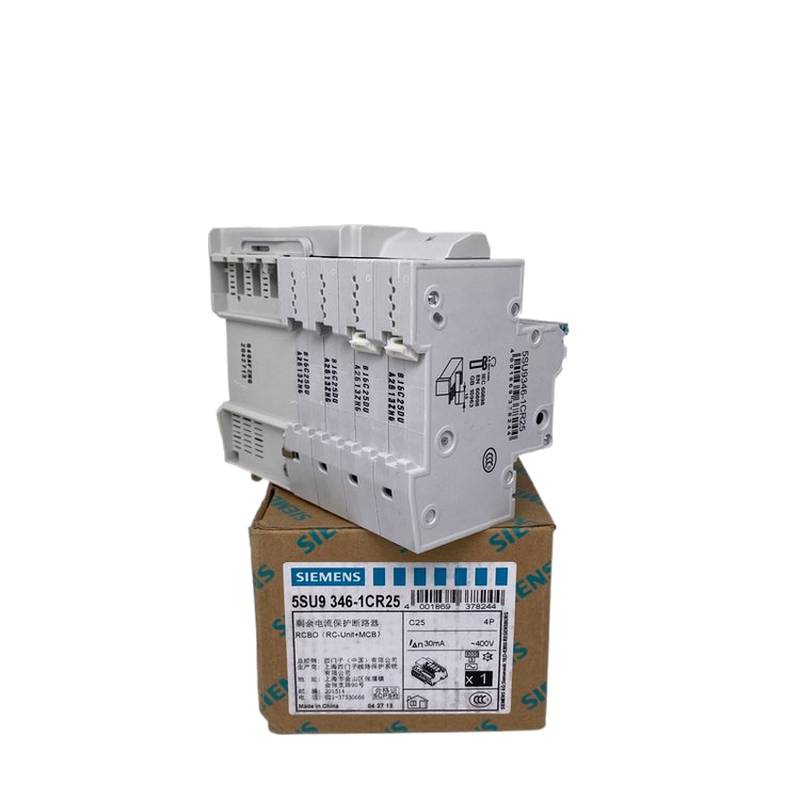












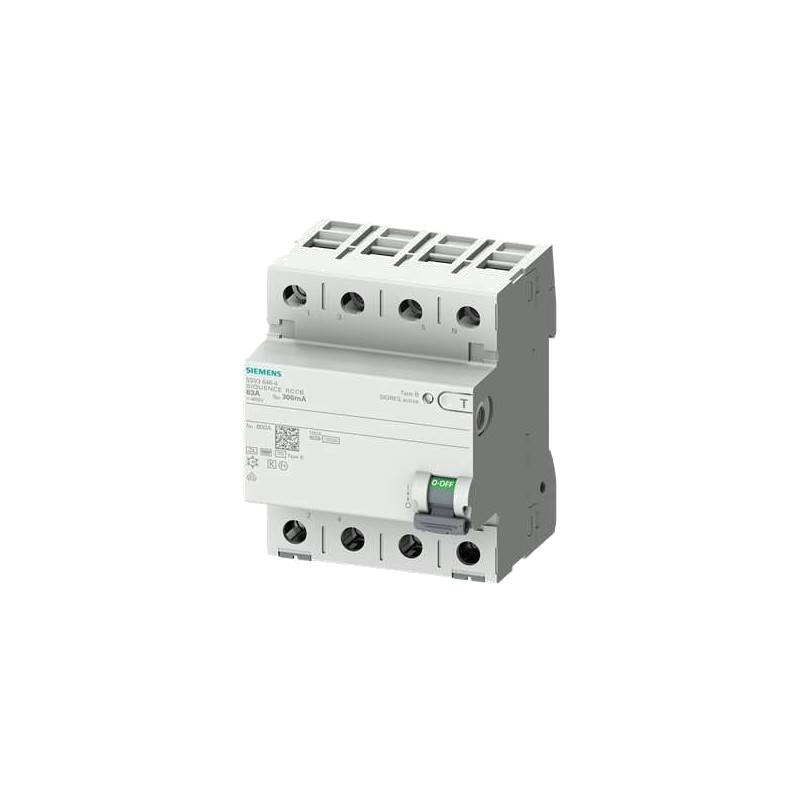
Siemens 5SV3646-4 Miniature Circuit Breaker 4P 63A 300mA


The Siemens 5SV3646-4 Miniature Circuit Breaker (MCB) stands as a robust solution for protecting electrical circuits in demanding industrial environments. This 4-pole, 63A, 300mA Residual Current Circuit Breaker (RCCB) variant offers superior safety and reliability, crucial for preventing electrical shocks and mitigating fire hazards. Its advanced tripping characteristics ensure rapid disconnection under fault conditions, safeguarding both personnel and equipment. Designed for seamless integration into modern electrical systems, the Siemens 5SV3646-4 embodies efficiency and advanced protection technology, making it an indispensable component for professionals in electrical engineering and industrial automation.
Product Specifications
| Feature | Specification |
| :--------------------- | :------------------------------------------------ |
| Manufacturer | Siemens |
| Product Series | 5SV3 |
| Type | Miniature Circuit Breaker (MCB) / Residual Current Circuit Breaker (RCCB) |
| Number of Poles | 4P (4-pole) |
| Rated Current (In) | 63 A |
| Rated Residual Operating Current (IΔn) | 300 mA |
| Rated Breaking Capacity (Icn) | 6 kA (at 400V) |
| Tripping Characteristic | Type AC |
| Voltage Rating (Ue) | 400 V AC |
| Frequency | 50/60 Hz |
| Mounting Type | DIN rail |
| Electrical Endurance | 10,000 cycles |
| Mechanical Endurance | 20,000 cycles |
| Ambient Temperature | -25 °C to +45 °C |
| Protection Class | IP20 (IP40 when installed in enclosure) |
Core Features & Market Positioning
The Siemens 5SV3646-4 distinguishes itself through its high breaking capacity of 6 kA at 400V AC, providing substantial protection against short circuits in industrial settings. Its Type AC tripping characteristic ensures effective detection of sinusoidal AC residual currents, a common occurrence in many industrial applications. This MCB is engineered for reliability, featuring robust construction that guarantees long-term performance even under challenging environmental conditions. Siemens' reputation for quality and innovation positions the 5SV3646-4 as a trusted component for critical power distribution and safety applications, offering a superior balance of performance and cost-effectiveness compared to other market alternatives.
Key Application Scenarios
This 4-pole 63A 300mA MCB is ideally suited for main distribution boards and sub-distribution boards in industrial facilities, manufacturing plants, and commercial buildings. It provides essential residual current protection for circuits supplying machinery, power tools, lighting systems, and HVAC equipment, significantly reducing the risk of electric shock and fire. Its application is particularly critical in areas where conductive floors or extensive metal structures increase the risk of ground faults. The 5SV3646-4 is also a key component in systems requiring protection against both overcurrents and earth faults, ensuring comprehensive circuit safety.
Practical System Integration Guidance
Installing the Siemens 5SV3646-4 involves secure mounting onto a standard 35mm DIN rail within a suitable enclosure. Ensure proper termination of conductors into the appropriate terminals, adhering to torque specifications for reliable connections. The 4-pole design allows for the simultaneous disconnection of all live conductors and the neutral in a 3-phase system, crucial for safety. Proper grounding of the enclosure and the incoming supply neutral is paramount for the effective operation of the residual current protection. Always consult the manufacturer's installation manual for detailed wiring diagrams and safety precautions before commissioning.
Operation and Risk Mitigation
The Siemens 5SV3646-4 operates by continuously monitoring the current balance between live conductors and the neutral. If an imbalance exceeding 300mA occurs – indicative of a leakage current to earth – the device rapidly trips, disconnecting the circuit. This prevents sustained electrical arcing and reduces the severity of electric shock. Common troubleshooting involves checking for insulation faults in connected equipment or wiring. If the breaker trips repeatedly, a systematic isolation of loads connected to the circuit is recommended to identify the source of the leakage. Ensure the device is appropriately rated for the circuit's load and fault current levels to prevent nuisance tripping or failure to protect.
Scalability & Long-Term Value
The 5SV3646-4 is designed to integrate seamlessly with other Siemens industrial control and automation components, offering excellent compatibility within the Siemens ecosystem. Its modular design facilitates future system expansions or upgrades. For businesses moving towards enhanced digitalization, this MCB can be part of a larger smart electrical infrastructure, potentially feeding data on circuit status or fault events into building management systems or Industrial Internet of Things (IIoT) platforms, enabling predictive maintenance and optimized energy management. Its robust construction ensures a long operational lifespan, contributing to overall system reliability and reducing long-term replacement costs.
Frequently Asked Questions (FAQs)
What is the primary function of the Siemens 5SV3646-4 MCB?
The Siemens 5SV3646-4 MCB primarily functions as a safety device. It provides protection against overcurrents and residual currents, preventing electrical shocks and fires.
Its 4-pole configuration is designed for 3-phase systems. This ensures all live conductors and the neutral are disconnected simultaneously during a fault.
This dual protection mechanism is vital for safety in industrial and commercial electrical installations. It safeguards both personnel and sensitive equipment.
How does the 300mA tripping sensitivity benefit an industrial application?
The 300mA residual current sensitivity is a standard for protection against indirect contact. It triggers quickly if current leaks to earth through unintended paths.
This tripping level is higher than personal protection devices (like 30mA) but is effective for fire prevention. It mitigates the risk of sustained dangerous currents flowing.
Such sensitivity is ideal for main distribution points where the primary concern is preventing widespread electrical fires from insulation faults.
Can the Siemens 5SV3646-4 be used in residential settings?
While technically capable, the 5SV3646-4 is generally specified for industrial or commercial use due to its 63A rating and 4-pole configuration.
Residential applications typically use single-pole or double-pole breakers with lower current ratings and 30mA sensitivity for direct personal protection.
Using this specific model in a home might be over-engineered and deviate from standard residential electrical codes and practices.
What does "4P" and "63A" signify in the product name?
"4P" indicates that the circuit breaker has four poles. These are typically used in 3-phase power systems to protect all three live conductors and the neutral line.
"63A" denotes the rated current of the breaker. This is the maximum continuous current the breaker can safely carry without tripping under normal operating conditions.
Together, these specifications define its capacity and suitability for higher-power industrial circuits.
What type of residual current does the 5SV3646-4 detect?
The Siemens 5SV3646-4 is a Type AC residual current circuit breaker. This means it is designed to detect sinusoidal alternating residual currents.
It responds to residual currents that change direction periodically, typical of AC power systems. It may not reliably detect pulsating DC residual currents.
For applications where DC leakage currents are a risk, Type A or Type B RCCBs would be more appropriate.
What is the breaking capacity (Icn) of this MCB and why is it important?
The breaking capacity (Icn) of the Siemens 5SV3646-4 is 6 kA. This signifies the maximum fault current it can safely interrupt without sustaining damage.
A higher breaking capacity is crucial in industrial environments where fault currents can be significantly larger. It ensures the breaker can safely disconnect the circuit during a short circuit.
Selecting an MCB with an adequate breaking capacity prevents catastrophic failure of the protective device and potential secondary damage.
How is the Siemens 5SV3646-4 installed on a DIN rail?
Installation involves simply clipping the MCB onto a standard 35mm DIN rail. Ensure the rail is securely mounted and properly grounded.
The device has a secure locking mechanism to prevent accidental dislodging. Proper torque should be applied to the terminal screws for a secure electrical connection.
Always follow the specific installation instructions provided by Siemens for safe and reliable mounting.
What are the environmental operating limits for this MCB?
The Siemens 5SV3646-4 is designed to operate within an ambient temperature range of -25°C to +45°C. This covers a wide spectrum of industrial operating conditions.
The enclosure should offer protection against dust and moisture, typically IP20 for the device itself, and IP40 when installed within a suitable enclosure.
Adhering to these environmental limits ensures optimal performance and longevity of the circuit breaker.
Is this MCB compatible with smart home or IIoT systems?
The 5SV3646-4 itself is a traditional electromechanical device and does not have native smart connectivity. It requires external integration for IIoT capabilities.
To integrate it into smart systems, auxiliary switches or communication modules could be added to monitor its status (tripped/closed) and report it to a building management system.
This allows for remote monitoring and potential integration into predictive maintenance or energy management platforms.
Where can I find a detailed wiring diagram for the Siemens 5SV3646-4?
Detailed wiring diagrams are typically found within the official product manual or datasheet provided by Siemens. You can usually download these from the Siemens Industry online catalog or support portal.
Always refer to the most current documentation for the specific version of the 5SV3646-4 you possess. Incorrect wiring can lead to safety hazards and device malfunction.
Ensure connections are made by a qualified electrician following all relevant safety standards and local electrical codes.