











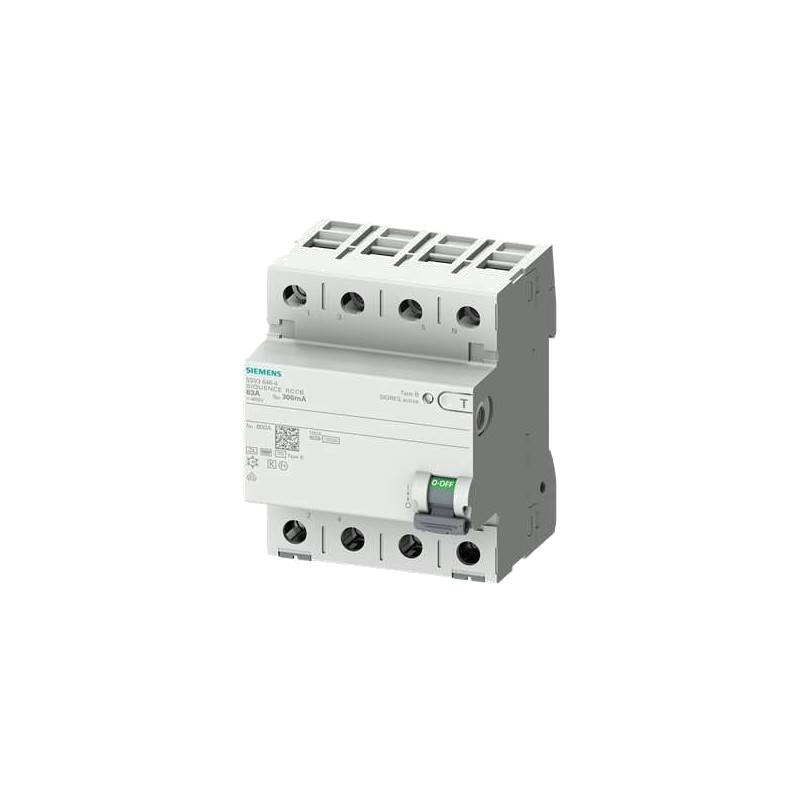
Siemens 5SV3647-8 Miniature Circuit Breaker 4P 80A 300mA


The Siemens 5SV3647-8 Miniature Circuit Breaker 4P 80A 300mA is a high-performance residual current circuit breaker (RCCB) designed for robust protection in demanding industrial and commercial environments. Its key advantages lie in its reliability, advanced safety features, and seamless integration capabilities. This 4-pole, 80A, 300mA device offers superior protection against electrical shocks, fire hazards, and equipment damage, making it a cornerstone for safe and efficient electrical installations. The Siemens 5SV3647-8 embodies Siemens' commitment to safety and innovation, providing peace of mind through its dependable performance.
Product Specifications
| Feature | Specification |
| :---------------------- | :------------------------------------------ |
| Product Type | Miniature Circuit Breaker (Residual Current) |
| Manufacturer | Siemens |
| Series | 5SV3 |
| Pole Configuration | 4-Pole |
| Rated Current (In) | 80A |
| Rated Residual Current | 300mA |
| Rated Voltage (Ue) | 400V AC |
| Breaking Capacity (Icn) | 10kA |
| Frequency | 50/60 Hz |
| Tripping Type | Type AC |
| Protection Class | IP20 (Terminals), IP40 (Enclosure) |
| Terminal Type | Tunnel terminals |
| Mounting Type | DIN rail |
| Ambient Temperature | -25°C to +45°C |
| Standards Compliance | IEC/EN 61008-1 |
Core Features & Market Positioning
The Siemens 5SV3647-8 distinguishes itself through its robust construction and adherence to stringent international safety standards, including IEC/EN 61008-1. Its Type AC tripping characteristic ensures effective detection of sinusoidal alternating residual currents, a common fault type in many industrial applications. The 10kA breaking capacity provides substantial protection against short circuits, preventing catastrophic failures and safeguarding downstream equipment. Positioned as a reliable and durable solution, this 80A, 4-pole RCCB is favored for its ability to handle high current loads while maintaining sensitive residual current detection. Its market presence is built on Siemens' reputation for quality and long-term operational performance in electrical protection systems.
Key Application Scenarios
This 4-pole, 80A, 300mA circuit breaker is exceptionally well-suited for protecting main distribution boards in commercial buildings, industrial facilities, and workshops. It is particularly valuable in areas with high power consumption where the risk of earth faults or insulation failures is present, such as in manufacturing plants with extensive machinery. The 300mA sensitivity makes it ideal for fire protection purposes in residential and commercial applications, as specified by certain electrical codes. Furthermore, its 4-pole configuration is essential for protecting three-phase loads, ensuring complete isolation and protection across all live conductors and the neutral.
Practical System Integration Guidance
Integrating the Siemens 5SV3647-8 into existing electrical systems is straightforward due to its standard DIN rail mounting and tunnel terminal design. The unit accommodates solid and stranded conductors with a specific cross-sectional area, typically ranging from 2.5 mm² to 35 mm² for the main terminals, facilitating secure and reliable connections. Proper wiring is crucial: the line and neutral conductors must be connected according to the markings on the device to ensure correct functionality. For three-phase systems, each phase conductor and the neutral conductor should be connected to the corresponding poles of the 4-pole breaker. Always ensure the main power supply is de-energized before commencing any installation or wiring work.
Operation and Risk Mitigation
The Siemens 5SV3647-8 operates by continuously monitoring the current balance between the live and neutral conductors. If an imbalance greater than 300mA occurs, indicating current leakage to earth, the breaker trips instantly, disconnecting the power supply. This rapid response is critical in mitigating the risk of electric shock to personnel and preventing fires caused by persistent earth faults. While the 5SV3647-8 itself is designed for high reliability, users should perform regular manual trip tests using the integrated test button to verify its operational status. This simple test, typically performed monthly, ensures the tripping mechanism remains functional and effective.
Scalability & Long-Term Value
The Siemens 5SV3647-8 Miniature Circuit Breaker is designed for robust performance and longevity, contributing to the long-term value of an electrical installation. Its compatibility with the broader Siemens SENTRON series allows for seamless integration into complex distribution boards and systems, offering flexibility for future expansions or upgrades. While this specific unit is an RCCB, its inclusion within a system that may also incorporate other Siemens protective devices ensures a cohesive and harmonized approach to electrical safety and management. This interoperability supports the evolution of electrical infrastructure, aligning with trends toward smarter grids and enhanced energy management solutions.
FAQs
What is the primary function of the Siemens 5SV3647-8?
The primary function is to protect electrical circuits and individuals from hazardous situations. It detects residual currents, which are indicative of earth faults or potential electric shocks.
This device provides crucial safety by automatically interrupting the power supply when leakage current exceeds a dangerous threshold. It safeguards against electrocution and reduces the risk of fire ignition caused by electrical faults.
Its application extends to ensuring personnel safety and preventing damage to electrical equipment by quickly disconnecting power during abnormal current conditions.
What type of electrical faults does the Siemens 5SV3647-8 detect?
This specific model, a Type AC RCCB, is designed to detect sinusoidal alternating residual currents. These are commonly generated by faults where current leaks to earth in an alternating fashion.
It is effective against residual currents arising from insulation degradation or direct contact with live conductors, where current finds an unintended path to ground. The 300mA sensitivity is for general safety and fire prevention.
While primarily for AC faults, it's important to note that Type AC devices may not detect all types of pulsating DC residual currents, which require different RCCB types for detection.
How is the Siemens 5SV3647-8 installed in a panelboard?
Installation is typically done by mounting the 4-pole breaker onto a standard 35mm DIN rail within the panelboard. Secure clipping ensures it remains firmly in place.
The tunnel terminals are used for connecting the incoming power supply (line and neutral) and outgoing circuit conductors. Ensure correct polarity and conductor sizing for a safe and effective connection.
Before installation, always ensure the main power supply to the panelboard is completely isolated to prevent electrical hazards during the wiring process.
What does "4P 80A 300mA" signify in the product name?
"4P" indicates that this is a 4-pole circuit breaker, meaning it has four conductive paths for current, suitable for three-phase systems plus a neutral. "80A" is the rated current, specifying the maximum continuous current the breaker can handle without tripping due to overload.
"300mA" refers to the rated residual operating current. This is the fault current level at which the breaker is designed to trip, providing protection against electric shock and fire.
Together, these parameters define its capacity, switching capability, and the sensitivity of its residual current protection.
What are the advantages of using a 4-pole breaker like the 5SV3647-8?
A 4-pole breaker is essential for applications involving three-phase power distribution systems. It ensures simultaneous switching of all three live conductors and the neutral for complete isolation.
This configuration provides comprehensive protection for three-phase equipment, preventing unbalanced loads and ensuring safety during maintenance or fault conditions across all phases. It is also often required by electrical codes for specific industrial setups.
The inclusion of a neutral pole means that when the breaker trips, both the phase conductors and the neutral conductor are disconnected, offering a higher level of safety compared to 2-pole or 3-pole devices for certain applications.
Can the Siemens 5SV3647-8 be used for overload protection?
The primary function of the Siemens 5SV3647-8 is residual current protection, not overload protection. While it has a rated current of 80A which dictates its continuous current handling capacity, it is designed to trip specifically due to earth leakage.
For overcurrent protection (overload and short-circuit), it must be used in conjunction with a miniature circuit breaker (MCB) or a fuse that offers these protective functions. This is a standard practice in electrical installations to ensure all types of faults are covered.
Therefore, this device complements, rather than replaces, standard overcurrent protection devices in a comprehensive electrical safety system.
What standards does the Siemens 5SV3647-8 comply with?
The Siemens 5SV3647-8 Miniature Circuit Breaker complies with international standards, notably IEC/EN 61008-1. This standard governs the requirements for residual current operated circuit-breakers without integral overcurrent protection for household and similar uses.
Compliance with these rigorous standards ensures the device meets specific performance, safety, and reliability criteria. It signifies that the product has undergone extensive testing and certification by accredited bodies.
Adherence to standards like IEC/EN 61008-1 is critical for electrical safety, ensuring that the device provides the intended level of protection against electric shock and fire hazards in various applications.
How do I perform a test on the Siemens 5SV3647-8?
Performing a test on the Siemens 5SV3647-8 is simple and crucial for ensuring its functionality. Locate the "TEST" button, usually a colored button (often blue or yellow) on the front of the device.
With the breaker in the ON position and power supplied to the circuit, press the TEST button. This action simulates a residual current fault and should cause the breaker to trip, disconnecting the power.
If the breaker does not trip when the TEST button is pressed, it indicates a potential fault with the device itself. In such cases, the breaker should be immediately replaced, and the circuit should not be used until a functional unit is installed.
What is the typical ambient temperature range for operation?
The Siemens 5SV3647-8 Miniature Circuit Breaker is designed to operate reliably within an ambient temperature range of -25°C to +45°C. This broad range makes it suitable for various industrial and commercial environments, including those with significant temperature fluctuations.
Operating the device outside this specified temperature range can affect its performance and lifespan. Extreme cold may impact the mechanical components, while excessive heat can affect the tripping characteristics and insulation integrity.
It is important to ensure that the electrical enclosure or room where the breaker is installed maintains an ambient temperature within these limits for optimal safety and longevity.
What does "Type AC" tripping mean for this breaker?
"Type AC" signifies that the Siemens 5SV3647-8 is designed to detect sinusoidal alternating residual currents, which are typical of faults in AC circuits. This is the most common type of residual current detection.
It means the breaker will trip reliably when sinusoidal AC currents leak to earth. However, it may not detect all types of residual currents, specifically pulsating DC or smooth DC leakage currents.
For installations where pulsating DC or smooth DC residual currents might occur (e.g., with certain electronic equipment), a Type A, Type F, or Type B RCCB would be required instead.