











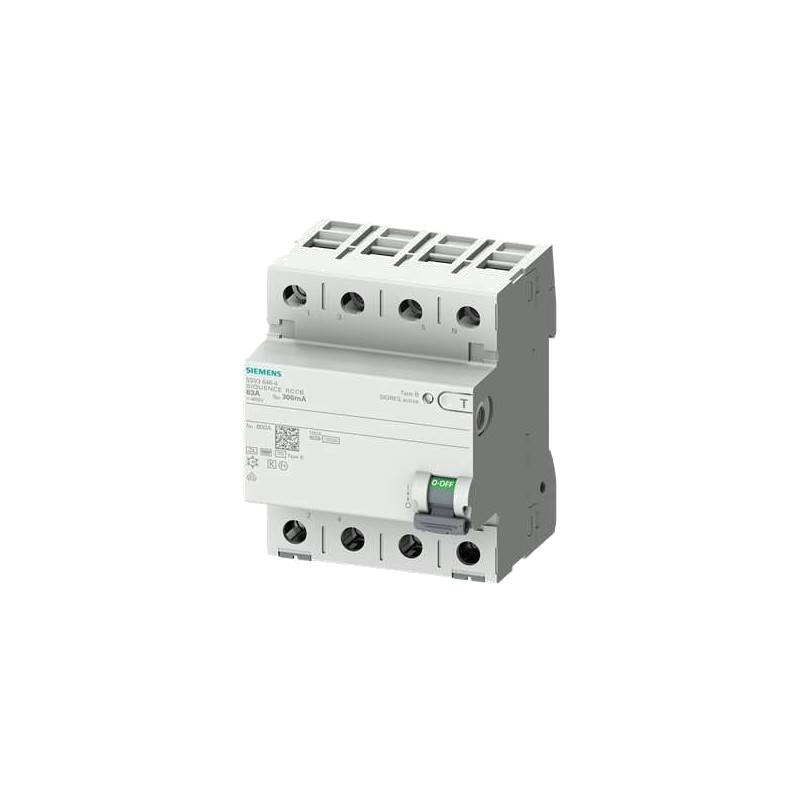
Siemens 5SV4346-0 Residual Current RCBO 4P 63A 30mA


The Siemens 5SV4346-0 Residual Current RCBO is a high-performance, four-pole circuit breaker designed for robust protection in demanding industrial environments. This device seamlessly combines overcurrent and residual current protection, offering a compact and efficient solution for safeguarding electrical installations. Its key advantages lie in its reliable tripping characteristics, enhanced safety features, and straightforward integration into existing power systems. Crucial technical parameters include a 4-pole configuration, a rated current of 63A, and a residual current sensitivity of 30mA, ensuring comprehensive protection against earth faults and short circuits.
Siemens 5SV4346-0 RCBO: Product Specifications
| Feature | Specification |
| :-------------------------- | :---------------------------------------------- |
| Product Type | Residual Current Circuit Breaker with Overcurrent Protection (RCBO) |
| Pole Configuration | 4-Pole |
| Rated Current (In) | 63 A |
| Residual Current (IΔn) | 30 mA |
| Rated Voltage (Un) | 400 V AC |
| Breaking Capacity (Icn) | 6 kA |
| Tripping Characteristic | Type AC (for sinusoidal AC residual currents) |
| Frequency | 50/60 Hz |
| Operating Temperature | -25 °C to +45 °C |
| Protection Class (Device) | IP20 |
| Mounting Type | DIN Rail (35 mm) |
| Standards | IEC/EN 61009-1, IEC/EN 60898-1, IEC/EN 60947-2 |
Core Features & Market Positioning
The Siemens 5SV4346-0 stands out in the market due to its integrated dual protection capabilities, reducing the need for separate residual current devices (RCDs) and miniature circuit breakers (MCBs). This integration not only saves space in electrical panels but also simplifies wiring and installation. The Type AC tripping characteristic is standard for many industrial applications, providing reliable detection of sinusoidal AC residual currents, which are common in equipment with motors and transformers. Its robust construction and adherence to stringent international standards like IEC/EN 61009-1 and IEC/EN 60947-2 underscore its suitability for critical infrastructure where dependable protection is paramount. Siemens' reputation for quality and innovation further solidifies its market position as a trusted provider of electrical safety solutions.
Key Application Scenarios
This 4-pole RCBO is ideally suited for a wide range of industrial and commercial applications requiring robust protection for personnel and equipment. It is frequently deployed in control panels for machinery, power distribution boards in manufacturing plants, and building management systems where multiple circuits require both overcurrent and residual current protection. Specific scenarios include protecting circuits feeding inductive loads, motors, pumps, and heating elements, where the 30mA sensitivity is crucial for preventing electric shock hazards. Its 63A rating makes it suitable for circuits with significant power demands, while the 4-pole design ensures complete isolation of all three phases and the neutral conductor, essential for three-phase systems.
Practical System Integration Guidance
Integrating the Siemens 5SV4346-0 into an electrical system is a straightforward process, facilitated by its standard DIN rail mounting and clearly marked terminals. For a 4-pole installation, ensure that the incoming live conductors (L1, L2, L3) and the neutral conductor (N) are connected to the corresponding line terminals of the RCBO, and the outgoing load conductors are connected to the respective load terminals. Proper grounding of the protected circuit is essential for the residual current protection to function effectively. When wiring, always adhere to local electrical codes and standards, ensuring adequate conductor sizing for the 63A rated current. The breaker's clear labeling simplifies identification and connection, minimizing potential installation errors.
Operation and Risk Mitigation
The Siemens 5SV4346-0 operates by continuously monitoring the balance of current flowing through the live and neutral conductors. If an imbalance is detected, indicating a fault current flowing to earth (e.g., due to insulation failure or contact with an earthed object), the device rapidly trips, disconnecting the power supply. The 30mA sensitivity is a critical safety feature designed to protect human life by tripping before a dangerous current level can cause serious injury. Risk mitigation is inherent in its design; however, regular testing of the residual current function using the integrated test button is recommended to ensure its continued operational integrity. Faults causing nuisance tripping, such as those caused by transient surges or high harmonic content in the supply, may require further investigation into the protected circuit or the use of RCBOs with specific characteristics (e.g., Type A or Type F) if applicable.
Scalability & Long-Term Value
The 5SV4346-0 RCBO offers excellent long-term value and integration capabilities within Siemens' broader electrical systems. Its modular design and adherence to universal mounting standards ensure compatibility with a wide array of Siemens switchgear, distribution boards, and control components. While this specific model provides integrated overcurrent and residual current protection, it can be part of a larger system designed for future expansion. For advanced applications, it can be integrated into smart electrical architectures, potentially working in conjunction with remote monitoring systems or energy management platforms, although direct digital communication capabilities are not a feature of this particular device. Its robust build quality ensures a long operational lifespan, minimizing the need for premature replacement and contributing to the overall reliability of the electrical installation.
Frequently Asked Questions
Q1: What is the primary function of a Siemens 5SV4346-0 RCBO?
The Siemens 5SV4346-0 RCBO provides essential dual protection. It safeguards electrical circuits against dangerous earth fault currents. It also protects against overloads and short circuits.
Q2: Can this RCBO be used for single-phase applications?
While it's a 4-pole device, it can be adapted for single-phase use. In such cases, one pole and the neutral would be used. Ensure correct wiring for safety and functionality.
Q3: What does a 30mA residual current sensitivity mean for safety?
A 30mA sensitivity is crucial for personal protection. It trips quickly when detecting small earth leakages. This rapid response helps prevent severe electric shocks to people.
Q4: How do I test the functionality of the 5SV4346-0 RCBO?
Regular testing is vital for ensuring device reliability. Use the integrated test button. Press it periodically to simulate a fault and confirm tripping.
Q5: Is the Siemens 5SV4346-0 compatible with other brands' components?
It's designed for Siemens systems but often works with others. It adheres to international standards for broad compatibility. Always verify specific interconnections.
Q6: What are the implications of using a Type AC RCBO in an industrial setting?
Type AC RCBOs are suitable for sinusoidal AC residual currents. Most common industrial loads generate this type. For non-sinusoidal currents, other types may be needed.
Q7: How important is proper grounding for the 5SV4346-0 to function correctly?
Effective grounding is absolutely critical. Residual current protection relies on a complete fault path to earth. Without it, the RCBO cannot detect leakage currents properly.
Q8: What is the breaking capacity of the Siemens 5SV4346-0 RCBO?
The breaking capacity is 6 kA. This indicates the maximum fault current it can safely interrupt. It's suitable for many standard industrial distribution networks.
Q9: Can this RCBO protect against indirect contact?
Yes, it is designed to protect against indirect contact. This occurs when a person touches a conductive part that has become live due to a fault. The 30mA trip setting is key here.
Q10: Where is the Siemens 5SV4346-0 typically installed?
This RCBO is commonly installed in electrical distribution boards. It's also found in control cabinets for machinery. It protects circuits in industrial and commercial buildings.