











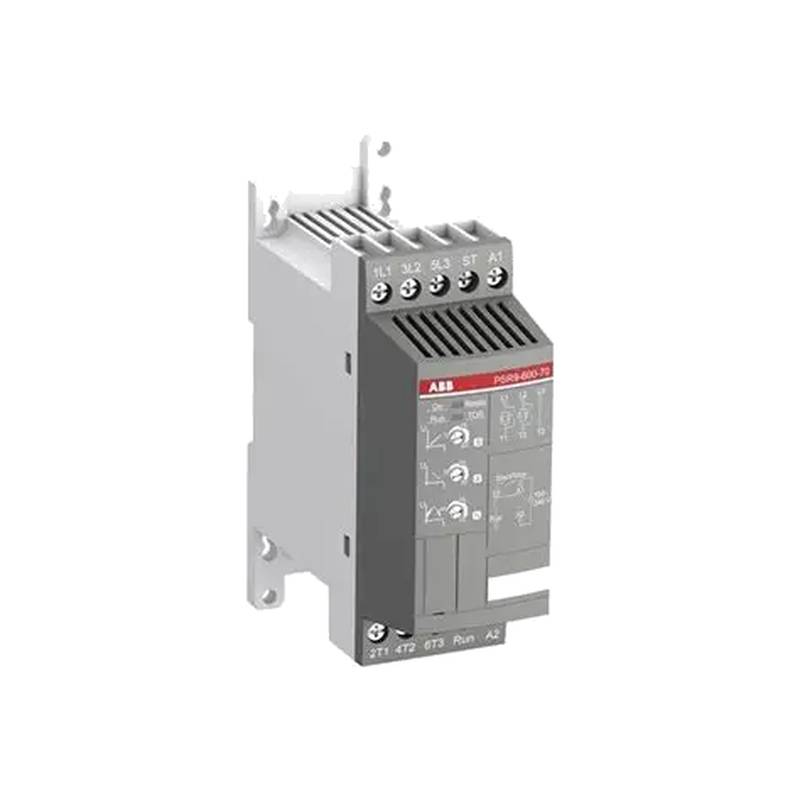
ABB PSR37-600-70 Quick Line Soft Starter 37A


The ABB PSR37-600-70 Quick Line Soft Starter 37A offers a robust solution for motor control, providing smooth acceleration, reduced mechanical stress, and energy savings. This 37A rated device operates on a 600V supply, featuring an integrated bypass for full voltage operation once motor ramp-up is complete. Its core advantages lie in its compact design, ease of use, and sophisticated motor protection capabilities, making it a valuable component for various industrial applications.
Product Specifications
| Feature | Specification |
| :---------------------- | :--------------------------------- |
| Product Series | PSR (Quick Line) |
| Rated Operational Current | 37 A |
| Rated Operational Voltage | 600 V AC |
| Control Voltage | 100-250 V AC |
| Bypass | Integrated |
| Soft Starter Type | Standard |
| Number of Phases | 3 |
| Enclosure Type | IP20 |
| Dimensions (H x W x D) | 186 mm x 45 mm x 160 mm |
| Mounting | DIN rail or direct mounting |
| Overload Protection | Adjustable thermal overload relay |
| Motor Control | Start/Stop |
| Ambient Temperature | -20 to +50 °C |
Core Features & Market Positioning
The ABB PSR37-600-70 distinguishes itself with its "Quick Line" design, emphasizing rapid installation and setup. This focus on ease of integration is a significant market differentiator, appealing to panel builders and maintenance engineers who prioritize efficiency. The integrated bypass function is a key technical advantage, eliminating the need for external bypass contactors and reducing panel space and wiring complexity. This not only simplifies installation but also contributes to energy efficiency by minimizing losses when the motor runs at full speed. The device offers advanced motor protection features, including adjustable overload protection, preventing costly downtime and extending motor lifespan. Its robust build and reliable performance position it as a dependable choice for demanding industrial environments.
Key Application Scenarios
This soft starter is ideally suited for applications requiring controlled motor start-up to minimize mechanical shock and electrical disturbances. Common scenarios include centrifugal pumps, fans, conveyors, and compressors where smooth acceleration is paramount. In water treatment plants, precise control of pump starts prevents water hammer and pipe damage. For fan applications in HVAC systems, gradual ramp-up reduces noise and energy consumption. On production lines, conveyor systems benefit from gentle starts to avoid product damage and maintain throughput. The PSR37-600-70's 37A rating and 600V compatibility make it versatile for medium-sized motors across various manufacturing sectors, from food and beverage to general manufacturing.
Practical System Integration Guidance
Integrating the ABB PSR37-600-70 into an existing system is straightforward due to its user-friendly design. Power connections involve connecting the incoming three-phase power to the line terminals (L1, L2, L3) and the motor leads to the load terminals (T1, T2, T3). Control voltage can be supplied via the dedicated terminals, accommodating a wide range of AC voltages (100-250V). The integrated bypass simplifies wiring; once the soft starter completes its ramp sequence, the bypass contactor within the unit engages, allowing the motor to run directly from the line. For overload protection, the thermal overload relay can be set using an easily accessible dial, typically calibrated based on the motor's full load current (FLC). Basic start/stop control can be implemented using simple pushbuttons or a PLC output connected to the control input terminals.
Operation and Risk Mitigation
Operating the ABB PSR37-600-70 involves setting the desired acceleration time and current limit through simple rotary switches. The soft starter manages the voltage ramp to control the motor's speed during startup. Its integrated motor protection, including thermal overload, actively monitors motor temperature to prevent overheating. Should a fault occur, such as an overload or short circuit, the unit will trip, disconnecting power to the motor. Common troubleshooting involves checking power supply, control signals, and overload settings. For instance, if the motor fails to start, verifying the control voltage and ensuring the start command is present is crucial. Overload trips often indicate an undersized starter for the application, incorrect overload setting, or a mechanical issue with the driven load. Referencing the product manual for specific fault code interpretations is recommended for detailed diagnostics.
Scalability & Long-Term Value
The ABB PSR37-600-70 offers long-term value through its robust construction and compatibility with ABB's broader automation ecosystem. While the PSR series is designed for direct motor control, its integration capabilities extend to PLC-based systems for advanced monitoring and control. This allows for centralized system management and data logging, crucial for IIoT initiatives and predictive maintenance strategies. For applications requiring more sophisticated control profiles, such as specific torque control or advanced diagnostics, ABB offers alternative soft starter series or Variable Frequency Drives (VFDs). However, for standard applications where smooth start-up and reliable protection are key, the PSR37-600-70 provides an excellent balance of performance and cost-effectiveness, representing a sound investment in operational efficiency and equipment longevity.
Frequently Asked Questions (FAQs)
Q1: What is the maximum motor size for the ABB PSR37-600-70?
The ABB PSR37-600-70 is rated for a maximum continuous operational current of 37 Amps. This translates to suitability for a range of motor power ratings depending on the specific voltage and motor efficiency. Typically, this rating is appropriate for motors up to approximately 25 horsepower (HP) or around 18.5 kilowatts (kW) at 600V. Always consult the motor's full load amperage (FLA) to ensure it does not exceed the starter's capacity.
For precise motor sizing, it is essential to consider the motor's design characteristics and the application's duty cycle. The starter's overload protection settings must be correctly adjusted to match the motor's thermal capacity. Over-sizing the motor or under-setting the overload protection can lead to premature tripping or motor damage, respectively. Therefore, verifying the motor's FLA against the starter's specifications is a critical step in the selection process.
Ensuring the motor's service factor and the application's starting torque requirements are within the soft starter's capabilities will guarantee optimal performance and longevity. Accurate matching prevents nuisance tripping and provides the necessary torque for smooth acceleration without excessive current draw.
Q2: Can the ABB PSR37-600-70 be used with single-phase motors?
No, the ABB PSR37-600-70 is specifically designed for three-phase motor applications. It requires a three-phase power supply to operate correctly and control the motor's acceleration. Single-phase motors have different starting characteristics and require specialized starting methods or control devices. Attempting to use this three-phase soft starter with a single-phase motor will result in malfunction and potential damage.
For single-phase motor control requiring soft-start functionality, you would need to source a dedicated single-phase soft starter or a variable speed drive (VFD) that explicitly supports single-phase operation. These devices are engineered to handle the unique electrical demands of single-phase motors. Always verify the product's technical specifications to confirm phase compatibility before installation.
ABB and other manufacturers offer a range of products for single-phase motor control. It is crucial to consult product datasheets and application guides to select the correct device for your specific motor type and operational needs. Using the appropriate equipment ensures safety, efficiency, and optimal performance.
Q3: What is the purpose of the integrated bypass in the ABB PSR37-600-70?
The integrated bypass in the ABB PSR37-600-70 serves to optimize energy efficiency and reduce heat generation once the motor has reached its full speed. During the soft-start phase, the starter controls the motor's voltage to provide smooth acceleration. Once the motor is up to speed, the bypass contactor within the soft starter closes, connecting the motor directly to the full line voltage.
This bypass functionality eliminates the energy losses that would otherwise occur if the motor current continued to pass through the soft starter's power electronics during normal operation. By bypassing the starter, the motor receives full voltage and current without the internal voltage drop and associated heat, leading to significant energy savings and a cooler operating environment. It also extends the lifespan of the soft starter components by reducing their continuous duty.
Furthermore, the integrated bypass simplifies system design and installation by eliminating the need for an external bypass contactor. This reduces wiring complexity, saves panel space, and lowers overall system costs. The starter automatically manages the transition from soft-start to bypass mode, ensuring seamless operation.
Q4: How do I set the overload protection on the ABB PSR37-600-70?
Setting the overload protection on the ABB PSR37-600-70 involves adjusting a rotary dial, typically located on the front of the unit. This dial corresponds to the motor's full load current (FLA) or rated full load amperage (RFLA). The setting should be based on the motor's nameplate information. It is crucial to select a value that accurately reflects the motor's operational current to ensure effective protection.
The specific range and resolution of the overload setting will be indicated on the soft starter itself or in its user manual. For example, a setting of '1' might correspond to 25A, and '10' to 37A, with intermediate values available. It is common practice to set the overload slightly above the motor's nominal FLA to prevent nuisance tripping during normal operation, but well below any level that could cause damage.
Always refer to the ABB PSR37-600-70's official documentation for precise instructions on setting the overload protection. Incorrect settings can lead to inadequate motor protection or premature tripping, affecting operational efficiency and equipment lifespan. If unsure, consult a qualified electrician or ABB technical support.
Q5: What is the typical acceleration time range for this soft starter?
The typical acceleration time range for the ABB PSR37-600-70 is adjustable to provide flexibility for different applications. While the exact range can vary slightly, these soft starters generally allow for acceleration times from as short as 0.5 seconds up to 20 seconds. This adjustable parameter allows users to fine-tune the start-up process to match the inertia of the driven load and minimize mechanical stress.
Selecting the appropriate acceleration time is crucial for effective soft starting. Shorter times may be suitable for loads requiring quick ramp-up, while longer times are beneficial for highly inertial loads or applications where extremely smooth acceleration is desired to prevent shock or vibration. The goal is to achieve full speed without exceeding peak current limits or stressing mechanical components.
It is important to experiment with different settings, starting with longer times and progressively reducing them, to find the optimal balance between smooth starting and reasonable start-up duration. Always consider the motor's starting torque characteristics and the driven equipment's torque requirements when setting the acceleration time.
Q6: What is the control voltage range for the ABB PSR37-600-70?
The ABB PSR37-600-70 supports a wide control voltage range, typically from 100 to 250 Volts AC. This broad compatibility allows the soft starter to be integrated into various electrical systems and controlled by different power sources, including standard mains voltages found in many industrial settings. The control voltage is used to power the internal electronics of the soft starter and to receive start/stop commands.
This flexibility in control voltage simplifies installation and wiring, as it can often be powered from the same control transformer used for other components in the control panel. It also makes the unit suitable for international applications where different standard control voltages might be encountered. Proper connection of the control voltage supply to the designated terminals is essential for the soft starter's operation.
Always confirm the specific control voltage requirements and the terminal designations in the ABB PSR37-600-70 user manual to ensure correct wiring and prevent damage. Using the incorrect control voltage can lead to the unit failing to operate or internal component failure.
Q7: Does the ABB PSR37-600-70 offer motor protection beyond overload?
Yes, the ABB PSR37-600-70 offers motor protection beyond basic thermal overload. It typically includes features such as phase loss detection and unbalanced phase voltage detection. These protections are critical for preventing severe damage to the motor during operation. For instance, phase loss can cause a three-phase motor to draw excessive current on the remaining phases, leading to overheating and winding damage.
The integrated protections work to ensure the motor operates within safe electrical parameters. If any of these fault conditions are detected, the soft starter will immediately trip and disconnect power to the motor, preventing damage. This comprehensive protection scheme significantly enhances motor reliability and reduces the risk of unplanned downtime and costly repairs.
While it provides robust protection, it's important to note that for highly advanced diagnostics or specific protection needs like jamming detection or earth fault protection, more sophisticated motor protection relays or drives might be required. However, for most standard industrial applications, the PSR37-600-70's built-in protections are highly effective.
Q8: How do I wire the ABB PSR37-600-70 for a simple start/stop application?
For a simple start/stop application, wire the main power supply to the line terminals (L1, L2, L3) and the motor to the load terminals (T1, T2, T3). Connect a control voltage supply (within the 100-250V AC range) to the designated control voltage input terminals. Use a simple switch or push-button connected to the control input terminals to send a start/stop signal to the soft starter.
Ensure the control voltage polarity is correct if applicable, although most AC control inputs are not polarity sensitive. The integrated bypass will automatically engage after the soft start ramp-up is complete, allowing the motor to run at full speed. The overload protection dial should be set according to the motor's full load amperage.
Always consult the wiring diagrams in the ABB PSR37-600-70 user manual to confirm terminal designations and recommended wiring practices. Proper wiring is crucial for safe and reliable operation, preventing damage to the unit and the motor.
Q9: Can I use the ABB PSR37-600-70 for reversing motor rotation?
No, the ABB PSR37-600-70 is not designed for reversing motor rotation. Soft starters like the PSR series are primarily intended for controlling the acceleration and deceleration of motors in one direction. Reversing motor rotation typically requires specific control circuitry, such as reversing contactors, or the use of a Variable Frequency Drive (VFD) that offers reversing capabilities.
To achieve motor reversal with this type of soft starter, you would need to incorporate external reversing contactors and control logic. The soft starter would then be used to control the acceleration of the motor in either the forward or reverse direction, depending on which set of contactors is energized. This adds significant complexity to the control system.
For applications requiring frequent or integrated motor reversal, it is highly recommended to consider a Variable Frequency Drive (VFD). VFDs offer seamless speed control, reversing capabilities, and often more advanced protection and diagnostics, simplifying the overall system design.
Q10: What are the dimensions of the ABB PSR37-600-70, and how is it mounted?
The ABB PSR37-600-70 has compact dimensions, typically measuring around 186mm in height, 45mm in width, and 160mm in depth. These relatively small dimensions make it suitable for installation in space-constrained control panels. Its narrow form factor is a key aspect of its "Quick Line" designation, facilitating efficient panel layout.
Mounting options for the PSR37-600-70 are versatile. It is designed for easy installation on a standard 35mm DIN rail, which is a common mounting standard in industrial control panels. Alternatively, it can be mounted directly onto a flat surface using screws, providing flexibility depending on the panel design and accessibility requirements.
Ensure that the mounting location provides adequate ventilation, as the unit generates some heat during operation, especially during the soft-start phase. Refer to the product manual for specific mounting clearances and environmental considerations to guarantee optimal performance and longevity.