











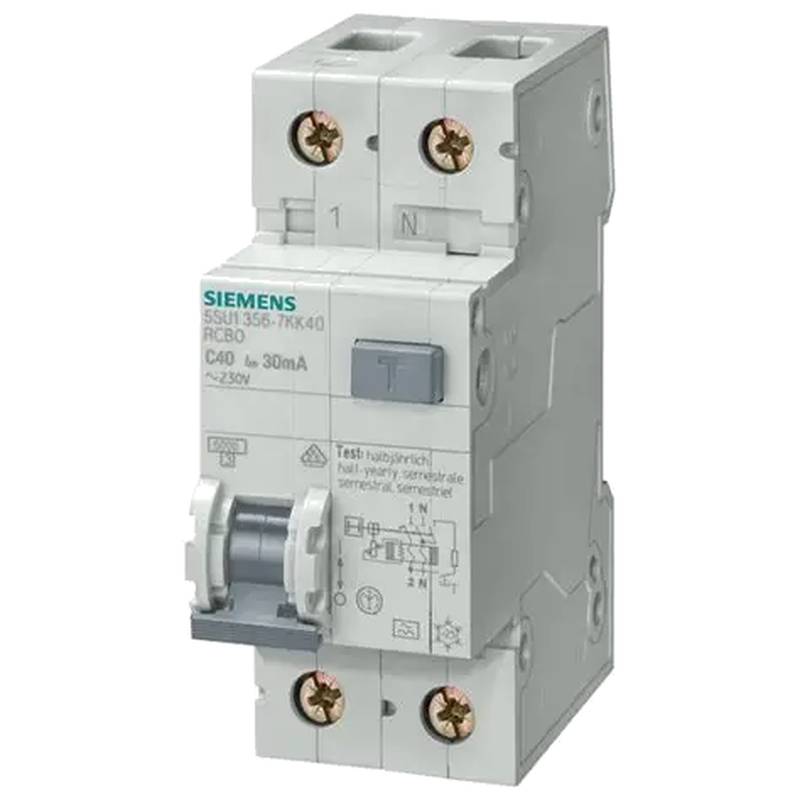
Siemens 5SU9326-1CN63 Electrical Safety Protection Device 63A 30mA 2P C


The Siemens 5SU9326-1CN63 is a sophisticated 63A, 30mA, 2-pole Residual Current Device (RCD) designed for robust electrical safety protection in demanding industrial and commercial environments. This device excels in preventing electrical shock hazards and mitigating fire risks by swiftly detecting and interrupting earth leakage currents. Its C-curve tripping characteristic ensures reliable operation in circuits with moderate inrush currents, common in motor control applications. The 5SU9326-1CN63 offers advanced protection with a rated residual operating current of 30mA, providing a high level of safety for personnel. It operates across a wide temperature range, ensuring consistent performance in various conditions.
| Feature | Specification |
| :---------------------- | :-------------------------- |
| Product Type | Residual Current Device (RCD) |
| Model Number | 5SU9326-1CN63 |
| Rated Current (In) | 63 A |
| Rated Residual Operating Current (IΔn) | 30 mA |
| Number of Poles | 2-Pole |
| Tripping Characteristic | Type C |
| Rated Voltage (Ue) | 230/400 V |
| Frequency | 50/60 Hz |
| Breaking Capacity (Icn) | 10 kA |
| Degree of Protection | IP20 |
| Operating Temperature | -25 to +45 °C |
The Siemens 5SU9326-1CN63 distinguishes itself through its reliable tripping mechanism and robust construction, typical of Siemens' commitment to industrial-grade electrical components. Its Type C characteristic makes it particularly suitable for applications where inductive loads, such as motors and transformers, are prevalent. This capability differentiates it from RCDs with Type B or Type A characteristics, which might trip erroneously due to temporary inrush currents. The device's 10kA breaking capacity ensures it can safely interrupt fault currents, preventing further damage to the electrical system and connected equipment. This positions the 5SU9326-1CN63 as a superior choice for critical infrastructure and high-demand industrial settings where operational continuity and safety are paramount.
Key application scenarios for the Siemens 5SU9326-1CN63 include protecting personnel and equipment in manufacturing plants, industrial control panels, and commercial buildings. It is ideally suited for circuits supplying machinery, pumps, and other inductive loads that exhibit moderate inrush currents, thanks to its Type C tripping characteristic. The 30mA sensitivity is crucial for applications requiring enhanced protection against electric shock, such as in areas with increased risk of contact with live parts or in environments where water ingress might be a concern. Its 2-pole design makes it suitable for single-phase circuits, commonly found in control systems and smaller industrial machinery.
Practical system integration of the Siemens 5SU9326-1CN63 involves straightforward DIN rail mounting within standard electrical enclosures. The device features clear terminal markings for incoming and outgoing power connections, ensuring correct wiring. For a 2-pole device, the live (L) and neutral (N) conductors must be connected to the designated terminals to ensure proper RCD functionality. It is essential to verify that the upstream circuit breaker or fuse provides adequate overcurrent protection for the RCD itself, aligning with its 63A rating and 10kA breaking capacity. Proper grounding of the protected circuits is also fundamental for the RCD to effectively detect earth leakage faults.
Operation and risk mitigation with the Siemens 5SU9326-1CN63 prioritize safety and reliability. Regular testing of the RCD using its integrated test button is crucial to ensure the tripping mechanism remains functional. This testing should be performed periodically, as per local electrical codes and safety regulations. In the event of a trip, identifying the cause of the earth leakage is paramount before resetting the device. Common causes include insulation degradation, faulty wiring, or equipment malfunction. Persistent tripping indicates a fault that requires professional diagnosis and repair to prevent electrical hazards and potential fires.
Scalability and long-term value are inherent in the Siemens 5SU9326-1CN63's design, fitting seamlessly into Siemens' broader industrial electrical ecosystems. Compatibility with other Siemens circuit protection devices, such as miniature circuit breakers (MCBs) and surge protective devices (SPDs), allows for the creation of comprehensive and layered protection schemes. While the 5SU9326-1CN63 itself is not directly upgradeable in terms of core functionality, its robust performance and durability ensure a long service life. Integration with modern IIoT platforms is typically achieved through external monitoring modules or by incorporating it into smart electrical panels that offer remote status indication and data logging capabilities, enhancing predictive maintenance and operational efficiency.
Frequently Asked Questions
What is the primary function of the Siemens 5SU9326-1CN63?
It serves as a residual current device (RCD) to protect against electric shock.
This device swiftly interrupts circuits when it detects dangerous earth leakage currents.
Its main goal is to enhance electrical safety and prevent electrocution hazards.
Can the Siemens 5SU9326-1CN63 be used for single-phase and three-phase applications?
No, this specific model is a 2-pole device designed for single-phase circuits.
It is intended for applications where both live and neutral conductors need to be switched.
For three-phase applications, a different configuration or multi-pole RCD would be required.
What does the "C" in 5SU9326-1CN63 signify regarding its tripping characteristic?
The "C" denotes a Type C tripping curve, suitable for loads with moderate inrush currents.
This characteristic allows for higher temporary currents without causing nuisance tripping.
Examples include motor starters and transformer-connected equipment.
What is the significance of the 30mA residual operating current?
A 30mA rating indicates a high level of sensitivity for personal protection against electric shock.
This level is generally considered the threshold for preventing serious injury to humans.
It ensures rapid disconnection upon detecting dangerous leakage paths to earth.
How does the 63A current rating affect its application?
The 63A rating specifies the maximum continuous current the device can safely handle.
It must be selected based on the load current of the protected circuit.
Ensure upstream overcurrent protection is appropriately rated for this 63A device.
Is the Siemens 5SU9326-1CN63 suitable for outdoor installations?
No, this device has an IP20 degree of protection, meaning it's for indoor use.
Outdoor installations require enclosures with higher IP ratings to protect against environmental factors.
Consult the product manual for specific environmental limitations and protection ratings.
What is the breaking capacity of this RCD?
The Siemens 5SU9326-1CN63 has a breaking capacity of 10 kA.
This means it can safely interrupt fault currents up to 10,000 Amperes without damage.
This high breaking capacity is essential for industrial environments with significant fault potential.
How often should the test button on the 5SU9326-1CN63 be used?
Regular testing is recommended, typically monthly, to ensure functionality.
Pressing the test button simulates an earth fault to verify the tripping mechanism.
Refer to local electrical codes and manufacturer guidelines for exact testing intervals.
What are the main advantages of using a Siemens RCD like the 5SU9326-1CN63?
It offers high reliability and safety, critical for industrial applications.
Siemens products are known for their robust construction and long service life.
The Type C characteristic provides enhanced compatibility with inductive loads.
Can this RCD be integrated with smart home or IIoT systems?
Direct integration might require additional accessories or smart panel solutions.
It can be part of a system monitored by external devices for status and tripping.
This allows for remote diagnostics and predictive maintenance in industrial settings.