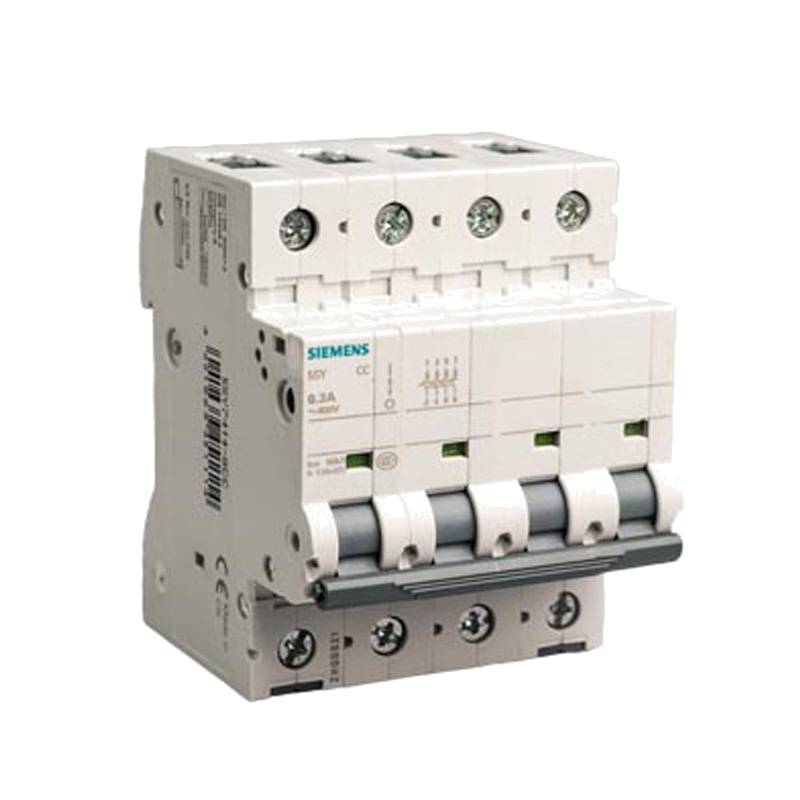
Siemens 5SY6425-8CC High Power Equipment Motor Protection Breaker 4P 25A


The Siemens 5SY6425-8CC is a robust 4-pole, 25A motor protection circuit breaker designed for demanding industrial applications. This device offers reliable protection against overcurrents and short circuits, ensuring the longevity and safe operation of electric motors and associated equipment. Its key advantages lie in its high breaking capacity, precise tripping characteristics, and straightforward integration into existing electrical systems. The 5SY6425-8CC is engineered to meet stringent industrial standards, providing a critical layer of safety and operational continuity.
Product Specifications
| Feature | Specification |
| :--------------------------- | :-------------------------------------------------- |
| Product Number | 5SY6425-8CC |
| Poles | 4 |
| Rated Current (Inom) | 25A |
| Breking Capacit (IEC) | 6 kA (EN 60898), 15 of the IEC 60947-2, DC) |
| Tripping Characteristic | D-Curve (High inrush current capability) |
| Rated Voltage (AC) | 400V |
| Rated Voltage (DC) | 60V (rated value), max. 72V |
| Insulation Voltage (Ui) | 440V |
| Frequency | 50/60 Hz |
| Mechanical Service Life | 10,000 operating cycles (typical) |
| Ambient Temperature Influence| Max. 95% RH up to 55°C |
| Protection Class | IP20 (with connected conductors) |
| Dimensions (H x W x D) | 90 mm x 72 mm x 83 mm |
| Connectable Conductor Cross-Section (Solid) | Min. 0.75 mm², Max. 35 mm² |
| Connectable Conductor Cross-Section (Stranded) | Min. 0.75 mm², Max. 35 mm² |
| Tightening Torque (Screw Terminals) | Min. 2.5 N·m, Max. 3.5 N·m |
| Country of Origin | Germany |
Core Features & Market Positioning
The Siemens 5SY6425-8CC stands out in the industrial circuit breaker market due to its specific design focus on motor protection. Its D-curve tripping characteristic is particularly advantageous for applications involving motors with high starting currents, preventing nuisance tripping while ensuring robust protection against short circuits. This differentiates it from standard B or C curve breakers, positioning it as a specialized solution for motor control centers and industrial machinery. The breaker's high breaking capacity (6kA to 15kA depending on the standard) ensures safety even in fault conditions with significant prospective short-circuit currents. Manufactured in Germany, it embodies Siemens' reputation for quality, reliability, and precision engineering, making it a trusted component in critical industrial infrastructure.
Key Application Scenarios
The Siemens 5SY6425-8CC finds its primary applications in protecting electric motors across various industrial sectors. This includes its use in manufacturing plants for motor control circuits, pump stations for water and wastewater management, HVAC systems in commercial buildings, and machine tools in the automotive and aerospace industries. Its four-pole design is ideal for three-phase motor applications where reliable protection for all three phases and the neutral conductor is required. The 25A rating makes it suitable for medium-sized motors that demand robust overcurrent and short-circuit protection without excessive tripping during startup. Industries requiring high operational continuity and minimal downtime benefit significantly from the dependable protection offered by this Siemens circuit breaker.
Practical System Integration Guidance
Integrating the Siemens 5SY6425-8CC into existing electrical panels is straightforward, thanks to its standard DIN rail mounting and familiar terminal layout. Installers must ensure the breaker is properly secured to the DIN rail and that all conductor connections are made securely using the specified tightening torque range of 2.5 to 3.5 N·m. The screw terminals accommodate a wide range of conductor sizes, from 0.75 mm² to 35 mm² for both solid and stranded wires, simplifying wiring. For optimal performance and safety, it is crucial to connect the supply power to the top terminals and the load (motor) to the bottom terminals. Ensure compliance with local electrical codes and standards during installation.
Operation and Risk Mitigation
The Siemens 5SY6425-8CC operates automatically, providing protection without manual intervention after installation. Its primary function is to interrupt the circuit when the current exceeds a safe level, either due to an overload or a short circuit. Users should understand that the D-curve tripping characteristic is designed for high inrush currents; however, persistent overloads will still trigger the breaker. Regular visual inspection of the breaker and its connections for signs of damage or overheating is recommended. In the event of a trip, a systematic troubleshooting process should be followed: first, identify the cause of the trip (e.g., motor fault, wiring issue, or external load problem), then address the root cause before resetting the breaker. Avoid repeatedly resetting a tripped breaker without resolving the underlying issue, as this could lead to equipment damage or safety hazards.
Scalability & Long-Term Value
While the Siemens 5SY6425-8CC itself is a fixed-component, its value lies in its robust protection and compatibility within the broader Siemens ecosystem. It integrates seamlessly with other Siemens components, such as contactors, overload relays, and motor control centers, forming a cohesive and reliable motor control solution. Although the specific model 5SY6425-8CC is noted as being at the end of its product lifecycle with a successor available (5SY4425-8), this indicates a pathway for future upgrades and continued support within Siemens' product lines. For businesses looking to enhance their systems with digital capabilities, Siemens offers solutions like the SIMATIC IOT gateways, which can interface with circuit breakers and other control devices to collect operational data for IIoT platforms like Insights Hub. This facilitates predictive maintenance, performance monitoring, and integration into Industry 4.0 initiatives, maximizing the long-term value of the installed electrical infrastructure.
Frequently Asked Questions
Q1: What is the main purpose of the Siemens 5SY6425-8CC circuit breaker?
The Siemens 5SY6425-8CC is primarily designed for motor protection. It safeguards electric motors against damage caused by overcurrents and short circuits. Its specific D-curve characteristic allows for high inrush currents during motor startup.
This specialized protection ensures operational continuity and prevents premature failure of motor windings. It's a critical component in industrial electrical systems.
The breaker acts as an automatic safety device, interrupting power flow when fault conditions are detected. This minimizes downtime and repair costs.
Q2: What does the "D" in the tripping characteristic "D25A" signify?
The "D" in D25A refers to the tripping characteristic of the circuit breaker. A D-curve breaker is designed to handle high inrush currents, typically encountered when starting motors. It has a higher trip point for transient currents compared to standard B or C curve breakers.
This characteristic prevents the breaker from tripping unnecessarily during the brief, high-current surge that occurs when a motor starts. It allows the motor to reach its operating speed before the breaker engages for sustained overloads.
Therefore, the D-curve makes the 5SY6425-8CC ideal for motor protection applications where frequent starts or high starting torques are common.
Q3: Can this breaker be used for DC applications?
Yes, the Siemens 5SY6425-8CC can be used for DC applications, with a specified rated voltage of 60V DC and a maximum operating voltage of 72V DC. Its DC breaking capacity is rated at 15 kA according to IEC 60947-2.
However, it is crucial to ensure that the DC voltage in your application does not exceed these limits. Using it beyond its specified DC voltage rating can lead to failure and safety hazards.
Always verify the system voltage against the breaker's specifications before connecting it in a DC circuit.
Q4: What is the breaking capacity of the Siemens 5SY6425-8CC?
The breaking capacity varies depending on the standard applied. According to EN 60898, the breaking capacity is 6 kA. However, under the more stringent IEC 60947-2 standard, its breaking capacity is 15 kA, both for AC and DC applications.
This higher breaking capacity (15 kA) ensures the breaker can safely interrupt fault currents in systems with higher prospective short-circuit levels. It provides a superior level of protection in demanding industrial environments.
The IEC 60947-2 rating is particularly relevant for industrial installations where higher fault currents are a concern.
Q5: What is the difference between 5SY6425-8CC and 5SY6425-8?
The "-8CC" designation typically indicates specific features or a variant of the base "-8" model. While the exact differences can be subtle and often related to packaging or specific market versions, the core electrical specifications, such as pole count, current rating, and breaking capacity, are generally aligned.
For the Siemens 5SY6425-8, it is described as a "CIRCUIT BREAKER 400V 6KA, 4-POLE, D, 25A" and is noted as being at the end of its product lifecycle with a successor available. The "-8CC" is a specific article number likely within this product family.
When replacing a device, it is always best to cross-reference the full article numbers and technical datasheets to ensure exact compatibility.
Q6: How do I reset the Siemens 5SY6425-8CC after it trips?
To reset the Siemens 5SY6425-8CC after it has tripped, ensure the fault condition that caused the trip has been identified and resolved. Then, simply move the operating lever back to the "ON" position.
Avoid forcing the lever if it feels jammed. If the breaker trips again immediately, there is still an issue with the circuit or the connected load that needs to be addressed.
Always follow safety protocols and consult an electrician if you are unsure about the cause of the trip or the reset procedure.
Q7: What conductor sizes can be connected to the 5SY6425-8CC?
The Siemens 5SY6425-8CC is designed to accept a wide range of conductor sizes. For both solid and stranded conductors, the minimum connectable cross-section is 0.75 mm², and the maximum is 35 mm².
This versatility in conductor sizing simplifies installation, accommodating various wiring gauges commonly used in industrial applications. Ensure proper stripping and termination for a secure connection.
When using finely stranded conductors, core end processing with ferrules may be required, with a maximum cross-section of 25 mm² for such cases.
Q8: Is this circuit breaker suitable for continuous operation at 25A?
Yes, the Siemens 5SY6425-8CC is rated for continuous operation at 25A. However, its operational current is affected by ambient temperature. For example, at 40°C, the rated operational current is 23.8A; at 50°C, it is 22.55A; and at 55°C, it drops to 21.88A.
It is essential to consider the operating temperature of the environment where the breaker will be installed. Ensure adequate ventilation to keep temperatures within acceptable limits for the rated current.
Adhering to these temperature derating guidelines ensures the breaker functions reliably and safely at its intended current level.
Q9: What is the physical size of the 5SY6425-8CC breaker?
The Siemens 5SY6425-8CC has compact dimensions suitable for standard electrical enclosures. Its height is 90 mm, its width is 72 mm, and its depth is 83 mm.
These dimensions allow for easy integration into distribution boards and control panels, often mounted on a standard 35mm DIN rail. The 4-pole design occupies more width than single or double-pole breakers.
The overall size is typical for a 4-pole circuit breaker with its current and breaking capacity ratings.
Q10: Can the Siemens 5SY6425-8CC be integrated into an IIoT system?
While the 5SY6425-8CC is a conventional circuit breaker, its operational status can be monitored indirectly. Siemens offers SIMATIC IOT gateways that can interface with control cabinets to collect data from devices. These gateways can then transmit data to IIoT platforms like Siemens' Insights Hub.
This integration allows for remote monitoring of breaker trips, operational cycles, and potentially other parameters, enabling predictive maintenance and performance analysis. It bridges the gap between traditional electrical infrastructure and digital industrial solutions.
By leveraging such gateway solutions, even older or standard components like the 5SY6425-8CC can contribute valuable data to a smart factory environment.