











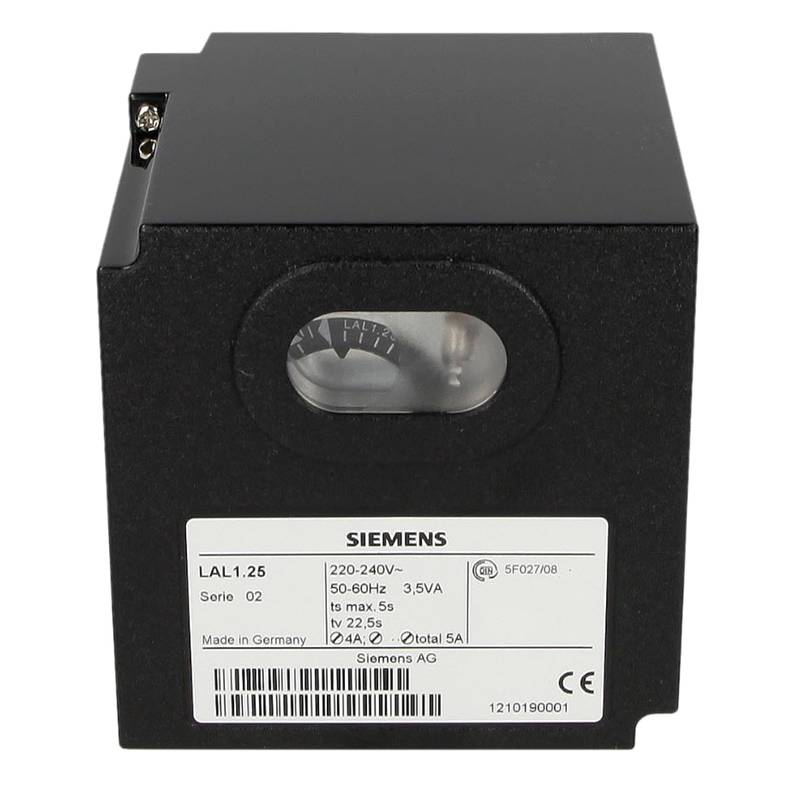
SIEMENS LFL1.122 Program Controller LFL1.122 Gas/Oil Burner


The Siemens LFL1.122 Program Controller is a sophisticated control unit designed for the precise management of gas and oil burners across a wide spectrum of industrial applications. This controller offers exceptional reliability and advanced functionality, making it a cornerstone for efficient and safe combustion processes. Key advantages include its robust design for demanding environments, advanced diagnostics for reduced downtime, and seamless integration into larger automation systems. Core features encompass a multi-stage burner control sequence, integrated safety monitoring, and flexible programming options to adapt to diverse burner types and fuel sources. Technical parameters highlight its universal power supply compatibility (100-240V AC) and a wide operating temperature range, ensuring consistent performance under various conditions.
Siemens LFL1.122 Program Controller: Technical Specifications
| Feature | Specification |
| :--------------------- | :----------------------------------------------------- |
| Product Type | Program Controller |
| Fuel Type Compatibility | Gas / Oil Burners |
| Power Supply | 100-240V AC |
| Operating Temperature | -20 to +60 °C (-4 to +140 °F) |
| Dimensions (W x H x D) | 144 x 144 x 195 mm (approx.) |
| Protection Class | IP40 (enclosure), IP20 (terminals) |
| Safety Functions | Flame monitoring, over-temperature protection |
| Control Sequence | Multi-stage burner control |
| Programming Interface | PC software (e.g., LFL Software) |
| Certifications | CE, UL, CSA |
Core Features & Market Positioning
The Siemens LFL1.122 distinguishes itself in the industrial burner control market through its unparalleled integration capabilities and robust safety features. It is engineered to provide multi-stage control for both gas and oil burners, enabling optimized combustion efficiency and fuel savings. Its market positioning is firmly established as a premium, reliable solution for applications where consistent performance and adherence to stringent safety regulations are paramount. The controller's advanced diagnostic capabilities, including detailed fault reporting, significantly reduce troubleshooting time and operational interruptions, a critical factor in high-demand industrial settings. Furthermore, its compatibility with various flame detection technologies, such as UV sensors and ionization probes, offers flexibility in system design.
Key Application Scenarios
The versatility of the Siemens LFL1.122 Program Controller makes it an ideal choice for a broad array of industrial heating applications. It is extensively used in the control of industrial boilers, process heaters, and thermal oxidizers, where precise regulation of fuel-air mixture is crucial for efficiency and emission control. Key application scenarios also include its deployment in large commercial heating systems, incinerators, and specialized drying equipment. Users frequently seek this controller for applications requiring multi-stage burner operation, such as those found in power generation facilities and large manufacturing plants that utilize thermal processes for their operations. Its robust design also lends itself to use in environments with fluctuating fuel quality or demanding startup/shutdown cycles.
Practical System Integration Guidance
Integrating the Siemens LFL1.122 into an industrial control system requires careful attention to wiring and configuration. Proper installation involves securing the unit within an appropriate enclosure, ensuring adequate ventilation to maintain optimal operating temperatures. The controller utilizes standardized terminal blocks for external connections, accommodating power supply, burner ignition, fuel valves, safety interlocks, and flame detection signals. Commissioning typically involves using dedicated Siemens software, such as the LFL Software suite, to program the burner sequence, establish safety limits, and define operating parameters specific to the burner and fuel type. It is essential to follow the manufacturer's wiring diagrams meticulously and to perform a thorough pre-startup checklist to verify all connections and safety circuits are correctly established.
Operation and Risk Mitigation
Safe and efficient operation of the Siemens LFL1.122 Program Controller hinges on understanding its operational sequences and potential fault conditions. The controller manages a programmed sequence of events, from pre-purge and ignition to main flame establishment and post-purge, all while continuously monitoring safety parameters. Risk mitigation is achieved through its inherent safety interlocks, flame monitoring functions, and built-in diagnostic error codes. In the event of a fault, the LFL1.122 will initiate a safe shutdown procedure and indicate the specific error code on its display or through connected signaling devices. Common troubleshooting involves verifying fuel supply, ignition system functionality, and the integrity of flame detection circuits. Regular maintenance and adherence to operational guidelines are critical to preventing operational risks and ensuring continuous, safe performance.
Scalability & Long-Term Value
The Siemens LFL1.122 Program Controller offers significant long-term value through its scalability and compatibility with modern industrial automation platforms. Its modular design and flexible programming capabilities allow for adaptation to evolving operational requirements or the integration of advanced burner technologies. For facilities looking to upgrade their combustion control systems or embrace digital transformation, the LFL1.122 can serve as a robust foundation. Its compatibility with Siemens' broader industrial control and automation portfolio facilitates seamless integration into SCADA systems, IIoT platforms, and plant-wide distributed control systems (DCS). This ensures that investments in burner control remain relevant and can leverage the benefits of data analytics, remote monitoring, and predictive maintenance for enhanced operational efficiency and reduced lifecycle costs.
Frequently Asked Questions
1. What are the primary applications for the Siemens LFL1.122?
The Siemens LFL1.122 is primarily used for controlling gas and oil burners in industrial settings. It is ideal for boilers, process heaters, and thermal oxidizers requiring precise fuel-air management. This controller ensures safe and efficient combustion across various industrial heating processes.
2. How does the LFL1.122 ensure burner safety?
The LFL1.122 incorporates multiple safety features. It continuously monitors flame presence using various detection methods. Pre-programmed safety sequences ensure proper purging before ignition and safe shutdown if flame is lost or an unsafe condition arises.
3. Can the Siemens LFL1.122 be programmed remotely?
Yes, remote programming is possible with the Siemens LFL1.122. It typically interfaces with dedicated PC software via a suitable connection. This allows for parameter adjustments and sequence modifications without direct physical access to the unit.
4. What type of flame detectors are compatible with the LFL1.122?
The LFL1.122 is compatible with common flame detection technologies. This includes UV flame detectors and ionization flame sensors. The specific choice depends on the burner type and application requirements for reliable flame sensing.
5. What are common error codes for the LFL1.122?
Common error codes often relate to flame failure, ignition problems, or safety interlock issues. Specific codes are detailed in the product manual, guiding technicians to the root cause. Understanding these codes is vital for rapid troubleshooting.
6. Is the LFL1.122 suitable for high-pressure oil burners?
Yes, the LFL1.122 is designed for a range of oil burner types, including those operating at higher pressures. Its robust construction and multi-stage control capabilities support demanding operational parameters. Always verify specific burner requirements against the controller's capabilities.
7. How is the LFL1.122 powered and what are its voltage requirements?
The Siemens LFL1.122 operates on a universal AC power supply. It accepts a wide voltage range, typically from 100 to 240 Volts AC. This broad compatibility simplifies installation across different electrical infrastructures.
8. What is the warranty period for a Siemens LFL1.122?
Warranty periods for industrial equipment like the LFL1.122 can vary by region and vendor. Standard manufacturer warranties typically apply. It is advisable to consult with the specific supplier or Siemens for precise warranty terms and duration.
9. Does the LFL1.122 support Modbus or other industrial communication protocols?
While the LFL1.122's primary interface is for programming and diagnostics, it can be integrated into larger systems that utilize communication protocols. It often interfaces with PLCs or SCADA systems that handle Modbus or other protocols. Direct native support varies.
10. Where can I find the LFL1.122 user manual and technical documentation?
Official Siemens documentation, including user manuals, installation guides, and technical specifications for the LFL1.122, can be found on the Siemens Industry Online Support (SIOS) portal. You can also obtain these from authorized Siemens distributors.