











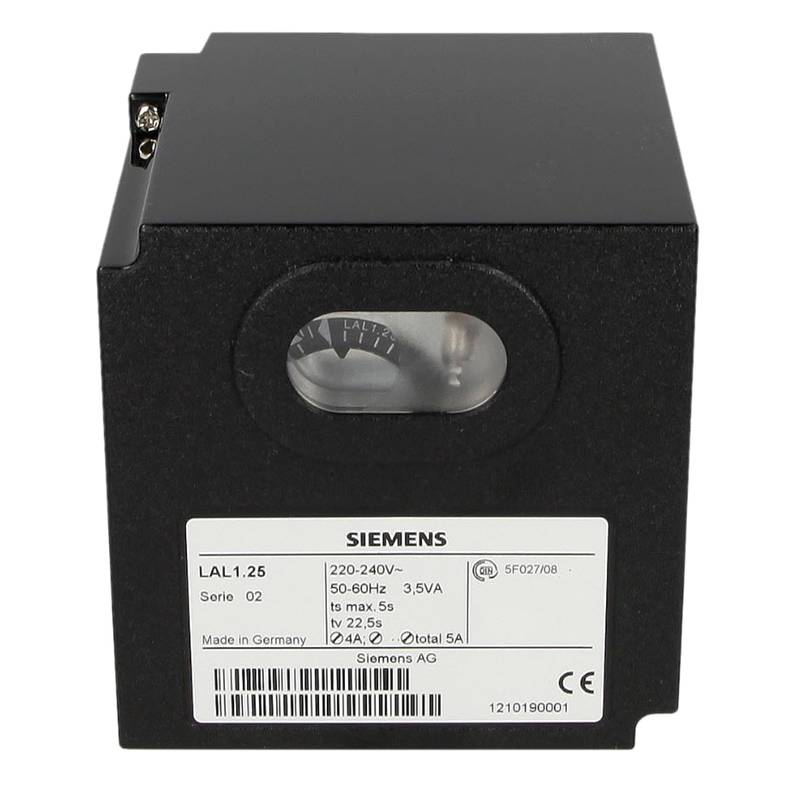
SIEMENS LFL1.333 Burner Safety Control LFL1.333 Gas/Oil


The Siemens LFL1.333 burner safety control is a critical component for industrial combustion systems, ensuring safe and reliable operation of gas and oil burners. This advanced control unit boasts key advantages such as enhanced safety interlocks, flexible application suitability, and robust performance in demanding environments. Its core features include a compact design, high switching capacity, and straightforward integration into existing control architectures. Technically, the LFL1.333 operates with a voltage range of 220-240V AC, a frequency of 50/60 Hz, and offers a wide operating temperature range, making it suitable for diverse industrial settings.
Siemens LFL1.333: Product Specifications
| Specification | Value |
| :---------------------- | :-------------------- |
| Product Type | Burner Safety Control |
| Model | LFL1.333 |
| Fuel Type | Gas / Oil |
| Supply Voltage | 220-240 V AC |
| Frequency | 50/60 Hz |
| Operating Temperature | -20 to +60 °C |
| Protection Class | IP40 |
| Dimensions (W x H x D) | 144 x 144 x 115 mm |
| Certification | CE, UL, CSA |
Core Features & Market Positioning
The Siemens LFL1.333 distinguishes itself through its sophisticated flame monitoring capabilities, employing either a flame rod or UV scanner for reliable detection and immediate shutdown in case of flame failure. Its robust construction and adherence to stringent international safety standards (CE, UL, CSA) position it as a preferred choice for applications where operational integrity and personnel safety are paramount. The unit's modular design also facilitates easier maintenance and component replacement, reducing downtime and operational costs, a significant advantage in the competitive industrial burner control market.
Key Application Scenarios
This burner safety control finds extensive use across a variety of industrial sectors, including power generation, chemical processing, and HVAC systems in large commercial buildings. It is ideal for single-burner applications requiring precise control over the combustion cycle, such as in industrial boilers, furnaces, and process heaters. The LFL1.333 is particularly well-suited for environments where consistent and safe fuel combustion is essential for uninterrupted production or heating processes.
Practical System Integration Guidance
Integrating the Siemens LFL1.333 into a combustion system requires careful attention to wiring and safety interlock configurations. The control unit features clearly labeled terminals for power supply, flame detection, fuel valves, and auxiliary safety devices. Proper grounding and adherence to local electrical codes are crucial during installation. For optimal performance, it is recommended to consult the official Siemens LFL1.333 manual for specific wiring diagrams based on the burner type and associated safety components, such as air proving switches and pressure limit controls.
Operation and Risk Mitigation
Safe operation of the LFL1.333 relies on its internal diagnostic functions and pre-purge/post-purge sequences, which ensure the combustion chamber is cleared of any unburned fuel before ignition and after shutdown. In the event of a fault, the control unit will typically enter a lockout state, indicated by specific LED codes on the device, requiring a manual reset after the fault condition has been rectified. Common troubleshooting involves checking flame signal strength, ensuring proper fuel supply and air flow, and verifying the integrity of all safety interlock circuits.
Scalability & Long-Term Value
While the LFL1.333 is designed as a standalone safety control, its integration into larger SCADA or PLC systems is common through its auxiliary output contacts. These contacts can signal operational status or fault conditions to a central control system. Siemens' commitment to backward compatibility and the availability of replacement parts ensure long-term value and support for systems utilizing the LFL1.333, allowing for seamless upgrades of other system components without necessitating a complete overhaul of the burner safety control.
Frequently Asked Questions
What are the primary safety functions of the Siemens LFL1.333?
The LFL1.333 ensures safe burner operation through automatic pre-ignition purges. It continuously monitors the flame during operation and initiates a lockout if flame is lost. The control also manages post-ignition purges to clear residual fuel.
The LFL1.333 monitors critical parameters like ignition timing and valve sequencing. Its robust design prevents unsafe conditions during startup and shutdown cycles. Adherence to EN 298 standards is a key safety aspect.
This safety control prevents hazardous accumulations of fuel and air within the combustion chamber. It provides essential interlocks for fan operation and fuel valve integrity.
How is flame detection handled by the LFL1.333?
Flame detection is typically achieved using a flame rod for gas burners. For oil burners or when a UV signal is preferred, a UV scanner can be connected. The unit analyzes the signal to confirm flame presence.
The LFL1.333 processes the electrical signal generated by the flame rod or UV scanner. A stable signal indicates a healthy flame. Any deviation triggers a safety shutdown.
It can differentiate between a true flame and nuisance signals. This ensures reliable operation and prevents false trips. The choice of detector depends on the fuel and burner type.
What are the typical voltage and frequency requirements for the LFL1.333?
The Siemens LFL1.333 operates on a standard mains voltage of 220 to 240 Volts AC. This makes it compatible with most industrial power supplies. Ensure your power source is within this specified range.
This burner control unit is designed to function with both 50 Hertz and 60 Hertz power frequencies. This broad compatibility simplifies its application across different global regions. Verify your local frequency.
Incorrect voltage or frequency can damage the unit. Always confirm your electrical supply matches the LFL1.333's specifications before installation. This prevents operational issues.
Can the LFL1.333 be used for both gas and oil burners?
Yes, the LFL1.333 is designed for versatility and supports both gas and oil firing applications. It provides the necessary safety interlocks for managing different fuel types. This dual capability is a key advantage.
The control logic can be configured to suit the specific combustion characteristics of gas or oil. Flame detection methods may vary based on the fuel type chosen. This ensures optimal safety for each application.
When installing, ensure the correct flame detection probe or scanner is used for the intended fuel. Refer to the manual for specific wiring and configuration guidelines for gas vs. oil.
What is the operating temperature range for this burner safety control?
The LFL1.333 is engineered to operate reliably within an ambient temperature range of -20 to +60 degrees Celsius. This wide range allows for deployment in various environmental conditions. It can withstand both cold and moderately hot industrial settings.
This operational temperature capability is crucial for industrial machinery operating in diverse climates. It ensures consistent performance regardless of external ambient temperature fluctuations. Proper ventilation is still advised.
Exceeding the specified temperature limits can lead to reduced performance or premature component failure. It is important to install the unit in an environment that respects these operational boundaries.
What kind of flame monitoring technology does the LFL1.333 support?
The LFL1.333 supports traditional flame rod technology for monitoring gas flames. It also accommodates UV scanners for detecting ultraviolet radiation emitted by flames, common in oil or certain gas applications. This offers flexibility in flame sensing.
The integrated circuitry within the LFL1.333 is designed to interpret the signals from these different flame detection methods. It ensures accurate flame verification and rapid response to flame loss. Proper connection is key.
The choice between a flame rod and UV scanner depends on the specific fuel, burner design, and surrounding environmental conditions. Consult the product documentation for detailed guidance on selecting and connecting the appropriate detector.
What are the typical application areas for the Siemens LFL1.333?
The LFL1.333 is commonly deployed in industrial boilers and furnaces for process heating. It is also found in commercial HVAC systems and applications requiring controlled combustion. Its versatility suits many single-burner setups.
This safety control is integral to power generation facilities, chemical plants, and food processing industries. Anywhere reliable and safe burner operation is essential, the LFL1.333 is a suitable choice. It ensures continuous operation.
Its robust design makes it ideal for demanding environments. It provides a critical safety layer for equipment that relies on consistent combustion for its primary function.
How do I reset the LFL1.333 after a lockout?
To reset the LFL1.333 after a lockout, first identify and rectify the cause of the shutdown. The control typically has a manual reset button on its front panel. Press and hold this button for a few seconds.
Always ensure the fault condition has been cleared before attempting a reset. If the unit immediately re-locks out, there is still an underlying issue that needs attention. Review error codes.
Consult the LFL1.333 operation manual for specific reset procedures, as they may vary slightly depending on the exact fault or configuration. A proper reset sequence is vital for safe restart.
What are the dimensions and protection class of the LFL1.333?
The Siemens LFL1.333 has compact dimensions of 144mm wide, 144mm high, and 115mm deep. This small footprint allows for easy integration into control panels with limited space. Its size is advantageous for panel builders.
This burner safety control features an IP40 protection class. This means it is protected against solid objects greater than 1mm in diameter and offers no protection against water ingress. It's suitable for indoor, protected environments.
Ensure the installation location prevents exposure to dust, moisture, or corrosive elements that exceed IP40 ratings. Proper enclosure is essential for maintaining the device's integrity and lifespan.
Where can I find the official manual for the Siemens LFL1.333?
You can typically find the official Siemens LFL1.333 manual on the Siemens Industry Online Support (SIOS) website. Search for the product number LFL1.333 to access technical documentation, including installation and operating manuals.
Many authorized Siemens distributors also provide access to product manuals upon request or through their online portals. Check with your local supplier if you have an account with them. They are a valuable resource.
Downloading the manual directly from Siemens ensures you have the most up-to-date version. This document contains critical safety information and detailed technical specifications for correct installation and operation.