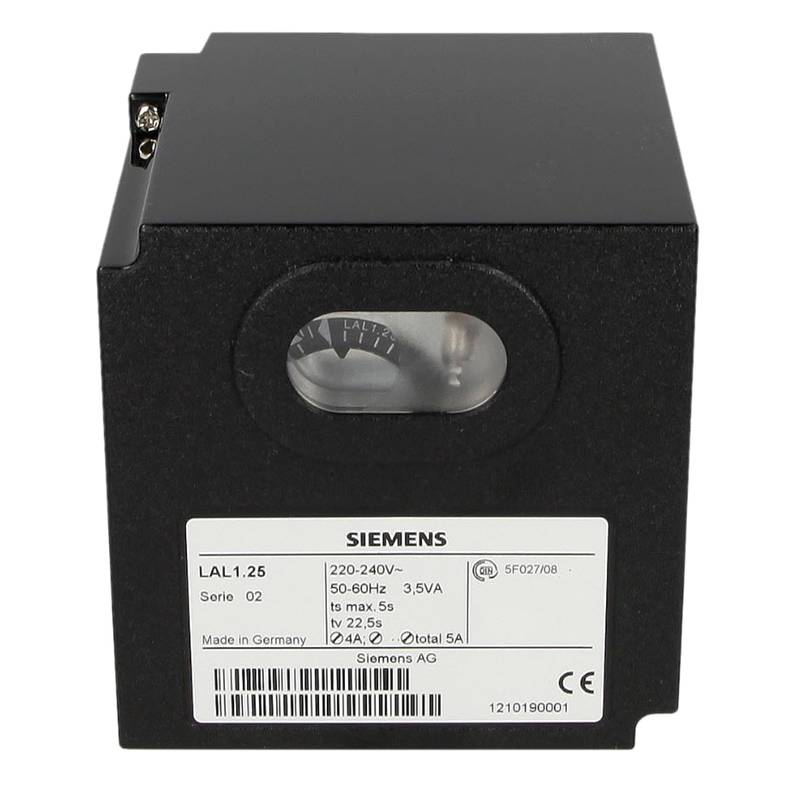
SIEMENS LFL1.333-110V 110V Program Controller LFL1.333


The SIEMENS LFL1.333-110V 110V Program Controller is a robust and reliable solution engineered for precise control in industrial burner management systems. Its key advantages lie in its secure and sequential burner ignition control, comprehensive safety interlocks, and dependable 110V AC operation. Core features include advanced flame monitoring capabilities, a user-friendly interface for parameter adjustment, and robust construction for demanding environments. Technical parameters highlight its 110V AC voltage rating, making it suitable for a wide range of power supply infrastructures. This program controller is designed to ensure safe and efficient operation of industrial combustion processes, offering peace of mind and operational continuity.
Product Specifications
| Specification | Value |
| :------------------------ | :-------------------------- |
| Product Type | Program Controller |
| Manufacturer | SIEMENS |
| Model Number | LFL1.333 |
| Voltage | 110V AC |
| Application | Burner Management Systems |
| Control Type | Sequential Ignition Control |
| Safety Features | Interlocks, Flame Monitoring|
Core Features & Market Positioning
The SIEMENS LFL1.333-110V distinguishes itself through its highly reliable sequential control logic, crucial for safe burner startup and shutdown sequences. Its integrated flame monitoring functions provide immediate detection of flame failure, triggering rapid safety shutdowns to prevent hazardous conditions. This level of inherent safety and operational certainty positions the LFL1.333 as a preferred choice for engineers prioritizing system integrity and compliance with stringent industrial safety standards. Unlike simpler controllers, the LFL1.333 offers a sophisticated yet accessible platform for managing complex combustion processes, reducing the risk of operational failures and associated downtime.
Key Application Scenarios
The SIEMENS LFL1.333-110V program controller is extensively utilized in industrial boiler systems, offering precise control over the ignition and operation of gas and oil burners. It is a critical component in heating furnaces and thermal oxidizers, where ensuring a safe and efficient combustion process is paramount for both operational performance and environmental compliance. Furthermore, its application extends to industrial ovens and kilns, providing reliable control for high-temperature processes requiring meticulous management of fuel-air ratios and ignition sequences. Its 110V AC compatibility facilitates integration into diverse power systems commonly found in these industrial settings.
Practical System Integration Guidance
Integrating the SIEMENS LFL1.333-110V program controller involves careful wiring of its terminal blocks according to the specific burner train and safety interlock requirements. Ensure proper grounding of all components to prevent electrical noise and ensure safety. Pre-commissioning checks should verify correct voltage supply to the LFL1.333 and continuity of all external sensor and actuator circuits. Commissioning typically involves a step-by-step functional test of the entire burner sequence, including flame detection verification, to confirm all safety interlocks are correctly implemented and the controller operates as per design specifications.
Operation and Risk Mitigation
Safe operation of the SIEMENS LFL1.333-110V necessitates adherence to the manufacturer's operating manual, particularly regarding pre-startup checks and sequence programming. Common troubleshooting often involves verifying the integrity of flame detectors, fuel valves, and air dampers, as well as ensuring correct voltage supply. Critical error codes, if indicated on connected diagnostics or through internal fault logging, should be cross-referenced with the LFL1.333 technical documentation to diagnose issues such as flame failure during operation or ignition failure. Regular maintenance, including cleaning of flame sensors and checking electrical connections, is essential for mitigating operational risks.
Scalability & Long-Term Value
While the SIEMENS LFL1.333-110V is a dedicated program controller, its long-term value is enhanced by its robust design and Siemens' established reputation for industrial automation reliability. Integration with modern IIoT platforms can be achieved through supplementary communication modules or by interfacing the controller's status signals with a Programmable Logic Controller (PLC) that is network-enabled. This approach allows for remote monitoring, data logging, and predictive maintenance capabilities, extending the controller's utility beyond basic sequential control and aligning it with Industry 4.0 initiatives. Compatibility with other Siemens industrial components further simplifies system expansion or upgrades.
FAQs
1. What is the primary function of the SIEMENS LFL1.333-110V?
The SIEMENS LFL1.333-110V acts as a critical program controller for industrial burner management systems. It expertly sequences the ignition and operation of burners, ensuring a safe startup and shutdown.
This controller is designed to manage combustion processes, integrating safety interlocks and flame monitoring for operational security. Its primary goal is to prevent hazardous conditions by controlling the burner's fuel and air supply.
By employing precise timing and sequence logic, the LFL1.333 ensures that each step of the burner's operation is completed before proceeding to the next. This prevents issues like unburnt fuel accumulation.
2. How does the SIEMENS LFL1.333-110V ensure burner safety?
The LFL1.333 integrates numerous safety interlocks and a sophisticated flame monitoring system. It continuously checks for the presence of a stable flame during operation.
If flame failure is detected, the controller immediately initiates a safety shutdown sequence, cutting off fuel supply. This rapid response is crucial for preventing explosions or fires.
The controller also manages pre-purge and post-purge cycles, ensuring the burner area is cleared of any combustible gases before ignition and after shutdown.
3. What are the typical applications for the SIEMENS LFL1.333-110V?
This program controller is commonly found in industrial boilers and furnaces where precise burner control is essential. It's vital for maintaining stable high temperatures in kilns and ovens.
Its robust design makes it suitable for applications involving industrial heating systems, thermal oxidizers, and other combustion equipment. It ensures safe and efficient fuel combustion.
The 110V AC operational voltage allows for easy integration into a wide array of industrial power infrastructures commonly used in these sectors.
4. Can the SIEMENS LFL1.333-110V be integrated with modern automation systems?
Yes, the LFL1.333 can be integrated into modern systems, often via a PLC or SCADA interface. This allows for remote monitoring and data acquisition.
External devices can read status signals from the LFL1.333 to provide insights into burner performance and safety parameters. This facilitates IIoT connectivity.
While not inherently networked, its outputs and inputs can be connected to network-enabled controllers, making it part of a larger smart manufacturing ecosystem.
5. What are the main advantages of using the SIEMENS LFL1.333-110V over other controllers?
A key advantage is its proven reliability and Siemens' reputation for robust industrial components. It offers a high degree of operational safety.
The LFL1.333 provides a well-defined, sequential control logic specifically optimized for burner management, simplifying complex ignition sequences. It offers advanced flame detection.
Its straightforward 110V AC operation and durable construction ensure longevity and ease of maintenance in demanding industrial environments.
6. What technical specifications are important for the SIEMENS LFL1.333-110V?
The 110V AC voltage rating is a primary specification, determining its power source compatibility. This is critical for installation.
Its application as a sequential program controller for burner management systems defines its core functionality. It handles ignition and flame supervision.
Key technical features include its safety interlock capabilities and the types of flame sensors it supports, which are vital for operational integrity.
7. How do you troubleshoot common issues with the SIEMENS LFL1.333-110V?
Begin troubleshooting by verifying the 110V AC power supply to the controller and checking all wiring connections for security. Inspect fuses.
Next, examine the status of connected components like flame sensors, ignition transformers, and fuel valves for proper function and fault indicators. Check for error codes.
Consult the LFL1.333 technical manual for specific error code interpretations and recommended corrective actions to address issues like ignition failure or flame loss.
8. What is the typical lifespan of a SIEMENS LFL1.333-110V program controller?
With proper installation, operation, and routine maintenance, the SIEMENS LFL1.333-110V can provide many years of reliable service. Siemens components are built for industrial durability.
Preventative maintenance, such as cleaning flame sensors and checking electrical connections, significantly contributes to extending the controller's operational lifespan. Adherence to guidelines is key.
Environmental factors like extreme temperatures or excessive dust can impact lifespan; therefore, ensuring the controller operates within its specified environmental limits is crucial.
9. Does the SIEMENS LFL1.333-110V require special programming software?
The LFL1.333 utilizes a pre-defined, fixed sequence of operations based on its internal logic. It is not typically programmed via external software for sequence changes.
Parameter adjustments, such as ignition timing or flame detection sensitivity, are usually made directly on the unit or via simple external interfaces, not complex software.
For advanced integration or custom logic, it might interface with a PLC, which would then be programmed, but the LFL1.333 itself is largely configured, not programmed in the traditional software sense.
10. Where can I find the official documentation for the SIEMENS LFL1.333-110V?
Official documentation, including operation manuals and technical data sheets, can be obtained from the Siemens Digital Industries website. Search for the product number.
Your authorized Siemens distributor or sales partner is another reliable source for obtaining the most current and relevant documentation for the LFL1.333-110V.
These resources provide essential details on installation, wiring diagrams, troubleshooting, and safety guidelines for optimal use of the program controller.