











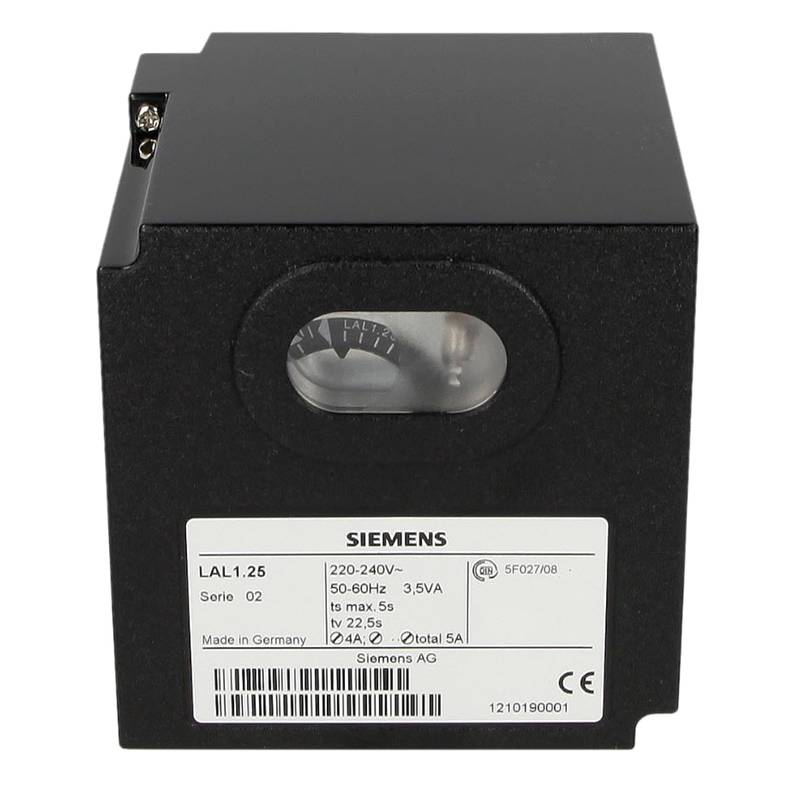
SIEMENS LFL1.622 Burner Control Box LFL1.622 Two-Stage


The SIEMENS LFL1.622 burner control box is a robust, two-stage control system designed for reliable operation of single-burner gas or oil combustion systems. This unit excels in providing essential safety and operational control, boasting a maximum pre-purge time of 45 seconds and a post-purge time of 25 seconds, ensuring efficient and safe burner startup and shutdown sequences. Its integrated flame monitoring capabilities, coupled with a supply voltage tolerance of -15% to +10%, underscore its suitability for demanding industrial environments. The LFL1.622 is engineered for single-phase AC power, operating efficiently within a temperature range of -20 to +60 °C, making it a versatile choice for a wide array of heating applications.
Product Specifications
| Feature | Specification |
| :------------------------ | :--------------------------------------------- |
| Product Type | Burner Control Box |
| Manufacturer | SIEMENS |
| Model Number | LFL1.622 |
| Stages | Two-Stage |
| Burner Type | Single-Burner (Gas or Oil) |
| Max. Pre-Purge Time | 45 seconds |
| Max. Post-Purge Time | 25 seconds |
| Supply Voltage | 220-240 V AC, -15% to +10% |
| Power Consumption | 5 VA |
| Ambient Temperature Range | -20 to +60 °C |
| Protection Class | IP40 |
| Flame Monitoring | Yes (Internal) |
Core Features & Market Positioning
The SIEMENS LFL1.622 distinguishes itself through its inherent reliability and straightforward functionality, positioning it as a dependable solution for standard industrial burner control. Its two-stage operation offers a significant advantage over single-stage controllers, enabling more precise temperature management and improved energy efficiency by allowing for modulated heat output. This capability directly addresses the market need for systems that can adapt to varying heating demands without sacrificing safety or performance. The unit's robust design, including its wide operating temperature range and tolerance for voltage fluctuations, further solidifies its standing as a long-term, low-maintenance component in critical combustion processes. Unlike more complex, proprietary systems, the LFL1.622 offers a more accessible and cost-effective entry point for essential burner control.
Key Application Scenarios
The SIEMENS LFL1.622 burner control box is ideally suited for a multitude of industrial heating applications where consistent and safe burner operation is paramount. It finds extensive use in commercial boiler systems, industrial furnaces, and process heaters across various sectors, including manufacturing, food processing, and building management. Its two-stage capability makes it particularly valuable for applications requiring precise temperature regulation, such as in kilns for ceramics or ovens used in industrial baking. Furthermore, its resilience to fluctuating power supplies and harsh environmental conditions makes it a preferred choice for installations in remote or challenging locations where reliable performance is non-negotiable.
Practical System Integration Guidance
Integrating the SIEMENS LFL1.622 burner control box into existing systems is a streamlined process, primarily involving secure electrical connections to the burner, ignition system, fuel valves, and flame sensor. Proper wiring is critical; the LFL1.622 typically requires connections for line and neutral power, ignition transformer, gas valve (stage 1 and stage 2), oil valve, and the flame detection device (e.g., a UV scanner or flame rod). Ensuring correct polarity and secure connections prevents operational faults and safety hazards. While the LFL1.622 is largely pre-programmed for standard two-stage burner operation, system commissioning involves verifying the timing sequences (pre-purge, post-purge) and ensuring the flame signal strength is within optimal parameters. For specific integration details, consulting the official SIEMENS LFL1.622 installation and operating manual is essential for ensuring correct setup and adherence to safety standards.
Operation and Risk Mitigation
Safe and efficient operation of the SIEMENS LFL1.622 burner control box hinges on understanding its operational sequence and implementing proper risk mitigation strategies. The control box manages the burner's lifecycle, initiating a pre-purge sequence to clear the combustion chamber of any residual fuel before ignition, followed by ignition activation, and then fuel valve opening for stage 1 operation. Upon receiving a demand for increased heat, it activates stage 2. During operation, continuous flame monitoring is performed. If the flame fails to establish or is lost, the control box immediately shuts off fuel to the burner and initiates a post-purge cycle. Critical error codes, often indicated by specific flashing patterns on an associated indicator lamp or within a connected control panel, signal issues such as flame failure, over-temperature, or interlock failures. Regular maintenance, including cleaning of the flame sensor and verification of safety interlocks, is crucial to prevent common troubleshooting issues like nuisance shutdowns or ignition failures. Adherence to manufacturer guidelines for troubleshooting and component replacement is vital for maintaining operational integrity and preventing potential hazards.
Scalability & Long-Term Value
The SIEMENS LFL1.622 burner control box offers inherent long-term value through its robust construction and compatibility with established burner technologies. While not a digital IIoT-ready device out of the box, its reliable electromechanical foundation provides a stable platform for essential combustion control. Its value is amplified when integrated into systems that may include more advanced supervisory controls, where the LFL1.622 acts as a dependable, safety-critical subsystem. For facilities looking to upgrade, the LFL1.622's established presence in the market means readily available replacement parts and a wide pool of technicians familiar with its operation, reducing long-term maintenance costs and minimizing downtime. Its two-stage functionality also offers a level of operational flexibility that supports energy efficiency improvements, contributing to its sustained economic value over the lifespan of the heating equipment.
Frequently Asked Questions
1. What is the primary function of the SIEMENS LFL1.622 burner control box?
The SIEMENS LFL1.622 is a two-stage control unit for single burners, managing ignition, fuel supply, and safety monitoring during operation. It ensures the burner ignites safely and maintains its flame reliably.
It executes pre-purge and post-purge cycles to clear the combustion chamber before and after operation, enhancing safety and efficiency. The control box is designed for gas and oil burners, offering precise two-stage control.
Its core role is to automate and safeguard the combustion process, preventing dangerous conditions like fuel accumulation or flame failure. This makes it a critical component in industrial heating systems.
2. What are the key technical specifications for the SIEMENS LFL1.622?
Key specifications include its two-stage operation, suitable for single-burner gas or oil applications. It features a maximum pre-purge time of 45 seconds and a post-purge time of 25 seconds.
The unit operates on a 220-240V AC supply with a tolerance of -15% to +10%, and consumes approximately 5 VA. It functions reliably within an ambient temperature range of -20 to +60 °C.
Safety is paramount, with integrated flame monitoring and an IP40 protection class, making it suitable for various industrial environments.
3. How does the two-stage operation of the LFL1.622 benefit industrial heating?
Two-stage operation allows for modulated heat output, meaning the burner can operate at a lower capacity for basic heating needs and a higher capacity when more heat is required. This precision improves temperature control and reduces energy waste.
By utilizing two stages, the system avoids frequent on/off cycling that occurs with single-stage burners. This leads to smoother operation, less wear on components, and potentially quieter performance.
This adaptive heating capability is ideal for processes requiring consistent temperatures, enhancing product quality and operational efficiency in applications like ovens or kilns.
4. What types of burners is the SIEMENS LFL1.622 compatible with?
The LFL1.622 is specifically designed for single-burner applications utilizing either gas or oil as fuel. It is engineered to control the complete combustion cycle for these fuel types.
Compatibility extends to burners that require a two-stage flame control sequence, allowing for different firing rates based on demand. This includes many industrial furnaces and boilers.
While compatible with various burner types, users must ensure their specific burner and associated components (like ignition transformers and fuel valves) are rated for use with this control box and its specified voltage.
5. What is the typical installation procedure for the LFL1.622?
Installation involves securely mounting the control box in a suitable location, typically near the burner assembly, ensuring it is protected from excessive dust or moisture. Electrical connections must be made according to the wiring diagram in the manual.
Connections include power supply (line and neutral), ignition transformer, fuel valves (for both stages), and the flame detection device (e.g., UV scanner or flame rod). Proper grounding is essential for safety.
After wiring, the unit must be commissioned. This involves verifying all safety interlocks are functional and the pre-purge and post-purge timings are correctly set to match the burner's requirements.
6. How does the LFL1.622 monitor for flame failure?
The LFL1.622 utilizes a flame detection sensor, such as a UV scanner or a flame rod (for gas burners), to continuously monitor for the presence of a flame during operation. This sensor is wired directly to the control box.
If the control box does not receive a valid flame signal within a specified timeframe after ignition, or if the flame signal is lost during operation, it interprets this as a flame failure.
Upon detecting flame failure, the LFL1.622 immediately cuts off fuel supply to the burner and initiates a post-purge sequence to clear the combustion chamber, ensuring a safe shutdown.
7. What are common troubleshooting issues with the LFL1.622?
Common issues include the burner failing to ignite, or shutting down unexpectedly after ignition. These can often be related to faulty flame detection, incorrect wiring, or issues with the ignition transformer or fuel valves.
Nuisance shutdowns, where the burner stops for no apparent reason, can sometimes stem from weak flame signals, incorrect pre- or post-purge timings, or the operation of safety interlocks that are not properly reset or functioning.
Troubleshooting should always start with checking the electrical connections, verifying the flame signal strength, and consulting the unit's fault codes or indicator light patterns for specific diagnostic information.
8. What safety features are integrated into the LFL1.622?
A primary safety feature is the automatic flame monitoring system, which immediately shuts down fuel if flame is lost. The pre- and post-purge cycles are also critical safety functions to prevent explosions.
The control box incorporates internal safety limits and interlocks. These ensure that the burner operates only when all conditions are met, such as proper airflow and valve operation, and that fuel is cut off if any safety parameter is violated.
It is designed to fail-safe, meaning that in the event of a component failure within the control box or a critical external fault, it will default to a safe state, typically a complete shutdown of the burner.
9. Can the SIEMENS LFL1.622 be used in outdoor applications?
The LFL1.622 has an IP40 protection class, which means it is protected against solid objects larger than 1mm but not against water ingress. Therefore, it is not designed for direct exposure to outdoor weather conditions.
For outdoor installations, the control box must be housed within a suitable enclosure that provides adequate protection against rain, snow, humidity, and extreme temperature fluctuations.
While the unit itself has a broad operating temperature range (-20 to +60 °C), the enclosure must also maintain these conditions and prevent condensation or physical damage from the elements.
10. Where can I find the official manual or technical documentation for the LFL1.622?
Official technical documentation, including installation, operation, and service manuals for the SIEMENS LFL1.622, can typically be found on the SIEMENS Industry Online Support (SIOS) portal.
You may also be able to access these documents through authorized SIEMENS distributors or automation solution providers who specialize in industrial controls and burner management systems.
Always ensure you are downloading the most current version of the manual directly from a reputable source to guarantee accuracy and adherence to the latest safety standards and product revisions.