











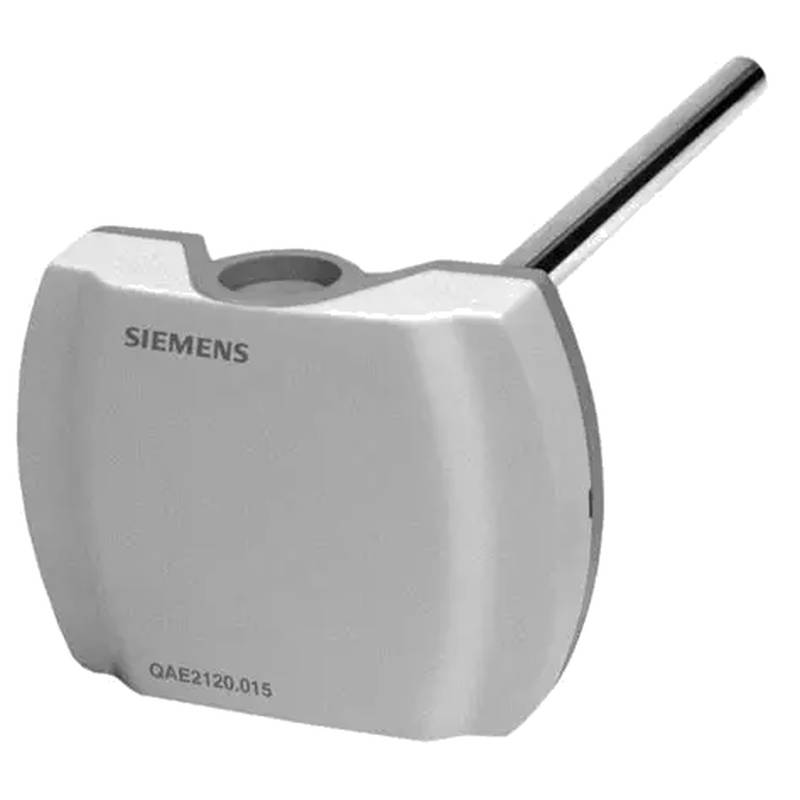
SIEMENS QAE2174.010 Temperature Sensor for Ducts 1.0m HVAC


The SIEMENS QAE2174.010 is a high-precision temperature sensor designed for duct mounting in HVAC systems, offering reliable performance and accurate environmental monitoring. Its key advantages include a robust construction suitable for industrial environments, a wide operating temperature range, and excellent long-term stability. The core features are its NTC 10kΩ sensing element, providing precise temperature readings, and a standard 1.0-meter cable length for flexible installation. Key technical parameters include a measurement range of -30 to +70 °C, an accuracy of ±0.5 K (at 20 °C), and an IP54 protection rating, ensuring durability against dust and splashes.
Product Specifications
| Parameter | Value |
| :------------------------ | :---------------- |
| Product Type | Duct Temperature Sensor |
| Model Number | QAE2174.010 |
| Sensing Element | NTC 10kΩ |
| Measurement Range | -30 to +70 °C |
| Accuracy | ±0.5 K (at 20 °C) |
| Cable Length | 1.0 meter |
| Ingress Protection | IP54 |
| Connection Type | Screw Terminals |
| Housing Material | ABS |
| Mounting Type | Duct Mounting |
Core Features & Market Positioning
The SIEMENS QAE2174.010 distinguishes itself in the HVAC sensor market through its inherent Siemens quality and reliability. Its NTC 10kΩ sensing element is a widely adopted standard, ensuring broad compatibility with various control systems and controllers. The sensor is engineered for straightforward integration into existing HVAC infrastructure, positioning it as a cost-effective yet high-performance solution for building automation. Its IP54 rating offers a significant advantage in applications where dust and moisture ingress are concerns, reducing maintenance requirements and extending operational lifespan compared to less protected sensors.
Key Application Scenarios
This duct temperature sensor is crucial for optimizing energy efficiency and maintaining comfortable indoor environments within commercial and industrial buildings. Its primary applications include supply air and return air temperature monitoring in air handling units (AHUs), enabling precise control of heating and cooling coils. It is also vital for monitoring the temperature of exhaust air streams and for ensuring accurate space temperature control by measuring air temperature in ventilation ducts. The QAE2174.010 is an ideal choice for applications demanding robust performance in demanding environments, such as factories, data centers, and large public facilities.
Practical System Integration Guidance
Integrating the SIEMENS QAE2174.010 into an HVAC control system is a streamlined process. The sensor connects via its 1.0-meter cable to a compatible controller using screw terminals. For optimal performance, it should be installed in a location within the duct that provides a representative air temperature reading, typically away from direct heat sources or drafts. Proper sealing around the sensor’s insertion point is recommended to prevent air leakage. When wiring, ensure compliance with local electrical codes and the specific requirements of the connected controller. The sensor’s NTC 10kΩ characteristic means it typically connects to an analog input configured for this resistance-temperature curve.
Operation and Risk Mitigation
The QAE2174.010 operates by measuring the resistance change of its NTC element, which directly correlates to the air temperature within the duct. This resistance is then converted into a temperature reading by the connected HVAC controller. To mitigate operational risks, it is essential to avoid exposing the sensor to temperatures outside its specified range (-30 to +70 °C), as this can lead to inaccurate readings or permanent damage. Regular visual inspection for physical damage or contamination can prevent performance degradation. Faulty readings are typically addressed by checking the wiring integrity, ensuring proper controller configuration, and verifying the sensor is correctly positioned within the duct.
Scalability & Long-Term Value
As a component within the broader Siemens building automation ecosystem, the QAE2174.010 offers excellent scalability and long-term value. Its standard NTC 10kΩ output ensures compatibility with a wide range of Siemens controllers (e.g., Desigo, Synco) and many third-party building management systems (BMS). This interoperability allows for easy expansion of monitoring capabilities as building needs evolve. The robust construction and reliable performance contribute to a long operational life, reducing the total cost of ownership. Integration into digital platforms and IIoT solutions is facilitated by its standard signal output, enabling advanced data analytics and predictive maintenance strategies.
FAQs
What is the operating temperature range of the SIEMENS QAE2174.010?
The SIEMENS QAE2174.010 is designed to operate within a temperature range of -30 to +70 degrees Celsius. This wide range ensures reliable performance in both extremely cold and moderately hot duct conditions. It is crucial to keep the sensor within these limits for accurate readings.
This specification allows the sensor to be deployed in a variety of HVAC applications, from chillers to heating systems. It provides engineers with flexibility when designing building control strategies. Exceeding these limits can lead to sensor failure or inaccurate data.
Adhering to the specified operating range is vital for maintaining the sensor's longevity and the accuracy of your HVAC control system. Consult the product datasheet for precise operational parameters.
How is the SIEMENS QAE2174.010 installed in an HVAC duct?
Installation involves inserting the sensor probe directly into the HVAC ductwork through a pre-drilled opening. The sensor is then secured in place, often with a mounting flange or by simply ensuring a snug fit within the aperture. It is important to position the sensor where it will get a representative air sample.
The sensor’s 1.0-meter cable allows for connection to controllers that may be located a short distance away from the duct. Wiring should be completed according to the controller’s manual and relevant electrical codes. Ensure the cable is protected from physical damage once installed.
For optimal accuracy and to prevent air leaks, seal the area around the sensor probe where it enters the duct. This typically involves using appropriate sealing compounds or gaskets designed for HVAC applications.
What type of signal does the SIEMENS QAE2174.010 output?
The SIEMENS QAE2174.010 utilizes an NTC 10kΩ sensing element. This means it outputs a resistance signal that varies with temperature, rather than a direct voltage or current signal. The controller reads this resistance.
Building management systems (BMS) or controllers are programmed to interpret this resistance value based on the NTC 10kΩ characteristic curve. This is a common and reliable method for temperature measurement in HVAC. Compatibility with this standard is key.
Therefore, when connecting this sensor, ensure your controller’s input is configured to accept and process an NTC 10kΩ input signal correctly for accurate temperature readings.