











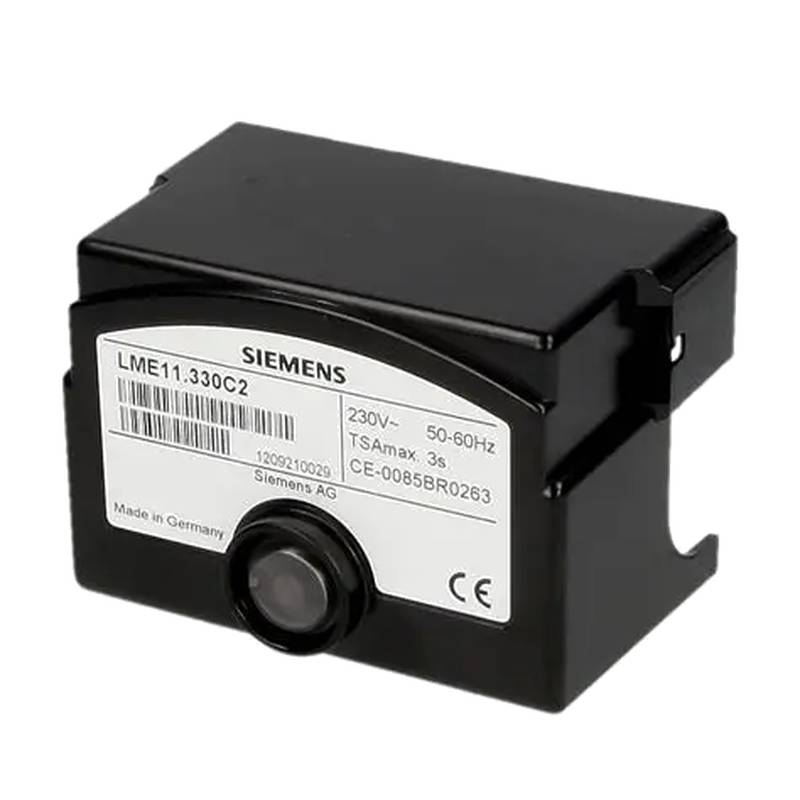
SIEMENS LME39.100C2 Burner Control Unit LME39 Advanced


The SIEMENS LME39.100C2 Burner Control Unit LME39 Advanced stands as a sophisticated solution for managing combustion processes in industrial applications. This advanced control unit offers unparalleled reliability and precise operational control, crucial for optimizing fuel efficiency and ensuring safety in demanding environments. Its core advantages lie in its robust design, comprehensive safety interlocks, and advanced diagnostic capabilities, making it a preferred choice for professionals seeking high-performance burner management. Key technical parameters include its operation on a 230V supply voltage, a switching capacity of 5A, and suitability for single-stage or two-stage burners across various fuel types.
| Feature | Specification |
| :------------------------- | :------------------------------------------ |
| Model | LME39.100C2 |
| Product Series | LME39 Advanced |
| Supply Voltage | 230 V AC |
| Switching Capacity | 5 A |
| Number of Stages | Single-stage or Two-stage burners |
| Applications | Industrial burners, heating systems |
| Safety Functions | Integrated safety interlocks |
| Diagnostics | Advanced diagnostic capabilities |
| Ambient Temperature | -20 to +60 °C |
| Ingress Protection | IP40 |
The SIEMENS LME39.100C2 distinguishes itself through its advanced flame monitoring and self-checking functionalities, ensuring continuous operational integrity. Its market positioning is firmly established as a premium control unit for applications demanding stringent safety standards and efficient combustion. The unit’s ability to interface with various burner types and fuel sources provides significant versatility, while its robust construction ensures longevity in harsh industrial settings. This advanced burner control unit integrates cutting-edge technology for superior performance and user confidence.
Key application scenarios for the SIEMENS LME39.100C2 include its deployment in industrial boilers, process heaters, and thermal oxidizers where precise and safe burner operation is paramount. It is a critical component in sectors such as chemical processing, power generation, and large-scale HVAC systems. Users frequently seek solutions for reliable ignition, flame control, and safety shutdown sequences, all of which are expertly handled by the LME39.100C2. Its advanced features are particularly valuable in applications requiring continuous operation and minimal downtime.
Practical system integration of the SIEMENS LME39.100C2 involves straightforward wiring to the burner's ignition transformer, fuel valves, and flame sensor. The unit typically connects to a pre-purge relay and post-purge relay, and its plug-in base facilitates easy replacement. Detailed wiring diagrams are provided with the unit, ensuring correct interconnection of safety circuits and operational controls. Commissioning involves setting parameters for ignition timing, purge cycles, and flame detection sensitivity to match the specific burner and fuel used.
Operation and risk mitigation with the SIEMENS LME39.100C2 are enhanced by its comprehensive diagnostic LEDs, which provide real-time status and fault indications. Common troubleshooting issues often relate to flame signal strength or valve operation, which can be quickly identified through the unit's integrated diagnostics. Critical error codes, such as those indicating a failure to ignite or a loss of flame, are clearly communicated by the control unit, enabling prompt corrective action and minimizing operational risks.
The scalability and long-term value of the SIEMENS LME39.100C2 are evident in its compatibility with Siemens' broader industrial automation portfolio. It can be integrated into larger Building Management Systems (BMS) or SCADA platforms, facilitating centralized monitoring and control. While not directly an IIoT device, its robust communication capabilities through auxiliary relays and potential integration with gateways allow it to be part of a digitally connected industrial ecosystem, offering future-proof performance and adaptable solutions.
*
FAQs
What are the primary benefits of the SIEMENS LME39.100C2?
The LME39.100C2 offers robust safety interlocks, ensuring reliable burner operation. It provides precise control for optimal fuel efficiency and reduced emissions. Its advanced diagnostics simplify troubleshooting and minimize downtime.
This control unit enhances operational integrity through continuous self-monitoring features. It is designed for demanding industrial environments requiring high reliability. The unit's advanced capabilities contribute to significant cost savings through energy optimization.
Users benefit from its straightforward integration and user-friendly interface. The advanced features cater to specific industry safety regulations. It ensures consistent performance across single and two-stage burner applications.
What are the key technical specifications of the LME39.100C2?
The unit operates on a 230V AC supply voltage for broad compatibility. It features a switching capacity of 5A, suitable for various industrial loads. It is designed for both single-stage and two-stage burner control.
The control unit supports a wide operating temperature range from -20 to +60 °C. It offers an IP40 ingress protection rating for dust resistance. Its compact design facilitates installation in space-constrained applications.
Its advanced functionalities include sophisticated flame monitoring and safety shutdown sequences. The unit is built for durability and long-term performance in industrial settings. It is a key component for efficient heating and combustion processes.
How is the SIEMENS LME39.100C2 installed and commissioned?
Installation involves wiring to the burner's ignition, fuel valves, and flame sensor. Use the provided wiring diagrams for correct connection of safety circuits. A plug-in base simplifies mounting and replacement of the unit.
Commissioning requires setting parameters for ignition timing and purge cycles. Adjustments to flame detection sensitivity are crucial for optimal performance. Ensure correct interconnection with pre- and post-purge relays.
Thorough testing of all safety functions is mandatory after installation. Verify proper burner ignition and stable flame during commissioning. Consult the manufacturer's manual for detailed setup procedures.
What are typical application areas for this burner control unit?
It is widely used in industrial boilers and process heaters for reliable combustion management. Chemical processing plants utilize it for critical heating applications. Large-scale HVAC systems also benefit from its precise control.
The LME39.100C2 is essential for thermal oxidizers requiring safe and efficient operation. Power generation facilities employ it in auxiliary heating systems. Food processing and manufacturing plants use it for steam generation.
Its versatility supports various fuel types and burner configurations. This makes it suitable for diverse industrial environments and specific process needs. It ensures consistent heat output and operational safety.
What kind of safety features are integrated into the LME39.100C2?
The unit incorporates integrated safety interlocks for secure burner operation. It features automatic shutdown in case of flame failure or ignition problems. Pre-purge and post-purge cycles are managed to prevent explosive mixtures.
It ensures that fuel valves only open after a successful ignition sequence. The control unit continuously monitors the flame signal for integrity. Multiple safety relays are often used in conjunction for redundancy.
Its design adheres to stringent industrial safety standards and regulations. This comprehensive approach mitigates risks associated with combustion processes. It provides peace of mind for operators and plant managers.
How does the LME39.100C2 handle operational faults and troubleshooting?
Diagnostic LEDs on the unit provide real-time status and fault indications. These LEDs help pinpoint the exact issue, such as flame loss or ignition failure. Consult the user manual for specific LED code interpretations.
Common faults include weak flame signals or issues with fuel valve actuation. Troubleshooting involves checking the flame sensor, wiring integrity, and valve solenoids. The unit’s self-checking capabilities aid in rapid diagnosis.
By providing clear fault codes, the LME39.100C2 significantly speeds up repair times. This allows for quicker restoration of plant operations. Preventive maintenance based on diagnostic data is also recommended.
What is the role of flame monitoring in the LME39.100C2?
Flame monitoring ensures that a stable flame is present during burner operation. It uses a flame sensor (e.g., ionization rod or UV scanner) to detect the flame. If the flame is lost, the unit immediately shuts off fuel.
This function is critical for preventing the accumulation of unburned fuel. Such accumulation could lead to dangerous conditions or explosions. The LME39.100C2 uses specific algorithms to reliably differentiate flame signals.
The sensitivity and response time of the flame monitoring system are adjustable. This ensures optimal performance with different burner types and fuels. It is a core safety feature of the unit.
Can the SIEMENS LME39.100C2 be integrated with IIoT or digital platforms?
While not inherently an IIoT device, it can connect to gateways for digital integration. These gateways translate its operational data for IIoT platforms. This allows for remote monitoring and analysis of burner performance.
Integration with SCADA or BMS systems is feasible via auxiliary relay outputs. These outputs can signal operational status or alarms. This enables centralized control and data logging within a larger automation architecture.
Its robust design and compatibility with Siemens' automation ecosystem support long-term digital transformation strategies. Future upgrades can leverage these connections for enhanced smart manufacturing capabilities.
What is the typical lifespan and maintenance requirement for the LME39.100C2?
The LME39.100C2 is built with high-quality components for extended operational lifespan. Regular visual inspections and functional checks are recommended. Periodic cleaning of the control unit and associated sensors is advised.
Maintenance typically involves testing safety interlocks and flame detection circuits. Checking electrical connections for corrosion or damage is important. Replacement of the flame sensor might be needed over time due to wear.
Following manufacturer guidelines for operation and maintenance ensures maximum reliability and longevity. Proactive maintenance can prevent unexpected failures and costly downtime. The unit’s durable construction minimizes the need for frequent replacements.
What types of fuel can be used with the SIEMENS LME39.100C2?
This advanced burner control unit is designed to manage combustion for various fuel types. It is compatible with natural gas and liquefied petroleum gases (LPG). It also supports light oil and heavy oil fuels.
The specific fuel type influences the burner design and settings. The LME39.100C2’s adjustable parameters allow for optimization across these fuels. Proper burner configuration is essential for efficient and safe combustion.
Always consult the technical documentation for specific fuel compatibility and recommended settings. Incorrect fuel usage or improper setup can lead to operational issues and safety hazards. This unit provides flexibility for diverse industrial fuel sources.