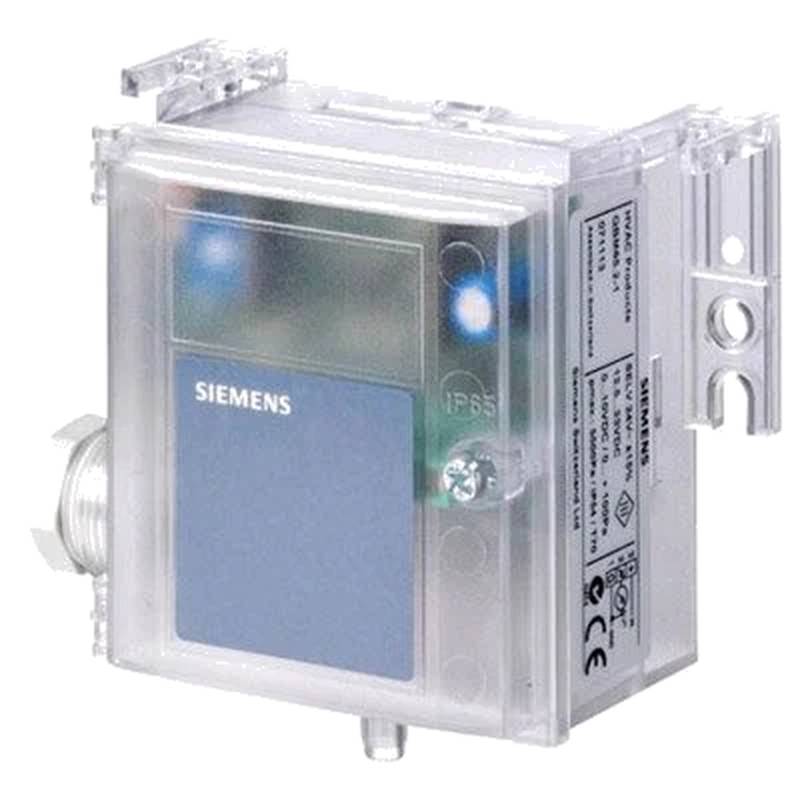
SIEMENS QBM3020-10D Differential Pressure Sensor 1000 Pa Display


The SIEMENS QBM3020-10D Differential Pressure Sensor is engineered for precise air pressure measurement in HVAC and building automation systems, offering critical advantages like high accuracy, robust construction, and user-friendly interface. This sensor is designed to monitor differential pressure across filters, fans, and air handling units, directly contributing to optimized energy consumption and maintaining superior air quality. With a measurement range of 0 to 1000 Pa and an integrated display, it provides real-time insights into system performance, enabling proactive maintenance and efficient operational control.
Product Specifications
| Parameter | Value |
| :-------------------- | :----------------------------------- |
| Product Type | Differential Pressure Sensor |
| Model Number | QBM3020-10D |
| Measurement Range | 0...1000 Pa |
| Output Signal | 0...10 V DC (or 4...20 mA configurable) |
| Accuracy | ±1.5 % of full scale |
| Operating Temperature | -10 to +50 °C |
| Protection Class | IP54 |
| Power Supply | 24 V AC/DC |
| Display | Integrated LCD |
Core Features & Market Positioning
The SIEMENS QBM3020-10D distinguishes itself through its exceptional accuracy and reliability, crucial for demanding industrial and commercial applications. Its integrated display significantly reduces the need for external monitoring devices, simplifying installation and operational checks. This feature directly addresses a market need for cost-effective, all-in-one solutions that enhance both system efficiency and user convenience. The sensor leverages Siemens' established reputation for quality and innovation in automation technology, positioning it as a premium yet accessible choice for facility managers and system integrators seeking dependable performance in HVAC control. The robust design ensures longevity even in challenging environmental conditions, a key differentiator in the competitive sensor market.
Key Application Scenarios
This differential pressure sensor is indispensable for monitoring the performance of air filtration systems in commercial buildings, hospitals, and cleanrooms, where maintaining precise air quality is paramount. Its ability to detect pressure drops across filters allows for timely filter replacement, preventing system inefficiencies and ensuring compliance with air purity standards. Furthermore, the SIEMENS QBM3020-10D is integral to fan performance monitoring, enabling HVAC systems to maintain optimal airflow rates under varying load conditions. It also finds application in static pressure control within ductwork, ensuring consistent air distribution to different zones. Building automation systems commonly utilize this sensor for demand-controlled ventilation, adjusting airflow based on occupancy or environmental conditions, thereby optimizing energy usage and occupant comfort.
Practical System Integration Guidance
Integrating the SIEMENS QBM3020-10D into existing building automation systems is streamlined due to its standard output signals and flexible power supply options. For wiring, connect the power supply terminals (typically labeled 1 and 2) to a 24 V AC/DC source, observing polarity for DC. The output signal (terminals 3 and 4) can be configured for either 0-10 V DC or 4-20 mA, depending on the controller's input requirements. Ensure the sensor's high-pressure port (typically labeled 'H' or 'P1') is connected to the higher pressure side and the low-pressure port ('L' or 'P2') to the lower pressure side of the system being monitored. For digital control systems, the analog output signal can be directly fed into a compatible Building Management System (BMS) input module. Calibration is typically performed during commissioning, utilizing the device's zero-adjust function if necessary, before being fully integrated into control loops.
Operation and Risk Mitigation
Proper operation of the SIEMENS QBM3020-10D requires adherence to its specified environmental and electrical parameters to prevent damage and ensure accurate readings. Avoid exposing the sensor to pressures exceeding its rated range, as this can lead to irreversible sensor failure. Ensure electrical connections are secure and correctly wired to prevent short circuits or incorrect power delivery, which could damage the device or associated control equipment. Regular inspection of tubing connections for leaks or blockages is crucial, as these can lead to erroneous pressure readings. While the QBM3020-10D is robust, unauthorized modifications to its internal components are strictly prohibited and will void the warranty. In case of system faults indicated by erratic readings, a primary troubleshooting step involves verifying the physical connections and the integrity of the pressure-sensing tubing.
Scalability & Long-Term Value
The SIEMENS QBM3020-10D offers significant long-term value through its compatibility with Siemens' extensive range of automation products and its support for industry-standard communication protocols. This ensures seamless integration with current and future building management systems, facilitating system expansion and upgrades without requiring complete overhauls. Its ability to provide accurate, real-time data also underpins its utility in advanced digital solutions, including predictive maintenance platforms and the Industrial Internet of Things (IIoT). By enabling detailed performance analytics, the sensor contributes to ongoing operational optimization and energy savings throughout the lifecycle of the building or industrial facility.
Frequently Asked Questions
What is the primary function of the SIEMENS QBM3020-10D?
The SIEMENS QBM3020-10D sensor measures the difference in air pressure between two points. This is vital for monitoring filter status in HVAC systems.
It helps ensure optimal airflow and energy efficiency by indicating when filters need replacement. The sensor provides precise data for building automation.
This device plays a key role in maintaining indoor air quality and operational performance in various environments.
How is the SIEMENS QBM3020-10D installed?
Installation involves connecting pressure ports to the system and electrical wiring to a power source. Ensure proper polarity for DC power.
The high-pressure port connects to the higher pressure side, and the low-pressure port to the lower pressure side. Secure all tubing connections firmly.
Refer to the official Siemens manual for detailed wiring diagrams and mounting instructions specific to your application.
What output signals does the QBM3020-10D provide?
This sensor offers a configurable output signal of either 0-10 V DC or 4-20 mA. The output is proportional to the measured differential pressure.
The 0-10 V DC signal is common for many analog input modules in building automation systems. The 4-20 mA signal is advantageous for longer cable runs due to its robustness against interference.
The specific output signal is typically selected during the initial setup or commissioning phase according to the requirements of the connected control system.
Can the QBM3020-10D be used outdoors?
The QBM3020-10D has an IP54 protection rating, which means it is protected against dust and splashing water. It is not designed for direct exposure to harsh weather conditions.
For outdoor installations, it is recommended to house the sensor in a protective enclosure that shields it from direct rain, snow, and extreme temperatures. Ensure ventilation if enclosing to prevent overheating.
Always consult the product's environmental specifications to determine its suitability for a specific installation location and any necessary protective measures.
What is the accuracy of the SIEMENS QBM3020-10D?
The SIEMENS QBM3020-10D offers an accuracy of ±1.5% of the full measurement scale. This ensures reliable and precise pressure readings.
This level of accuracy is sufficient for most critical HVAC applications, including filter monitoring and airflow control. It contributes to efficient system operation.
For applications requiring even higher precision, alternative sensor models with tighter tolerances might be considered, but this sensor meets standard industry requirements.
What is the measurement range of this sensor?
The SIEMENS QBM3020-10D sensor is designed to measure differential pressures within a range of 0 to 1000 Pascals (Pa). This is a common range for HVAC applications.
This range allows it to effectively monitor pressure drops across standard air filters, fans, and other components in air handling units. It provides sensitive detection of subtle pressure changes.
If your application involves significantly higher or lower pressure differentials, a sensor with a different specified range would be necessary.
Does the QBM3020-10D have an integrated display?
Yes, the SIEMENS QBM3020-10D features an integrated LCD display. This allows for direct, on-site reading of the differential pressure.
The display simplifies installation and commissioning by eliminating the need for separate monitoring equipment. It provides immediate visual feedback on system status.
This integrated display is a key feature that enhances user convenience and reduces the overall complexity of system monitoring solutions.
What are the typical applications for this sensor?
This sensor is widely used in HVAC systems for monitoring air filters, fan performance, and duct static pressure. It is essential for maintaining air quality and energy efficiency.
Applications include commercial buildings, hospitals, laboratories, and cleanrooms where precise airflow control is critical. It's also used in demand-controlled ventilation.
Its ability to accurately measure small pressure differences makes it suitable for a variety of air management tasks within building automation.
What power supply is required for the SIEMENS QBM3020-10D?
The SIEMENS QBM3020-10D operates on a 24 V AC or 24 V DC power supply. This is a standard voltage for many building automation and HVAC control systems.
Ensure the power supply is stable and within the specified voltage range to guarantee accurate sensor operation and longevity. Incorrect voltage can damage the device.
Always refer to the wiring diagram in the product manual to correctly connect the power supply terminals, paying attention to polarity if using DC.
How do I troubleshoot common issues with the QBM3020-10D?
First, check all physical connections, including pressure tubing and electrical wiring, for any looseness, leaks, or blockages. Ensure correct polarity for DC power.
Verify that the sensor's measurement range is appropriate for the application and that it is not being exposed to excessive pressure. Consult the manual for error codes.
If readings are consistently inaccurate, consider recalibration if the process is supported by the connected system, or contact Siemens support for further assistance.