











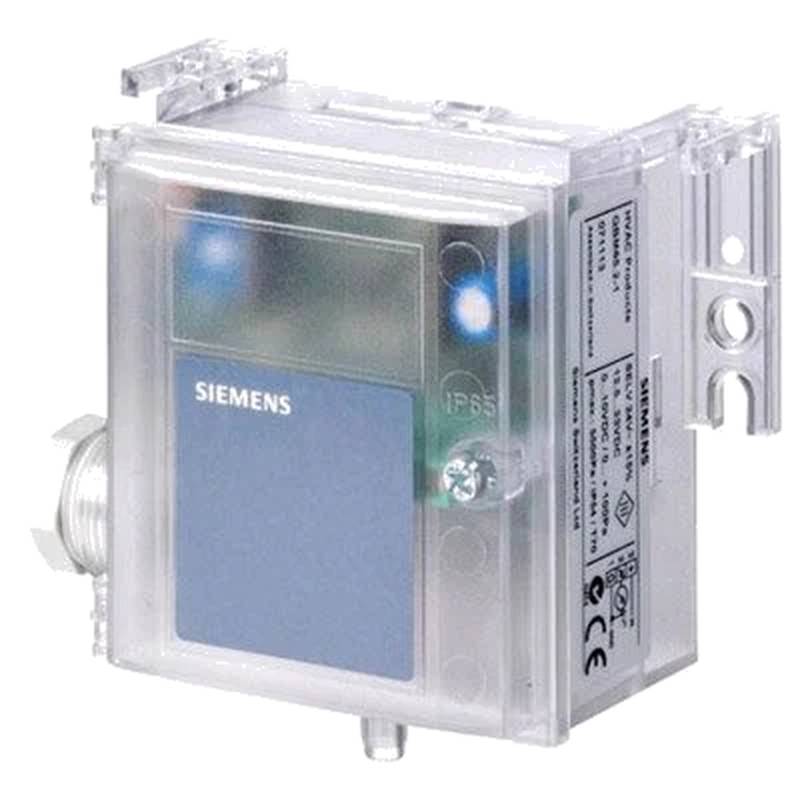
SIEMENS QBM3020-25D Differential Pressure Sensor 2500 Pa Display


The SIEMENS QBM3020-25D Differential Pressure Sensor, with a selectable range up to 2500 Pa, offers precise and reliable measurement for a wide array of HVAC and building automation applications. This advanced sensor leverages robust technology to deliver critical data for system optimization, energy efficiency, and operational safety. Its key advantages include high accuracy, flexible range selection, and seamless integration into Siemens' comprehensive automation portfolio. With a typical accuracy of ±1.5% FS and a response time of <10 seconds, the QBM3020-25D ensures timely and precise readings. The device operates within a temperature range of -10 to +50 °C and supports a wide power supply from 24 VAC/VDC.
| Parameter | Specification |
| :------------------------- | :-------------------------------------------------- |
| Measuring Range | 0…1000 Pa, 0…1600 Pa, 0…2500 Pa (selectable) |
| Output Signal | 0…10 VDC or 4…20 mA (selectable) |
| Accuracy | ±1.5% of full scale (typ.) |
| Response Time | < 10 s |
| Operating Temperature | -10…+50 °C |
| Power Supply | 24 VAC / 24 VDC |
| Pressure Connection | 2x G1/8" internal thread |
| Ingress Protection | IP54 (with cable gland) |
| Dimensions | 80 x 90 x 36 mm |
Core Features & Market Positioning
The SIEMENS QBM3020-25D distinguishes itself through its selectable measuring ranges, offering unparalleled flexibility for varying application demands without requiring multiple sensor types. This adaptability, coupled with its high accuracy and robust construction, positions it as a superior choice for professionals seeking dependable differential pressure monitoring. The sensor's ability to output either a voltage (0-10 VDC) or current (4-20 mA) signal enhances its compatibility with a broad spectrum of control systems and PLCs, a significant advantage in diverse industrial environments. Its inherent reliability and integration within the Siemens ecosystem, known for its quality and innovation in automation, further solidify its market standing as a premium solution.
Key Application Scenarios
This differential pressure sensor is critically important in monitoring airflow in ventilation systems, ensuring optimal air quality and energy efficiency in commercial buildings and industrial facilities. It plays a vital role in maintaining static pressure in cleanrooms, laboratories, and pharmaceutical manufacturing environments, where precise air pressure differentials are paramount for contamination control. Furthermore, the QBM3020-25D is extensively used for filter monitoring, detecting pressure drops across air filters to signal when maintenance or replacement is needed, thereby preventing system degradation and ensuring peak performance. Its application also extends to controlling fan speed based on system pressure requirements and monitoring duct static pressure for precise airflow regulation in complex HVAC setups.
Practical System Integration Guidance
Integrating the SIEMENS QBM3020-25D into existing systems is streamlined due to its universal power supply and selectable output signals. For electrical connections, terminal connections are clearly marked for power (L/+, N/-) and output signals (0-10 VDC or 4-20 mA). The sensor features two G1/8" internal threads for pressure connections, which should be connected to the high and low-pressure ports of the system being monitored using appropriate tubing. Users can select the desired measuring range and output signal via DIP switches located on the device, simplifying configuration and reducing commissioning time. For seamless integration with Siemens controllers like the Desigo™ platform, direct analog input configuration is typically employed, ensuring accurate data acquisition and control loop functionality.
Operation and Risk Mitigation
Proper operation of the SIEMENS QBM3020-25D involves ensuring that the pressure connections are correctly made to the higher and lower pressure points of the system. It is crucial to avoid over-pressurization beyond the sensor's rated capacity to prevent damage. Regular checks of the tubing for leaks or blockages are recommended to maintain measurement accuracy. While the QBM3020-25D is designed for robust performance, potential issues such as inaccurate readings could stem from improper installation, air leaks in the tubing, or sensor damage. Fault codes are not typically displayed by this sensor directly; instead, control systems receiving its output will indicate deviations from expected operational parameters, prompting troubleshooting of the sensor or the system it monitors.
Scalability & Long-Term Value
The SIEMENS QBM3020-25D offers significant long-term value through its inherent compatibility with the broader Siemens Building Technologies ecosystem and its ability to integrate with modern Industrial Internet of Things (IIoT) platforms. Its standard analog output signals make it readily adaptable to various building management systems (BMS) and SCADA systems, facilitating data collection for performance analysis and predictive maintenance. As building automation evolves towards more sophisticated digital solutions, sensors like the QBM3020-25D provide the foundational data necessary for smart building management, enabling energy optimization and enhanced occupant comfort. Its robust design also ensures a long operational lifespan, minimizing the need for frequent replacements and contributing to overall cost-effectiveness.
FAQs
What is the primary function of the SIEMENS QBM3020-25D sensor?
This sensor measures differential pressure, crucial for HVAC airflow control. It monitors pressure differences in ducts and across filters.
It ensures precise air quality management in sensitive environments like cleanrooms. The data helps optimize fan speeds for energy efficiency.
Accurate readings prevent system strain and indicate filter maintenance needs promptly. It supports building automation system integration.
How do I select the measuring range for the QBM3020-25D?
The measuring range is set using DIP switches on the sensor. Users can choose between 0-1000 Pa, 0-1600 Pa, or 0-2500 Pa.
Refer to the product manual for the exact location and configuration of these switches. Proper selection depends on the application's specific pressure requirements.
Ensure the sensor is powered off before adjusting DIP switches to avoid potential damage. Always verify the setting after installation.
What output signals does the SIEMENS QBM3020-25D provide?
It offers both 0-10 VDC and 4-20 mA output signals. These are selectable via DIP switches.
This dual output capability ensures compatibility with a wide range of control systems and PLCs. The specific signal choice depends on the connected automation hardware.
Ensure the correct wiring is used for the chosen output signal type to guarantee accurate data transmission. Consult the control system documentation for input configuration.
What is the typical accuracy of the QBM3020-25D?
The sensor boasts a typical accuracy of ±1.5% of the full-scale range. This ensures reliable and precise measurements.
This high accuracy is critical for applications requiring stringent control over airflow and pressure differentials. It contributes to efficient system operation.
For critical applications, verify the sensor's calibration status or consider recalibration if readings appear inconsistent. System design should account for this accuracy level.
What are the pressure connection types for this sensor?
The QBM3020-25D features two G1/8" internal threaded ports for pressure connections. These are standard industrial fittings.
Use appropriate tubing and fittings to connect these ports to the high and low-pressure points of the system being measured. Ensure airtight connections for accurate readings.
Regularly inspect the tubing for kinks, leaks, or blockages that could affect the differential pressure measurement. Secure mounting of the tubing is also important.
What is the operating temperature range for this differential pressure sensor?
The sensor operates reliably within a temperature range of -10 to +50 °C. This covers most standard HVAC and building environments.
Avoid exposing the sensor to temperatures outside this specified range, as it may affect performance or cause damage. Ensure adequate ventilation around the sensor.
Consider thermal insulation or protective enclosures if the sensor is installed in environments with extreme temperature fluctuations. Monitor operating temperatures for long-term reliability.
Can the QBM3020-25D be used for filter monitoring?
Yes, it is commonly used to monitor pressure drop across filters. A rising pressure drop indicates a clogged filter.
This allows for proactive maintenance scheduling, preventing reduced airflow and system inefficiency. It helps optimize filter replacement cycles.
The selectable range of up to 2500 Pa is suitable for various filter types and ventilation system pressures. Accurate monitoring ensures optimal filter performance.
What power supply is required for the SIEMENS QBM3020-25D?
The sensor operates on a universal power supply of 24 VAC or 24 VDC. This simplifies integration into existing power infrastructures.
Ensure the correct polarity is observed when using a DC power supply. Verify that the power supply voltage is within the specified tolerance.
Check the wiring for secure connections to prevent power interruptions that could lead to data loss or control system instability. Proper grounding is also essential.
How is the QBM3020-25D protected against environmental factors?
The sensor features an IP54 ingress protection rating when a suitable cable gland is used. This protects against dust and water splashes.
This level of protection is adequate for most indoor HVAC applications and many industrial settings. Ensure the cable gland is correctly installed and sealed.
For environments with higher moisture or dust ingress risks, additional protective measures might be considered, though IP54 generally offers good resilience. Inspect the sealing regularly.
What are the dimensions of the SIEMENS QBM3020-25D?
The sensor has compact dimensions of 80 x 90 x 36 mm. This allows for easy installation in tight spaces.
Its small footprint facilitates integration into existing ductwork or control panels without requiring significant modifications. Consider mounting clearance in your design.
The physical size is optimized for typical building automation enclosures and air handling unit components. Ensure adequate access for wiring and maintenance.