











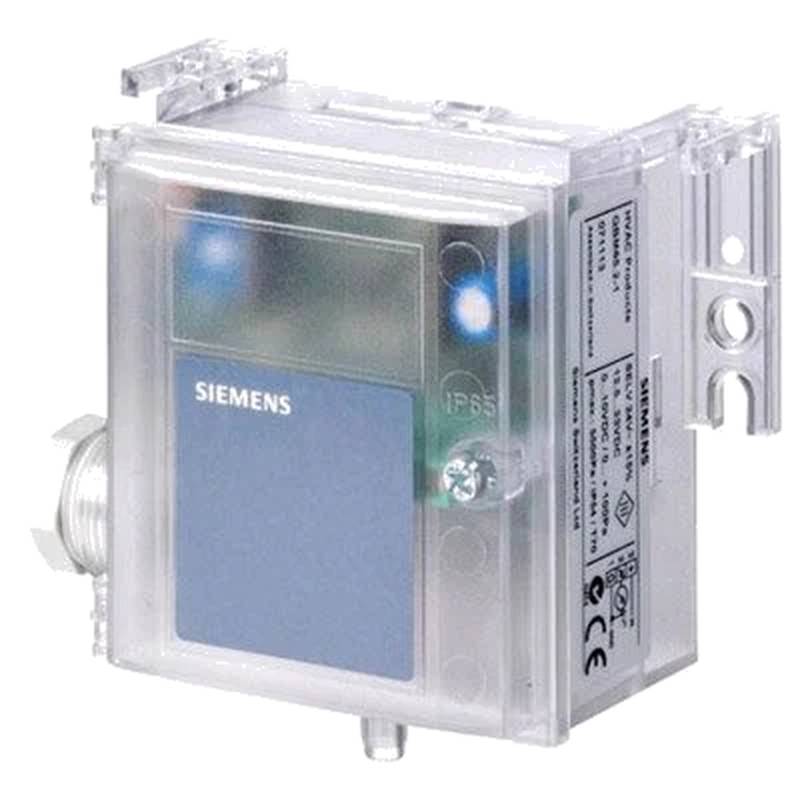
SIEMENS QBM3020-5D Differential Pressure Sensor 500 Pa Display


The SIEMENS QBM3020-5D is a highly accurate differential pressure sensor designed for demanding HVAC and building automation applications. This robust device offers a measurement range of 0 to 500 Pascals, featuring a clear integrated display for real-time monitoring. Its primary advantages lie in its precise measurement capabilities, reliable performance in diverse environmental conditions, and seamless integration into existing building management systems. Key technical parameters include a ±1.5% accuracy, an IP54 protection rating, and compatibility with a 0-10 VDC output signal.
SIEMENS QBM3020-5D: Product Specifications
| Parameter | Value |
| :------------------- | :---------------------------------- |
| Product Type | Differential Pressure Sensor |
| Model Number | QBM3020-5D |
| Measuring Range | 0…500 Pa |
| Accuracy | ±1.5% F.S. (Full Scale) |
| Output Signal | 0…10 VDC |
| Power Supply | 24 VAC / 24 VDC |
| Protection Class | IP54 |
| Operating Temperature| -20…+50 °C |
| Display | Integrated LCD |
| Connection Type | Screw terminals, G 1/4" male thread |
| Housing Material | ABS plastic |
Core Features & Market Positioning
The SIEMENS QBM3020-5D distinguishes itself through its high-precision sensing element, ensuring accurate airflow and pressure monitoring crucial for energy efficiency and occupant comfort. Its integrated display simplifies on-site diagnostics and reduces the need for additional monitoring equipment, directly impacting installation costs and complexity. This sensor is positioned as a reliable, cost-effective solution for applications where precise differential pressure measurement is paramount, offering a competitive edge over simpler, non-display models. The Siemens brand reputation further underpins its market standing, assuring users of quality and long-term operational stability.
Key Application Scenarios
This differential pressure sensor finds extensive use in variable air volume (VAV) systems for maintaining precise airflow control to individual zones. It is critical for monitoring filter status in air handling units (AHUs), alerting operators to clogged filters that impact performance and energy consumption. Applications also include controlling fan speed to maintain static pressure in ductwork, ensuring optimal system operation and reducing energy waste. Furthermore, the QBM3020-5D is ideal for monitoring room pressure differentials in sensitive environments such as laboratories, cleanrooms, and hospitals to maintain desired air balance and containment.
Practical System Integration Guidance
Integrating the SIEMENS QBM3020-5D into building automation systems is straightforward. Power is supplied via a 24 VAC or 24 VDC source, connected to the designated terminals. The differential pressure is converted into a proportional 0-10 VDC output signal, which can be directly wired to a compatible Building Management System (BMS) input. For installation, ensure the sensor is mounted in a clean environment, away from direct sources of heat or vibration, and that the pressure ports are correctly connected to the high and low-pressure sides of the system being monitored. Proper sealing of the pressure connections is vital to prevent leaks and ensure accurate readings.
Operation and Risk Mitigation
The QBM3020-5D operates automatically upon receiving power. The integrated display shows the current differential pressure reading in Pascals. To mitigate risks, regular calibration checks are recommended, especially in applications requiring high accuracy. Avoid exposing the sensor to pressures exceeding its rated range, as this can damage the sensing element. Ensure electrical connections are secure and protected from moisture ingress, particularly in environments with high humidity. If the display shows erratic readings or no output, verify power supply, wiring integrity, and the correct connection of the pressure ports.
Scalability & Long-Term Value
The SIEMENS QBM3020-5D offers significant long-term value through its robust design and compatibility with industry-standard communication protocols. Its 0-10 VDC output signal ensures seamless integration with a wide array of existing BMS platforms and controllers. For organizations moving towards enhanced digital integration, the sensor's data output can be readily digitized and transmitted to IoT platforms for advanced analytics, predictive maintenance, and energy management optimization. This makes it a scalable component within a evolving smart building infrastructure.
FAQs
What is the primary function of the SIEMENS QBM3020-5D?
This sensor measures the difference in air pressure between two points. It is crucial for monitoring airflow and static pressure in HVAC systems.
It provides real-time data for optimizing building energy consumption and maintaining desired environmental conditions. The sensor's integrated display offers immediate visual feedback on pressure levels.
Its applications range from VAV box control to filter monitoring and room pressure regulation in critical environments.
What is the typical accuracy of the SIEMENS QBM3020-5D?
The SIEMENS QBM3020-5D offers a high degree of accuracy for its class. It is rated at ±1.5% of the full scale.
This accuracy ensures reliable performance for applications like airflow control and static pressure regulation in HVAC systems. Consistent accuracy is key for maintaining optimal system efficiency and comfort.
For applications demanding even higher precision, it is advisable to consult Siemens' broader range of specialized pressure sensors.
How is the SIEMENS QBM3020-5D powered and what is its output signal?
The sensor operates on a flexible power supply, accepting either 24 VAC or 24 VDC. This dual compatibility simplifies installation across various electrical systems.
Its output signal is a standard 0-10 VDC analog signal. This signal is directly proportional to the measured differential pressure.
This analog output allows for easy integration with most Building Management Systems (BMS) and data acquisition devices without complex conversion.
What are the key environmental considerations for installing the QBM3020-5D?
The SIEMENS QBM3020-5D is designed with an IP54 protection rating, offering good defense against dust and splashing water. This makes it suitable for many industrial and building environments.
It can operate within a temperature range of -20°C to +50°C, accommodating a wide spectrum of typical HVAC operational conditions. Avoid direct exposure to extreme temperatures or corrosive substances.
Proper mounting away from direct heat sources or excessive vibration is recommended to ensure long-term sensor stability and measurement accuracy.
Can the SIEMENS QBM3020-5D be used for monitoring duct static pressure?
Yes, monitoring duct static pressure is one of its primary applications. It helps maintain consistent airflow regardless of system load variations.
By measuring the difference between the internal duct pressure and ambient pressure, it enables fan speed control for optimal static pressure. This conserves energy and ensures proper air distribution.
Accurate static pressure control is vital for the efficient operation of VAV systems and overall HVAC performance.
What is the significance of the integrated display on the QBM3020-5D?
The integrated display provides immediate, on-site visualization of the differential pressure readings. This simplifies commissioning and troubleshooting tasks.
Operators can quickly check system status and pressure levels without needing external diagnostic tools or a connected BMS. This saves valuable time during installation and maintenance.
Having a local display enhances operational awareness and aids in rapid identification of potential issues within the HVAC system.
How does the QBM3020-5D contribute to energy efficiency in buildings?
It enables precise control of airflow and fan speeds, preventing over-ventilation and reducing energy waste. Accurate pressure readings optimize the performance of VAV systems.
By monitoring filter status, it ensures that AHUs operate efficiently and alerts maintenance to clean or replace filters, preventing strain on equipment and energy loss.
Maintaining optimal static pressure in ducts directly translates to reduced fan energy consumption, contributing significantly to overall building energy savings.
What type of output connection does the SIEMENS QBM3020-5D utilize?
The sensor provides a standard 0-10 VDC analog output signal. This signal is proportional to the measured differential pressure.
This output is compatible with virtually all modern Building Management Systems (BMS) and programmable logic controllers (PLCs). It is a widely adopted standard in automation.
The analog output facilitates straightforward integration into existing control loops for pressure regulation and airflow management.
Is the SIEMENS QBM3020-5D suitable for cleanroom applications?
Yes, its precision in measuring small pressure differentials makes it suitable for maintaining cleanroom environments. It helps regulate air pressure to prevent contamination.
By ensuring the correct positive or negative pressure balance relative to adjacent areas, it is key for containment and air quality management. This is critical for pharmaceuticals and electronics manufacturing.
Accurate differential pressure monitoring is essential for meeting the stringent requirements of controlled environments like cleanrooms and laboratories.
What are the typical troubleshooting steps for a non-responsive QBM3020-5D?
First, verify that the sensor is receiving the correct power supply voltage (24 VAC or 24 VDC) at the terminals. Check all wiring connections for security and proper polarity.
Next, ensure the pressure ports are correctly connected to the high and low-pressure sources, and that there are no leaks in the tubing or connections. Confirm the system pressure is within the sensor's operating range.
If the issue persists, consult the detailed Siemens product manual for specific error codes or advanced diagnostics. Consider sensor calibration or replacement if necessary.