











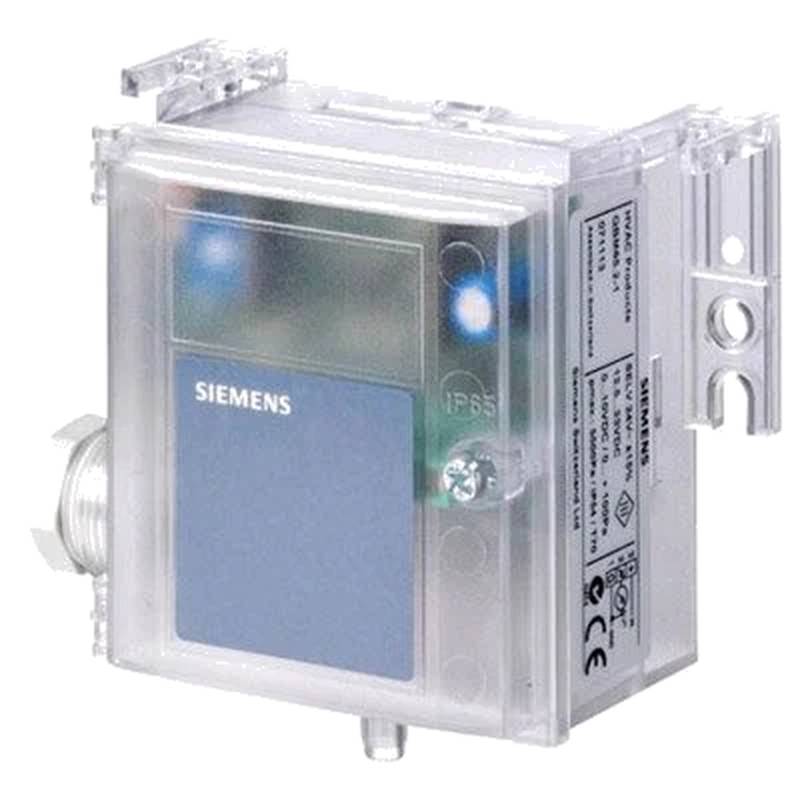
SIEMENS QBM3120-3 Differential Pressure Sensor 300 Pa Air Flow


The SIEMENS QBM3120-3 Differential Pressure Sensor, with a range of 300 Pa for air flow, stands as a critical component for precise environmental monitoring and control in various industrial and building automation systems. This sensor excels due to its robust design, high accuracy, and seamless integration capabilities. Its core technical specifications include a measuring range of 0 to 300 Pa, an accuracy of ±1.5 Pa, and a robust operating temperature range from -10 to +50 °C. The sensor utilizes a MEMS technology for reliable and stable differential pressure measurement, essential for applications such as HVAC system balancing, filter monitoring, and overpressure detection in cleanrooms. Its compact form factor and straightforward mounting options further enhance its utility in demanding industrial settings.
Core Features & Market Positioning
The SIEMENS QBM3120-3 differentiates itself in the market through its inherent reliability and Siemens' established reputation for quality and innovation in industrial automation. Its advanced MEMS sensing element provides exceptional long-term stability and resistance to environmental influences, a crucial factor for continuous operation in industrial environments. The sensor's design prioritizes ease of use, featuring clear electrical connections and standard signal outputs (0-10 V or 4-20 mA selectable) that simplify integration into existing control systems. This positions the QBM3120-3 as a preferred choice for engineers and technicians seeking a dependable and accurate solution for differential pressure monitoring, offering a competitive edge through its performance consistency and low maintenance requirements.
Key Application Scenarios
This differential pressure sensor is highly versatile, finding critical applications across numerous sectors. In HVAC systems, it precisely measures air pressure differences across filters, enabling timely replacement notifications and maintaining optimal air quality and energy efficiency. For cleanroom environments, the QBM3120-3 is indispensable for monitoring and maintaining the required positive or negative pressure differentials, safeguarding product integrity and personnel safety. It is also widely employed in variable air volume (VAV) systems to control airflow rates accurately, ensuring comfort and compliance with stringent building codes. Furthermore, its utility extends to fan and blower monitoring, detecting performance degradation or blockages by measuring pressure changes.
Practical System Integration Guidance
Integrating the SIEMENS QBM3120-3 into existing control architectures is a streamlined process. The sensor typically requires a 24 VAC/VDC power supply, readily available in most industrial control panels. For signal output, engineers can select between a 0-10 VDC analog signal or a 4-20 mA current loop, catering to a broad spectrum of controllers and PLCs. Installation involves securely mounting the sensor and connecting the pressure ports using appropriate tubing to the points of differential pressure measurement. For 0-10 VDC output, the signal wire connects to the controller's analog input, while for 4-20 mA, a series connection with the load resistor is required. Proper commissioning involves verifying the zero-point calibration and ensuring the sensor's output corresponds correctly to the applied pressure.
Operation and Risk Mitigation
The QBM3120-3 is engineered for robust operation, but like all sensors, understanding potential issues is key to risk mitigation. Over-pressurization beyond the sensor's rated limit can lead to permanent damage. Users should ensure that the maximum expected differential pressure does not exceed the 300 Pa range. Electrical connections must be made according to the wiring diagram to prevent short circuits or incorrect operation. Faulty readings can sometimes be attributed to blocked or leaking pressure tubing; regular inspection of these connections is crucial. If the sensor fails to provide a stable output, checking the power supply and signal wiring for continuity and integrity is recommended. Periodic recalibration, though not frequently required due to its stability, can be performed if extreme accuracy drift is suspected.
Scalability & Long-Term Value
The SIEMENS QBM3120-3 offers significant long-term value through its compatibility with Siemens' broader building automation and industrial control platforms, such as Desigo. This ensures seamless integration into larger, more complex systems and facilitates future upgrades or expansions. The sensor's digital communication capabilities, often through standard protocols, allow for easy incorporation into Industrial Internet of Things (IIoT) initiatives, enabling remote monitoring, data analytics, and predictive maintenance strategies. Its robust construction and resistance to environmental factors contribute to a long operational lifespan, reducing the total cost of ownership. When integrated into a networked system, the QBM3120-3 becomes a scalable asset, providing valuable data for optimizing building performance and energy consumption over many years.
Frequently Asked Questions
What is the primary function of the SIEMENS QBM3120-3?
It measures the difference in air pressure between two points. This is crucial for controlling airflow in HVAC systems. It helps maintain balanced air distribution.
This sensor is vital for monitoring filter status in air handling units. It detects clogging by measuring pressure drop across the filter. This ensures optimal air quality and system efficiency.
The QBM3120-3 also plays a role in cleanroom environments. It maintains required positive or negative pressure differentials to protect sensitive areas.
How accurate is the SIEMENS QBM3120-3 sensor?
The sensor offers a high level of precision for its intended applications. It provides an accuracy of ±1.5 Pa within its measuring range.
This accuracy ensures reliable readings for critical control loops. It is suitable for applications demanding precise airflow management.
The consistent accuracy is a hallmark of Siemens' quality engineering. It contributes to stable system performance and reduced operational issues.
What is the maximum pressure the SIEMENS QBM3120-3 can measure?
The sensor is designed for a specific differential pressure range. It can measure up to 300 Pascals (Pa) of air pressure difference.
Exceeding this 300 Pa limit could potentially damage the sensor. It's important to design systems within this specified operational boundary.
This range is ideal for typical HVAC and cleanroom applications. It offers sufficient sensitivity for most airflow control needs.
What type of output signal does the SIEMENS QBM3120-3 provide?
This sensor offers selectable output signal types. You can choose between a 0-10 VDC analog output or a 4-20 mA current loop.
The 0-10 VDC signal is common for many building automation controllers. The 4-20 mA loop is often preferred for longer cable runs or noisy environments.
This flexibility simplifies integration with various types of control systems and PLCs. It ensures compatibility across different platforms.
Can the SIEMENS QBM3120-3 be used outdoors?
The sensor is primarily designed for indoor industrial and building automation environments. Its operating temperature range is -10 to +50 °C.
Exposure to direct weather elements like rain, snow, or extreme temperatures could affect performance or cause damage. It's best to install it in a protected enclosure if outdoor use is considered.
Ensure proper ventilation and protection from environmental factors if deployed in less controlled settings. Always consult the full datasheet for environmental ratings.
How is the SIEMENS QBM3120-3 powered?
The QBM3120-3 requires a standard power supply for operation. It typically operates on 24 VAC or 24 VDC.
This voltage is commonly available in most industrial control cabinets. Ensure the power source is stable and within the specified voltage limits.
Check the wiring diagram carefully to connect the power supply correctly. Incorrect voltage can lead to malfunction or damage.
What are the physical dimensions of the SIEMENS QBM3120-3?
The sensor features a compact and modular design. Specific dimensions are usually detailed in the product's technical documentation.
Its size is optimized for easy mounting in control panels or ductwork. This makes installation less complex in confined spaces.
Compactness is a key advantage for integration into existing infrastructure without major modifications. Refer to the datasheet for exact measurements.
What is the lifespan of the SIEMENS QBM3120-3?
With proper installation and maintenance, this sensor offers a long operational life. Its robust construction ensures durability in industrial settings.
Siemens products are known for their reliability and extended service intervals. This minimizes downtime and replacement costs over time.
Factors like environmental conditions and operating stress can influence lifespan. Following operational guidelines maximizes its longevity.
Does the SIEMENS QBM3120-3 require calibration?
The sensor utilizes advanced MEMS technology for high long-term stability. Frequent calibration is usually not necessary for most applications.
However, for applications demanding extremely high accuracy, periodic checks might be beneficial. Refer to system requirements for calibration schedules.
If a calibration is needed, follow the procedures outlined in the product manual. This ensures continued precise performance.
What troubleshooting steps can be taken if the QBM3120-3 is not working?
First, verify the power supply is connected correctly and providing the right voltage. Check all electrical connections for looseness or damage.
Inspect the pressure tubing for any kinks, blockages, or leaks. Ensure the tubing is securely attached to both the sensor and the measurement points.
If the issue persists, consult the product manual for error codes or specific diagnostic procedures. You may need to reset the sensor or verify controller input settings.