











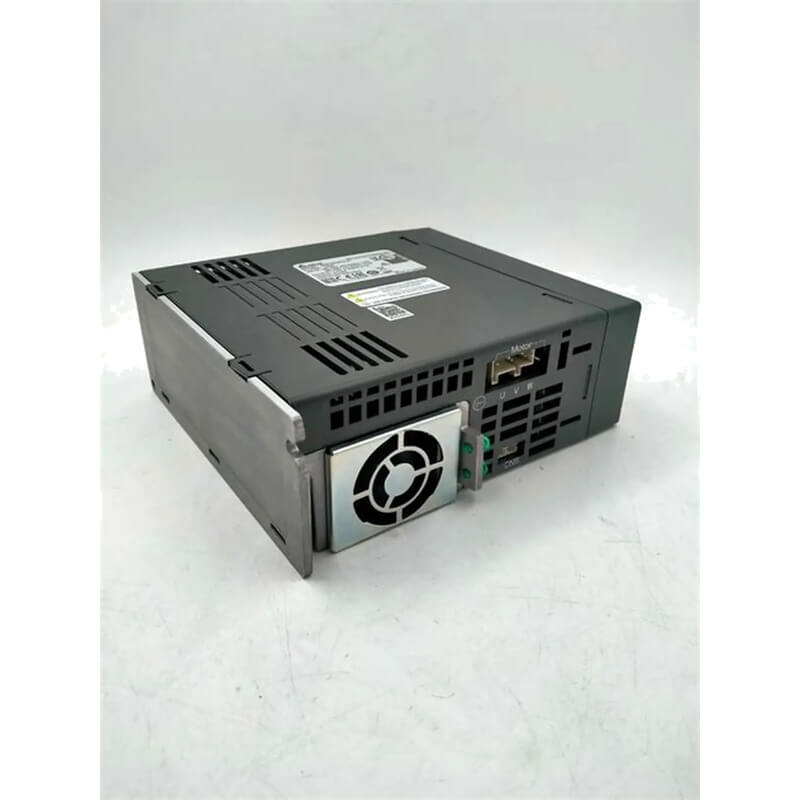
Delta ASD-B3-3023-M Low Voltage High Power Three Phase Servo System


The Delta ASD-B3-3023-M is a cutting-edge low-voltage, high-power three-phase servo system designed for demanding industrial automation applications. This sophisticated servo drive offers exceptional performance with a 3.1 kHz bandwidth and a 24-bit encoder for high-precision positioning. It supports motor speeds up to 6000 RPM and boasts a significant improvement in settling time, reduced by up to 40% compared to previous generations, directly enhancing production line productivity. The ASD-B3-3023-M is engineered for robust operation, featuring high tolerance and stable performance crucial for optimized efficiency and output value in various industrial sectors. Its compact design and advanced motor control algorithms contribute to a user-friendly environment, making it a powerful solution for complex motion control tasks.
Product Specifications
| Specification | Value |
| :------------------------- | :----------------------------------------- |
| Model Name | ASD-B3-3023-M |
| Series | B3 Servo Drive |
| Phase | 3-Phase |
| Input Voltage | 220 VAC |
| Rated Output Power | 3 Kilowatts |
| Continuous Output Current | 19.4 Arms |
| Instant Max Output Current | 58.9 Arms |
| Encoder Resolution | 24-bit |
| Max Motor Speed | 6000 RPM |
| Bandwidth | 3.1 kHz |
| Communication Options | PR Mode, Analog Voltage Control, CANopen |
| Features | Auto-tuning, Vibration Suppression, STO (Safe Torque Off) |
Core Features & Market Positioning
The Delta ASD-B3-3023-M stands out in the competitive servo drive market due to its advanced technological integration and performance enhancements. Its primary advantage lies in its significantly faster response and settling times compared to the ASDA-B2 series, a critical factor for applications demanding high throughput and precision. The 3.1 kHz bandwidth and 24-bit encoder provide superior control resolution and system stability, enabling smoother and more accurate motion profiles. Furthermore, the inclusion of features like auto-tuning, vibration suppression, and an advanced gain adjustment function simplifies commissioning and optimizes performance without extensive manual intervention. The ASDA-B3 series also offers compatibility with existing B2, A3, and A2 motors, providing a degree of backward compatibility for upgrades. The embedded Safe Torque Off (STO) function enhances operational safety, aligning with modern industrial safety standards.
Key Application Scenarios
The versatility and high performance of the Delta ASD-B3-3023-M servo system make it suitable for a wide array of industrial applications requiring precise and dynamic motion control. It excels in environments such as machine tools, where accuracy and repeatability are paramount for intricate machining operations. In the electronics and semiconductor industries, its high-speed response and positioning accuracy are vital for automated assembly, pick-and-place operations, and precision testing equipment. Industrial robots benefit from the drive's ability to deliver smooth, controlled movements, enhancing their dexterity and efficiency in manufacturing processes. The printing and packaging sectors leverage its capabilities for high-speed, synchronized operations, ensuring consistent product quality and throughput. Additionally, the textile and warehousing industries can utilize this servo system for automated material handling, sorting, and high-precision control of complex machinery.
Practical System Integration Guidance
Integrating the Delta ASD-B3-3023-M into an existing system involves careful consideration of wiring, power supply, and communication protocols. The drive supports three-phase 220 VAC input power and requires appropriate circuit protection. For optimal performance and noise immunity, shielded twisted-pair cables are recommended for encoder and communication signals. The CN1 connector serves as the primary interface for digital inputs/outputs, analog inputs, and communication ports. Delta provides configuration software, such as ASDA-Soft-V7.1.1.0, which facilitates parameter setup, auto-tuning, and system analysis, significantly streamlining the commissioning process. When connecting multiple drives, the DC Bus Sharing feature can improve energy efficiency by allowing drives to share regenerated power, reducing the need for external braking resistors in many applications. Always refer to the latest user manual for detailed wiring diagrams and configuration examples specific to your application.
Operation and Risk Mitigation
Safe and efficient operation of the Delta ASD-B3-3023-M servo system relies on adherence to best practices and understanding potential fault conditions. The drive features an integrated Safe Torque Off (STO) function, compliant with SIL 2 standards, which provides a reliable method for preventing unexpected machine startup. Proper installation within a control cabinet, adhering to EMC guidelines, is crucial to prevent electromagnetic interference and ensure stable operation. In case of operational issues, the drive's diagnostic display can indicate alarm codes that correspond to specific faults, such as overload (AL006), excessive deviation (AL007), or encoder errors. Troubleshooting often involves checking parameter settings, motor wiring, and mechanical load conditions. For instance, an AL006 alarm might indicate the load exceeds the drive's rated capacity, requiring adjustments to the motor or load. Consulting the comprehensive troubleshooting section in the user manual is essential for diagnosing and resolving issues effectively.
Scalability & Long-Term Value
The Delta ASD-B3-3023-M servo system is designed with scalability and long-term value in mind. Its compatibility with previous Delta servo motor series, including ASDA-B2, A3, and A2 motors, allows for phased upgrades and integration into existing infrastructure without requiring a complete overhaul. The availability of multiple high-speed communication bus options, such as CANopen and EtherCAT, provides flexibility for connecting to various industrial networks and control systems, including support for multi-axis control with remote I/O modules. This interconnectivity facilitates integration with IIoT platforms and digital manufacturing solutions, enabling advanced data acquisition, monitoring, and predictive maintenance strategies. The system's robust design and Delta's commitment to continuous product development ensure ongoing support and a solid return on investment for manufacturing operations seeking to enhance their automation capabilities.
Frequently Asked Questions (FAQs)
Q1: What are the key advantages of the Delta ASD-B3-3023-M servo system?
The Delta ASD-B3-3023-M offers a high 3.1 kHz bandwidth for rapid response. It features a 24-bit encoder for exceptional positional accuracy. Its improved settling time significantly boosts production efficiency.
This servo drive provides advanced functions like auto-tuning and vibration suppression. It offers enhanced load tolerance and system stability. The compact design also leads to reduced equipment footprint.
The system is compatible with previous Delta motor series. It supports various high-speed communication protocols. The integrated STO function enhances operational safety.
Q2: What are the main technical specifications of the Delta ASD-B3-3023-M?
The ASD-B3-3023-M operates on a 3-phase, 220 VAC power supply. It delivers a rated output power of 3 kilowatts.
This drive provides a continuous output current of 19.4 Arms and a peak current of 58.9 Arms. It supports motor speeds up to 6000 RPM.
Key features include a 3.1 kHz bandwidth and a 24-bit encoder for precise motion control. It supports PR mode, analog voltage control, and CANopen communication.
Q3: Which industries and applications are best suited for the Delta ASD-B3-3023-M?
This servo system is ideal for machine tools requiring high precision and repeatability. It is also used in electronics and semiconductor manufacturing for automated assembly.
Industrial robots benefit from its smooth motion control for enhanced dexterity. Printing and packaging industries utilize it for high-speed, synchronized operations.
Other applications include textile machinery, warehousing automation, and medical equipment. Its versatility covers a broad range of precise motion control needs.
Q4: How is system integration typically performed with the Delta ASD-B3-3023-M?
Integration involves connecting the drive to a 3-phase, 220 VAC power source. Ensure proper circuit protection and grounding are in place.
Utilize shielded, twisted-pair cables for encoder and communication signals for signal integrity. Consult the user manual for detailed wiring diagrams.
Configuration is done using Delta's ASDA-Soft software. Features like auto-tuning simplify parameter setup and commissioning.
Q5: What are the primary operational considerations and safety features?
The drive includes a Safe Torque Off (STO) function for enhanced safety. This meets SIL 2 standards and prevents unintended machine starts.
Ensure installation within a shielded control cabinet to meet EMC requirements. This prevents interference and ensures stable operation.
Understand common alarm codes like AL006 (overload) or AL007 (excessive deviation). Refer to the manual for detailed troubleshooting steps.
Q6: Can the Delta ASD-B3-3023-M be used with existing Delta servo motors?
Yes, the ASDA-B3 series is designed to be compatible with previous Delta motor series. This includes ASDA-B2, ASDA-A3, and ASDA-A2 motors.
This compatibility allows for a smoother upgrade path. It reduces the need for complete system replacements during modernization projects.
This feature maximizes the long-term value of existing Delta servo motor investments. It ensures flexibility in system design and expansion.
Q7: What communication protocols does the Delta ASD-B3-3023-M support?
The drive supports multiple high-speed communication options. These include CANopen and EtherCAT for robust network integration.
It also offers PR Mode for position registration and analog voltage control for simpler applications. RS-485 communication is also available.
These protocols enable seamless integration into various automation architectures. They support advanced multi-axis coordination and remote I/O.
Q8: What are some common troubleshooting steps for the Delta ASD-B3-3023-M?
Check parameter settings and motor wiring if an alarm occurs. For example, AL006 overload may indicate a need to reduce load or increase motor capacity.
Verify mechanical connections and ensure no excessive vibration is present. Review acceleration and deceleration settings for optimization.
If issues persist, especially with encoder-related alarms, contact Delta support or a qualified technician. Faulty encoders may require replacement.
Q9: How does the auto-tuning function of the ASD-B3-3023-M benefit users?
The auto-tuning feature simplifies the setup process significantly. It optimizes servo parameters without manual adjustments by the user.
This function ensures optimal performance tailored to the specific application. It reduces commissioning time and the need for specialized tuning expertise.
Auto-tuning helps achieve better system stability and responsiveness. It allows the drive to adapt to varying inertia loads for improved control accuracy.
Q10: What is the significance of the 3.1 kHz bandwidth in this servo system?
A higher bandwidth directly translates to faster system response. This enables more precise control over motion profiles.
It allows the servo drive to react quickly to command changes. This is crucial for high-speed positioning and dynamic applications.
The 3.1 kHz bandwidth helps reduce settling time by up to 40%. This leads to increased throughput and productivity in automated systems.