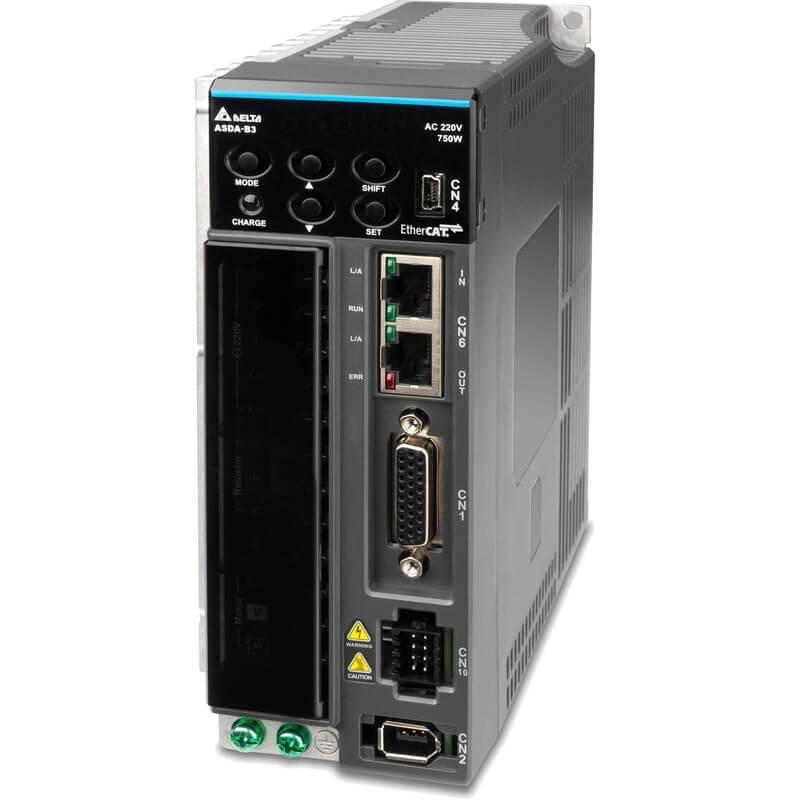
Delta ASD-B3A-7543-P High Inertia Servo for Large Industrial Equipment


The Delta ASD-B3A-7543-P High Inertia Servo redefines precision control for heavy-duty industrial machinery, offering unparalleled performance in demanding applications. This advanced servo drive system is engineered to manage large industrial equipment requiring substantial torque and smooth, consistent motion. Its key advantages lie in its robust construction, high inertia handling capabilities, and sophisticated control algorithms that ensure superior accuracy and efficiency. Critical technical parameters include its high power output, precise position feedback, and advanced thermal management, all contributing to reliable operation under continuous, strenuous conditions.
Product Specifications
| Feature | Specification |
| :-------------------- | :----------------------------------------------- |
| Model | ASD-B3A-7543-P |
| Servo Type | High Inertia |
| Rated Output Power | 7.5 kW |
| Input Voltage | 3-Phase, 380-480 VAC |
| Output Voltage | 3-Phase, 0-480 VAC |
| Encoder Resolution | High-resolution absolute encoder |
| Communication Options | EtherNet/IP, PROFINET, Modbus/TCP |
| Protection Class | IP20 |
| Operating Temperature | 0°C to 50°C (without derating) |
| Inertia Matching | Designed for high-inertia loads |
| Control Modes | Position, Velocity, Torque |
| Braking System | Integrated regenerative braking system options |
Core Features & Market Positioning
The Delta ASD-B3A-7543-P distinguishes itself through its exceptional capacity for handling high-inertia loads, a critical factor for machinery like large presses, metalworking machines, and material handling systems. Unlike standard servo systems, this unit is optimized to manage the significant kinetic energy associated with these loads, preventing overshoot and ensuring smooth acceleration and deceleration. Its market positioning is firmly within the high-performance industrial automation sector, targeting applications where precision, power, and reliability are paramount. The integration of advanced feedback systems, such as high-resolution absolute encoders, guarantees precise positioning even under dynamic conditions, setting it apart from competitors who may offer less sophisticated feedback mechanisms. This focus on high inertia and precision makes the ASD-B3A-7543-P a compelling choice for industries seeking to enhance throughput and product quality.
Key Application Scenarios
The robust design and high inertia capabilities of the Delta ASD-B3A-7543-P servo system make it ideally suited for a variety of demanding industrial applications. It excels in operating large stamping presses, where the precise control of heavy slides is essential for forming operations. In the metal fabrication industry, it finds critical use in CNC machining centers and large-scale robotic welding applications, managing the substantial mass of robotic arms and workpieces to maintain accuracy. Furthermore, its suitability extends to automated warehousing and large-scale material handling equipment, such as gantry systems and high-capacity conveyors, ensuring smooth and efficient movement of heavy loads. These applications frequently present challenges that the ASD-B3A-7543-P is specifically engineered to overcome, such as rapid start/stop cycles and the need for consistent torque delivery.
Practical System Integration Guidance
Integrating the Delta ASD-B3A-7543-P into existing industrial control architectures requires careful consideration of its power and communication requirements. Proper wiring is paramount; ensure the power supply conforms to the 3-phase, 380-480 VAC specification, and utilize shielded motor and encoder cables to prevent electrical noise interference. For communication, the servo drive supports industry-standard protocols like EtherNet/IP, PROFINET, and Modbus/TCP, facilitating seamless integration with leading PLCs and motion controllers. Configuration typically involves setting motor parameters, control mode selection (position, velocity, or torque), and defining motion profiles via Delta's proprietary servo software or compatible third-party tools. The drive's built-in diagnostics and status indicators aid in efficient commissioning and troubleshooting.
Operation and Risk Mitigation
Safe operation of the Delta ASD-B3A-7543-P necessitates adherence to established industrial safety protocols and understanding its operational parameters. Always ensure that the machine is properly grounded and that emergency stop circuits are functional before powering up the drive. The drive features internal protection mechanisms against overcurrent, overvoltage, and overheating, but external protective measures like appropriate circuit breakers and fuses are still required. When troubleshooting, common issues may relate to encoder signal loss or motor tuning parameters. For instance, an "Error 01: Overcurrent" may indicate a mechanical issue or incorrect motor tuning, while an "Error 07: Encoder Malfunction" points to a connection problem or encoder failure. Always consult the user manual for specific fault code resolutions.
Scalability & Long-Term Value
The Delta ASD-B3A-7543-P is designed with scalability and long-term value in mind, enabling integration into evolving industrial automation strategies. Its compatibility with multiple industrial communication protocols allows for flexible deployment within diverse network architectures, supporting future upgrades or expansions of control systems. For organizations embracing Industry 4.0 and the Industrial Internet of Things (IIoT), the ASD-B3A-7543-P can be integrated into broader data acquisition and analysis platforms, providing valuable operational insights for predictive maintenance and process optimization. This forward-thinking design ensures that the investment in this high-inertia servo system provides lasting benefits, adapting to technological advancements and maintaining peak performance over the equipment's lifecycle.
Frequently Asked Questions
Q1: What makes the Delta ASD-B3A-7543-P suitable for high-inertia loads?
This servo drive features advanced algorithms optimized for managing significant kinetic energy. Its motor and controller are specifically engineered to provide high torque for smooth acceleration and deceleration of heavy masses.
Q2: What are the primary industries that benefit from this servo system?
Industries like metal fabrication, automotive manufacturing, and heavy machinery production benefit greatly. Applications include large presses, CNC machines, robotic automation, and material handling systems.
Q3: What communication protocols does the ASD-B3A-7543-P support?
It supports major industrial Ethernet protocols, including EtherNet/IP, PROFINET, and Modbus/TCP. This ensures broad compatibility with various PLC and automation system platforms.
Q4: How does the high-resolution absolute encoder contribute to performance?
The absolute encoder provides precise position feedback without requiring a homing sequence on startup. This ensures consistent accuracy and repeatability in demanding motion control applications.
Q5: What are common troubleshooting steps for this servo drive?
Begin by checking power and encoder connections, then review motor tuning parameters. Consult the drive's diagnostics for specific error codes and their corresponding solutions.
Q6: Can this servo drive be integrated into existing automation systems?
Yes, its support for standard industrial communication protocols facilitates seamless integration. It's designed for compatibility with a wide range of PLCs and distributed control systems.
Q7: What safety features are integrated into the ASD-B3A-7543-P?
The drive includes built-in protections for overcurrent, overvoltage, and overheating. External safety circuits and proper grounding are still essential for overall machine safety.
Q8: What is the typical power output range for this servo drive model?
The Delta ASD-B3A-7543-P has a rated output power of 7.5 kW. This capacity is suitable for driving substantial industrial equipment.
Q9: Does this servo drive offer options for energy regeneration?
Yes, the drive often comes with options for integrated regenerative braking systems. This allows for energy recovery during deceleration, improving overall system efficiency.
Q10: What technical expertise is generally required for installation and configuration?
Installation requires knowledge of industrial electrical wiring and safety standards. Configuration typically involves servo software operation and understanding of motion control principles.