











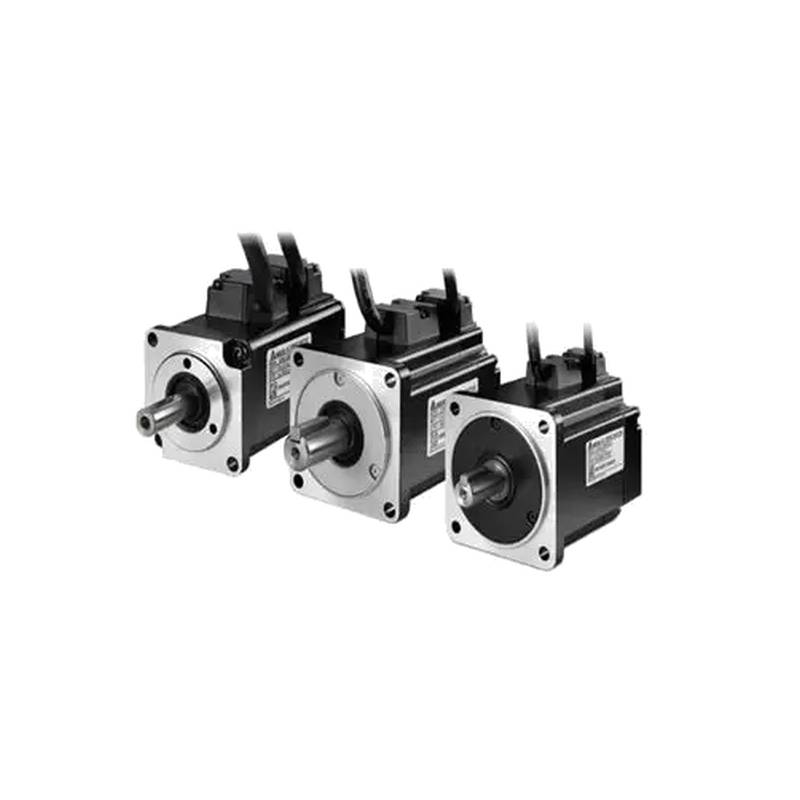
Delta ECM-E3H-F21313RSE Low Inertia High Resolution Precision Servo


The Delta ECM-E3H-F21313RSE is a low inertia, high-resolution precision servo motor engineered for demanding motion control applications. This servo boasts exceptional dynamic performance and accuracy, making it ideal for automation systems requiring precise positioning and rapid acceleration/deceleration. Its core advantages lie in its compact design, high torque density, and advanced feedback capabilities, enabling superior control in complex machinery. Key technical parameters include a rated voltage of 200V, a continuous stall torque of 1.3 Nm, and an encoder resolution of 17-bit (262144 pulses/rev), ensuring intricate movement control.
Product Specifications
| Parameter | Value |
| :---------------------- | :---------------------------------------- |
| Model | ECM-E3H-F21313RSE |
| Motor Type | Low Inertia Servo Motor |
| Rated Voltage | 200V |
| Rated Output Power | 100W |
| Continuous Stall Torque | 1.3 Nm |
| Peak Stall Torque | 3.9 Nm |
| Rated Speed | 3000 r/min |
| Max Speed | 5000 r/min |
| Encoder Resolution | 17-bit (262144 pulses/rev) |
| Brake | None |
| Shaft | Straight shaft with keyway |
| Protection Class | IP65 |
Core Features & Market Positioning
The Delta ECM-E3H-F21313RSE stands out in the precision servo market due to its remarkably low inertia, which translates to faster response times and improved settling accuracy. This characteristic is critical for high-speed pick-and-place operations, advanced robotic articulation, and intricate CNC machining where rapid trajectory changes are paramount. The 17-bit encoder provides unparalleled positional feedback, enabling micro-level precision that reduces error accumulation and enhances overall system performance. Compared to higher inertia motors, the ECM-E3H-F21313RSE offers a significant competitive edge in applications demanding agility and pinpoint accuracy, positioning it as a superior choice for next-generation automation solutions.
Key Application Scenarios
This precision servo motor is exceptionally suited for sophisticated automation tasks across various industries. Its high resolution and low inertia make it a prime candidate for robotic arms in electronics manufacturing, where precise placement of delicate components is essential. In the semiconductor industry, it excels in wafer handling and lithography equipment, guaranteeing sub-micron accuracy. Furthermore, it finds critical applications in advanced packaging machinery, high-precision CNC machines for intricate part fabrication, and automated optical inspection systems that require stable, vibration-free operation. Its robust performance also supports sophisticated laboratory automation and medical device manufacturing.
Practical System Integration Guidance
Integrating the Delta ECM-E3H-F21313RSE into an automated system requires careful consideration of the drive and controller. Delta's ASD-A0221-E series servo drives are a recommended companion, offering seamless compatibility and optimized performance. Ensure proper motor cabling, paying close attention to encoder feedback lines to maintain signal integrity and prevent noise interference. For initial setup, utilizing Delta's DMCNET or EtherCAT communication protocols facilitates rapid parameter configuration and diagnostics. Always perform a thorough tuning process to match the servo's dynamic capabilities with the mechanical system's characteristics, thereby maximizing responsiveness and minimizing overshoot.
Operation and Risk Mitigation
Operating the Delta ECM-E3H-F21313RSE within its specified parameters is crucial for longevity and safety. Always ensure the servo drive is correctly sized and configured for the motor's torque and speed requirements to prevent overheating and premature failure. Critical fault codes, such as "Over-current" or "Encoder Communication Error," typically indicate issues with power supply, cabling, or the feedback system. Implementing proper grounding and shielding for all motor and encoder cables mitigates electromagnetic interference, a common cause of operational instability. Regular inspection of mechanical connections and monitoring drive status via diagnostic tools will preemptively address potential risks.
Scalability & Long-Term Value
The Delta ECM-E3H-F21313RSE offers significant long-term value through its compatibility with Delta's broader automation ecosystem. This allows for straightforward scalability, enabling users to integrate multiple units or upgrade to higher-performance Delta servo systems as their automation needs evolve. Its support for standard industrial communication protocols like EtherCAT ensures interoperability with various PLCs and motion controllers, facilitating integration into existing or future IIoT-enabled smart factory architectures. This forward-looking design ensures that investments in these precision servo motors remain relevant and adaptable in the face of evolving industrial automation demands.
Frequently Asked Questions
What is the primary advantage of low inertia in the Delta ECM-E3H-F21313RSE?
Low inertia allows for very quick accelerations and decelerations. This rapid response is key for high-speed precision tasks. It minimizes settling time after movements.
This feature enhances overall machine throughput and accuracy. It reduces energy consumption during dynamic operations. The motor can precisely follow complex trajectories.
Quick dynamic response is vital for robotic pick-and-place. It's crucial for high-speed sorting and assembly. It improves precision in CNC machining.
How does the 17-bit encoder resolution benefit the ECM-E3H-F21313RSE's applications?
The 17-bit encoder provides 262144 pulses per revolution. This translates to extremely fine positional control. It allows for highly accurate positioning and smooth motion.
This high resolution minimizes positioning errors and reduces cumulative errors. It is essential for applications requiring sub-micron precision. The servo can maintain tighter tolerances.
Applications like semiconductor manufacturing and advanced medical devices benefit greatly. It ensures consistent quality in intricate automated processes. It supports precise trajectory following.
What are the recommended servo drives for the Delta ECM-E3H-F21313RSE?
Delta's ASD-A0221-E series servo drives are highly recommended. They offer optimized performance and seamless integration. These drives are designed to match the ECM-E3H-F21313RSE's capabilities.
Using compatible Delta drives ensures full functionality. It simplifies setup and parameter configuration. It maximizes the servo motor's dynamic performance.
Other compatible drives exist but require careful verification. Always consult Delta's documentation for a precise match. Proper drive selection is critical for system reliability.
Can the Delta ECM-E3H-F21313RSE be used in environments requiring frequent cleaning or washdown?
The ECM-E3H-F21313RSE has an IP65 protection rating. This means it is dust-tight and protected against water jets. It can withstand cleaning with water, but not immersion.
Care should be taken during washdown procedures. Avoid direct high-pressure spraying on the motor's connectors. Ensure seals remain intact for optimal protection.
This rating makes it suitable for many industrial environments. It is robust enough for typical manufacturing floors. Always refer to the manual for specific cleaning guidelines.
What communication protocols are best suited for integrating the ECM-E3H-F21313RSE into a network?
EtherCAT and DMCNET are excellent choices for integration. EtherCAT offers high-speed, real-time communication. DMCNET is Delta's proprietary high-speed network.
These protocols enable efficient data exchange between drives and controllers. They support synchronized multi-axis motion control. Network setup is straightforward with compatible PLCs.
Using these protocols is ideal for advanced automation systems. They facilitate easier diagnostics and system monitoring. They are crucial for IIoT integration.
How critical is proper motor tuning for the Delta ECM-E3H-F21313RSE?
Proper tuning is absolutely essential for optimal performance. It ensures the servo motor accurately follows commands. It minimizes overshoot and oscillation.
Tuning adapts the servo's response to the specific mechanics. It maximizes speed and precision. Without it, performance will be significantly degraded.
Default settings are rarely sufficient for demanding applications. Iterative tuning is often required. Consult the drive's manual for tuning procedures.
What are common causes for an "Over-current" fault on the ECM-E3H-F21313RSE?
Over-current faults can stem from mechanical binding. Excessive load torque exceeding motor limits is another cause. Incorrect drive parameters can also trigger this.
Check for any physical resistance in the driven mechanism. Ensure the applied load does not exceed peak torque ratings. Verify drive current limits are set appropriately.
Loose motor connections or short circuits can also lead to over-current. Inspect all wiring carefully. Ensure the drive's power supply is stable and within specifications.
How can electromagnetic interference (EMI) be mitigated when using this servo?
Use shielded motor and encoder cables. Ensure proper grounding of both the motor and the drive. Route cables away from high-frequency noise sources.
Employ ferrites or chokes on cables if necessary. Install filters on the drive's power input. Keep signal and power cables separated.
Proper cable management significantly reduces EMI issues. This is vital for maintaining precise encoder feedback. It ensures stable operation in electrically noisy environments.
Is the Delta ECM-E3H-F21313RSE suitable for continuous high-speed operation?
Yes, the ECM-E3H-F21313RSE is designed for demanding duty cycles. Its low inertia allows for sustained high-speed performance. Thermal management is key for continuous operation.
Ensure the motor and drive are adequately cooled. Monitor motor temperature to prevent overheating. The IP65 rating offers protection in harsh environments.
Continuous operation at rated torque requires careful heat dissipation. It is well-suited for applications requiring rapid, repeated movements. Always adhere to the thermal limits specified.
What is the long-term value proposition of using Delta automation components like this servo?
Delta offers a comprehensive automation ecosystem. This facilitates future system expansion and upgrades. Components are designed for interoperability.
Using Delta products ensures compatibility and support. This reduces integration challenges and downtime. It simplifies maintenance and troubleshooting.
The technology is continuously updated, offering modern solutions. This ensures your automation investment remains relevant. It supports integration into Industry 4.0 initiatives.