ABB AX150-30-11-84 150A Contactor 110V AC Coil


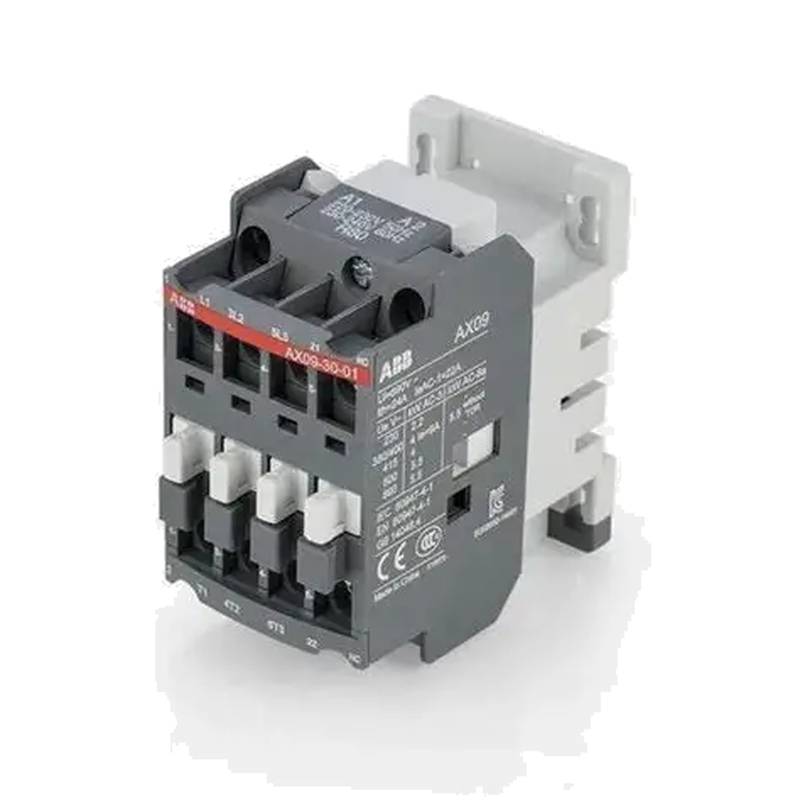
The ABB AX150-30-11-84 is a robust 150A contactor designed for demanding industrial applications, featuring a reliable 110V AC coil for straightforward power integration. This contactor excels in motor control, power distribution, and various automation tasks, offering superior performance and operational longevity. Its core advantages lie in its high switching capacity, compact design, and adherence to stringent international safety standards, making it a preferred choice for system integrators and plant managers prioritizing uptime and safety. Key technical parameters include a rated operational voltage of up to 1000V AC, a rated operational current of 150A (AC-3 duty), and a supplementary pole configuration of 3 Normally Open (NO) poles. The 110V AC coil voltage ensures compatibility with common control power systems.
Product Specifications
| Parameter | Specification |
| :---------------------------- | :------------------------------- |
| Product Name | AX150-30-11-84 Contactor |
| Rated Operational Current (AC-3) | 150 A |
| Coil Voltage | 110 V AC |
| Number of Poles | 3 |
| Pole Configuration | 3 Normally Open (NO) |
| Rated Operational Voltage | Up to 1000 V AC |
| Auxiliary Contact | 1 Normally Open (NO) + 1 Normally Closed (NC) |
| Control Circuit Type | AC |
| Mounting Type | DIN Rail / Screw Mounting |
| Dimensions (H x W x D) | 158 x 90 x 134 mm (approx.) |
| Protection Class | IP20 |
Core Features & Market Positioning
The ABB AX150-30-11-84 distinguishes itself in the industrial control market through its exceptionally durable construction and advanced arc-quenching technology. Its ability to handle high currents reliably makes it a cornerstone for robust motor control circuits and main power switching applications. ABB's reputation for engineering excellence underpins the AX150 series, positioning it as a premium solution for environments where performance consistency and minimal downtime are paramount. This contactor's design prioritizes user safety and ease of maintenance, further solidifying its appeal to professionals seeking dependable, long-term operational solutions. The integrated auxiliary contacts offer immediate feedback on the contactor's status, enhancing control system integration.
Key Application Scenarios
This ABB AX150-30-11-84 contactor finds extensive use in a variety of critical industrial settings. It is ideal for directly controlling medium-sized to large three-phase induction motors in manufacturing plants, such as those driving pumps, fans, and conveyors. In power distribution systems, it serves as a main switch or a vital component in feeder circuits for heavy machinery. Furthermore, its reliability makes it suitable for HVAC systems, material handling equipment, and process automation lines where consistent and safe electrical switching is essential. The 110V AC coil voltage is particularly well-suited for control circuits powered by standard industrial transformers.
Practical System Integration Guidance
Integrating the ABB AX150-30-11-84 into existing or new control panels is straightforward due to its standard DIN rail mounting capabilities and clear terminal designations. For motor control, connect the main power terminals (L1, L2, L3 and T1, T2, T3) to the motor circuit, ensuring correct phase rotation. The control circuit for the 110V AC coil should be connected to terminals A1 and A2, with appropriate fusing and overcurrent protection for the coil circuit. The auxiliary contacts (often labeled 31/32 for NO and 43/44 for NC) can be wired into the control logic for status monitoring, interlocking, or signaling. Always adhere to local electrical codes and ensure proper lockout/tagout procedures are followed during installation and maintenance.
Operation and Risk Mitigation
Proper operation of the ABB AX150-30-11-84 involves ensuring the control voltage supplied to the A1/A2 terminals is within the specified 110V AC range. Over- or under-voltage can lead to malfunction or premature failure. It is crucial to select the correct AC-3 rating for motor control applications, as this defines the contactor's capability to interrupt motor starting currents. Risk mitigation primarily involves correct electrical installation, including proper conductor sizing and grounding, and ensuring the contactor is not subjected to environmental conditions exceeding its IP20 rating (e.g., excessive dust, moisture). Regular inspection for wear on contacts and proper functioning of the coil are recommended to prevent unexpected shutdowns.
Scalability & Long-Term Value
The ABB AX150-30-11-84 offers significant long-term value through its robust design and compatibility with ABB's broader range of automation and control products. While this specific model is a standalone component, its integration capabilities within larger ABB control systems or third-party platforms are substantial. For evolving industrial automation needs, including the adoption of Industrial Internet of Things (IIoT) solutions, contactors like the AX150 can be interfaced with smart relays or communication modules to provide remote monitoring and diagnostics. This ensures that investments in reliable hardware can be leveraged within future, more connected, and intelligent industrial environments.
Frequently Asked Questions (FAQs)
Q1: What is the correct coil voltage for the ABB AX150-30-11-84?
The ABB AX150-30-11-84 utilizes a 110V AC coil voltage for its operation. This voltage level is standard in many industrial control circuits. Ensure your power supply precisely matches this specification for optimal performance.
Proper supply ensures reliable switching and prevents coil damage. Always verify supply voltage before energizing the contactor. Compatibility with existing control power is key.
Using the correct coil voltage is critical for safe and efficient operation. It directly impacts the electromagnet's ability to engage the contactor.
Q2: Can the ABB AX150-30-11-84 be used for DC motor control?
No, this contactor is specifically designed for AC applications with its AC coil and AC-3 rating. DC motor control requires specialized DC contactors. Using this AC contactor for DC loads can lead to arc instability and failure.
DC circuits behave differently than AC, especially regarding arc suppression. Standard AC contactors lack the necessary features for reliable DC interruption. Consult ABB's DC product range for suitable alternatives.
Always match the contactor's intended use to the application's electrical characteristics. Using the wrong type can cause safety hazards and equipment damage.
Q3: What is the AC-3 rating of the ABB AX150-30-11-84?
The ABB AX150-30-11-84 is rated for 150 Amperes under AC-3 duty. This rating is crucial for starting and stopping three-phase squirrel-cage motors. It signifies the contactor's ability to handle motor starting currents.
AC-3 duty is defined by IEC standards and accounts for the high inrush current of motors. It ensures the contactor can reliably interrupt motor circuits. Always consider this rating for motor applications.
Exceeding the AC-3 rating can cause premature contact wear or welding. Ensure your motor's full load current and starting characteristics are within this limit.
Q4: How do I wire the auxiliary contacts on the AX150-30-11-84?
This contactor typically includes one NO and one NC auxiliary contact. The standard numbering is 31/32 for the NO contact and 43/44 for the NC contact. Wire these into your control logic for status feedback or interlocks.
These auxiliary contacts mirror the state of the main power poles. They are low-power contacts, suitable for control circuits, not main load switching. Use them for signaling or interlocking purposes.
Refer to the contactor's wiring diagram for precise terminal identification and connection examples. Proper wiring ensures your control system receives accurate status information.
Q5: What is the maximum switching frequency for this contactor?
While specific switching frequency limits are not always explicitly stated for every industrial contactor model, for AC-3 duty, a general guideline for such robust contactors is around 600 to 1200 cycles per hour. Frequent operation may require derating.
For very high-frequency switching applications, specialized contactors or solid-state relays might be more appropriate. Always consult the detailed technical documentation or ABB support for specific operational limits.
Continuous, rapid switching can increase contact wear and heat generation. Ensure adequate cooling and consider reduced duty cycles for extended longevity.
Q6: Can the AX150-30-11-84 be mounted horizontally?
ABB contactors are generally designed for vertical mounting to ensure optimal performance and thermal management. Horizontal mounting may affect coil operation and cooling efficiency. Check the manufacturer's guidelines for specific mounting orientations.
While some industrial contactors might offer flexibility, deviating from the intended mounting can compromise safety and reliability. Always prioritize manufacturer recommendations for safe installation.
If horizontal mounting is absolutely necessary, consult ABB technical support to understand any potential performance implications or derating requirements. Proper ventilation is critical in such cases.
Q7: What are the dimensions of the ABB AX150-30-11-84?
The approximate dimensions are 158mm in height, 90mm in width, and 134mm in depth. These dimensions are crucial for panel design and ensuring adequate space for wiring and ventilation. Always confirm with precise datasheets for exact measurements.
These compact dimensions allow for high-density control panel construction. Ensure sufficient clearance around the contactor for heat dissipation and maintenance access. Proper spacing is vital for operational longevity.
Accurate measurement is essential for fitting the contactor into pre-designed enclosures. Verify these figures against the official product specifications before finalizing panel layouts.
Q8: What is the typical lifespan of this contactor?
The lifespan of the ABB AX150-30-11-84 depends heavily on the application, switching frequency, and load conditions. Under typical industrial conditions and within its specified ratings, these contactors are engineered for millions of electrical operations.
Factors like load current, voltage fluctuations, and environmental conditions significantly impact electrical endurance. Proper installation and maintenance are key to maximizing its operational life. Regular inspections are advisable.
ABB products are known for their durability. However, for critical applications, consult ABB's lifecycle data or consider predictive maintenance strategies to ensure reliability.
Q9: Does this contactor require external overload protection?
Yes, the ABB AX150-30-11-84 contactor itself does not include built-in overload protection. It must be used in conjunction with an external motor overload relay or a motor protection circuit breaker (MPCB) to protect the motor from overcurrents and phase loss.
The overload relay is wired in series with the contactor's main power terminals and provides thermal or electronic protection. This is a fundamental requirement for safe and reliable motor operation. Always install according to standards.
The combination of a contactor and an appropriate overload relay ensures comprehensive motor protection against damaging overloads and short circuits. This is a standard practice in industrial electrical design.
Q10: What safety standards does the ABB AX150-30-11-84 comply with?
This ABB contactor typically complies with major international standards such as IEC/EN 60947-4-1 for low-voltage switchgear and controlgear, and potentially UL and CSA standards for North American markets. Always verify compliance on the product label or datasheet.
Adherence to these standards ensures the product meets rigorous safety and performance requirements. This is crucial for system certification and safe operation in industrial environments. It signifies a commitment to quality.
Compliance with IEC/EN standards, for example, guarantees its suitability for general industrial use, including motor control and power switching applications, with specified safety measures.