











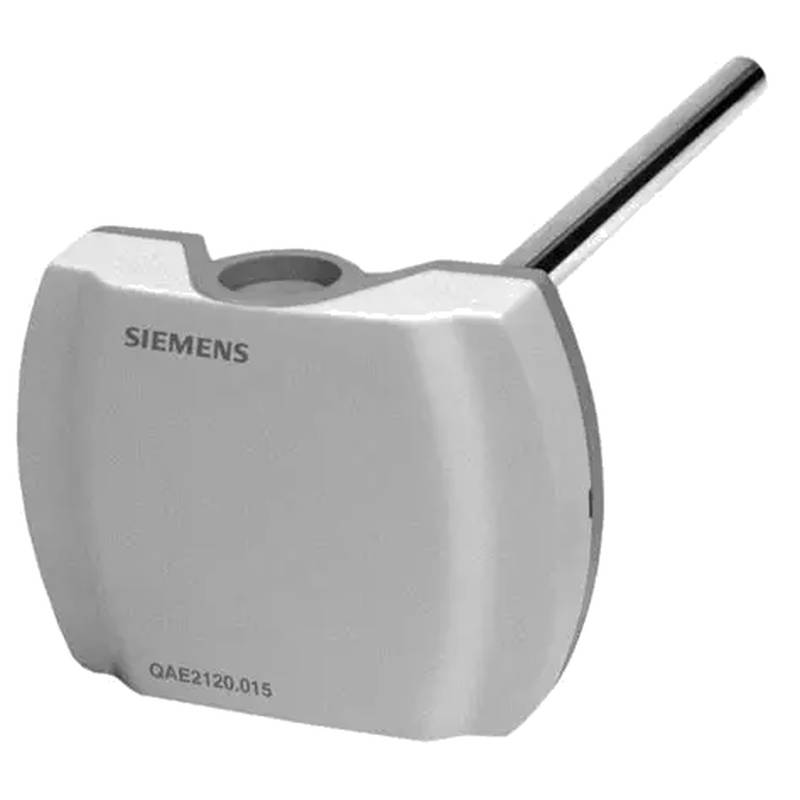
SIEMENS QAE2174.015 Immersion Temperature Sensor 1.5m Ducts


The SIEMENS QAE2174.015 immersion temperature sensor, designed for duct applications, stands as a robust solution for precise temperature monitoring in HVAC and industrial processes. This sensor offers rapid response times, a wide operating temperature range, and durable construction, making it ideal for demanding environments. Its key technical parameters include a measuring range of -50 to 150 °C, a sensor element of NTC 10 kΩ, and a protection tube material of stainless steel, ensuring reliability and longevity. The QAE2174.015 boasts an IP65 protection rating, safeguarding it against dust and water ingress, and a 1.5-meter cable length for flexible installation.
Core Features & Market Positioning
Engineered with Siemens' renowned precision, the QAE2174.015 immersion temperature sensor excels in delivering accurate real-time temperature data crucial for building automation and industrial control systems. Its NTC 10 kΩ sensor element ensures high sensitivity and a fast response, allowing for immediate detection of temperature fluctuations. The robust stainless steel protection tube not only enhances durability but also provides superior resistance to corrosive elements, positioning it as a premium choice for applications where reliability is paramount. Compared to standard sensors, its IP65 rating offers enhanced protection against harsh environmental conditions, reducing maintenance intervals and ensuring continuous operation. This sensor integrates seamlessly into Siemens' broader building management ecosystem, offering a competitive edge through compatibility and advanced feature sets.
Key Application Scenarios
The SIEMENS QAE2174.015 immersion temperature sensor finds critical applications across a spectrum of industrial and commercial environments. It is predominantly used for precise temperature measurement within air ducts in HVAC systems, enabling efficient climate control and energy management. In industrial settings, it serves to monitor temperatures in pipelines, tanks, and process streams where maintaining specific thermal conditions is vital for product quality and operational safety. Its suitability for ductwork installations makes it a go-to component for monitoring supply air, return air, and exhaust air temperatures, ensuring optimal performance of ventilation systems. Furthermore, it is applied in heating and cooling circuits to regulate fluid temperatures, preventing system overloads and optimizing energy consumption.
Practical System Integration Guidance
Integrating the SIEMENS QAE2174.015 sensor into existing systems is straightforward, leveraging its standard NTC 10 kΩ output signal. For optimal performance, ensure the sensor is fully immersed in the medium being measured, with the immersion length appropriate for the duct or pipe diameter. The 1.5-meter cable provides flexibility, but secure termination is essential to maintain the IP65 rating. Connect the sensor's two wires directly to a compatible controller or monitoring device that supports NTC 10 kΩ input. Refer to the controller's manual for specific wiring terminals and configuration settings, typically involving selecting the correct sensor type and temperature scaling. Proper installation prevents air gaps around the sensor, which could lead to inaccurate readings.
Operation and Risk Mitigation
The QAE2174.015 operates by converting ambient temperature into a resistance value, which is then interpreted by a connected control system. Its robust construction, including the stainless steel sheath and IP65 rating, significantly mitigates risks associated with physical damage, moisture ingress, and dust contamination, common failure points in industrial environments. To ensure longevity and accuracy, avoid exceeding the sensor's specified operating temperature range of -50 to 150 °C. Regular visual inspection for any signs of physical damage or corrosion is recommended, though its durable design minimizes the need for frequent interventions. In case of erratic readings, verify wiring integrity and ensure the sensor is correctly calibrated within the control system.
Scalability & Long-Term Value
The SIEMENS QAE2174.015 immersion temperature sensor offers excellent long-term value due to its compatibility with a wide range of Siemens automation platforms and many third-party control systems that accept NTC 10 kΩ inputs. This ensures seamless integration into both new installations and upgrades of existing infrastructure, protecting investment. Its durable design and resistance to harsh conditions reduce the total cost of ownership by minimizing replacement needs. As part of the Siemens ecosystem, it supports the transition towards smart buildings and Industrial IoT (IIoT) by providing reliable data for advanced analytics, predictive maintenance, and energy optimization strategies, allowing for future scalability and enhanced system intelligence.
Frequently Asked Questions
What is the primary function of the SIEMENS QAE2174.015 sensor?
The SIEMENS QAE2174.015 is an immersion temperature sensor. Its primary role is to accurately measure and transmit temperature data from within ducts or pipes.
This data is crucial for maintaining optimal operating conditions in HVAC systems and industrial processes. It enables precise control over heating, cooling, and ventilation functions.
By providing real-time temperature feedback, it allows building management systems and industrial controllers to make informed adjustments, ensuring efficiency and comfort.
How is the SIEMENS QAE2174.015 sensor installed in ductwork?
Installation requires inserting the sensor into a pre-drilled hole or a specific mounting boss within the duct. The stainless steel probe should be fully exposed to the airflow for accurate readings.
The sensor's 1.5-meter cable allows for flexible connection to control panels, but proper sealing around the insertion point is critical to maintain the IP65 rating and prevent air leakage.
Ensure the sensor is securely fastened to prevent vibration-induced damage and to guarantee consistent contact with the medium being measured.
What are the typical applications for the SIEMENS QAE2174.015?
This sensor is widely used in HVAC systems for monitoring supply, return, and exhaust air temperatures. It is also applied in industrial processes to measure temperatures in pipelines and tanks.
It is suitable for applications requiring continuous and accurate temperature monitoring in environments where dust and moisture are present, due to its IP65 rating.
Common uses include regulating air handling units, ensuring optimal performance of heating and cooling coils, and maintaining process temperatures in various manufacturing sectors.
What is the NTC 10 kΩ specification and why is it important?
NTC 10 kΩ refers to the sensor's resistance characteristic at 25°C, indicating it's a Negative Temperature Coefficient thermistor. As temperature rises, its resistance decreases.
This specific resistance value is a standard in the industry, ensuring compatibility with a vast array of controllers and data loggers from Siemens and other manufacturers.
The 10 kΩ at 25°C value is crucial for the control system to accurately interpret the sensor's output and translate the resistance reading into a precise temperature value.
What is the operating temperature range of the SIEMENS QAE2174.015?
The sensor is designed to operate reliably within a temperature range of -50 to 150 degrees Celsius. This broad range covers most typical HVAC and industrial process requirements.
Operating within this specified range ensures the sensor's accuracy and longevity, preventing damage or inaccurate measurements from extreme temperatures.
Exceeding these limits can lead to sensor malfunction or permanent damage, compromising the integrity of the monitored system.
Can the SIEMENS QAE2174.015 be used in outdoor environments?
Yes, the SIEMENS QAE2174.015 is rated IP65, which means it is protected against dust ingress and low-pressure water jets. This makes it suitable for many outdoor duct applications.
However, it's important to consider that while protected against water jets, it's not designed for complete submersion. Proper installation that prevents direct water accumulation is advisable.
Always consult the product's detailed specifications and local environmental conditions to confirm its suitability for specific outdoor installations.
What type of protection tube material does the SIEMENS QAE2174.015 have?
The SIEMENS QAE2174.015 features a durable protection tube made from stainless steel. This material is chosen for its excellent resistance to corrosion and mechanical stress.
Stainless steel provides a robust barrier against the environment within ducts or pipelines, ensuring the sensor element remains protected during operation.
This material choice contributes to the sensor's long lifespan and reliability in demanding industrial and commercial settings.
How does the SIEMENS QAE2174.015 ensure accuracy?
The sensor's accuracy is derived from its high-quality NTC 10 kΩ sensing element, which provides precise temperature-to-resistance conversion. Coupled with its stainless steel probe, it ensures stable readings.
Correct installation, ensuring full immersion in the medium and avoiding external heat sources or drafts, is vital for maintaining its inherent accuracy.
The sensor's design minimizes thermal lag, allowing for rapid response to temperature changes, further contributing to overall measurement accuracy.
What is the significance of the IP65 protection rating?
The IP65 rating signifies a high level of protection against environmental factors. '6' indicates complete dust protection, meaning no dust ingress is possible.
'5' indicates protection against water jets from any direction. This means the sensor can withstand direct exposure to water spray without compromising its functionality.
This robust protection makes the QAE2174.015 ideal for installations in areas prone to dust accumulation or where cleaning involves water spraying.
What kind of control systems are compatible with the SIEMENS QAE2174.015?
The SIEMENS QAE2174.015 is compatible with most Siemens building automation controllers and many third-party systems that accept an NTC 10 kΩ input signal.
These systems interpret the sensor's resistance output to determine the ambient temperature, using this data for control logic.
When integrating, ensure the controller's input is configured for an NTC 10 kΩ sensor and the correct temperature scaling is applied.