











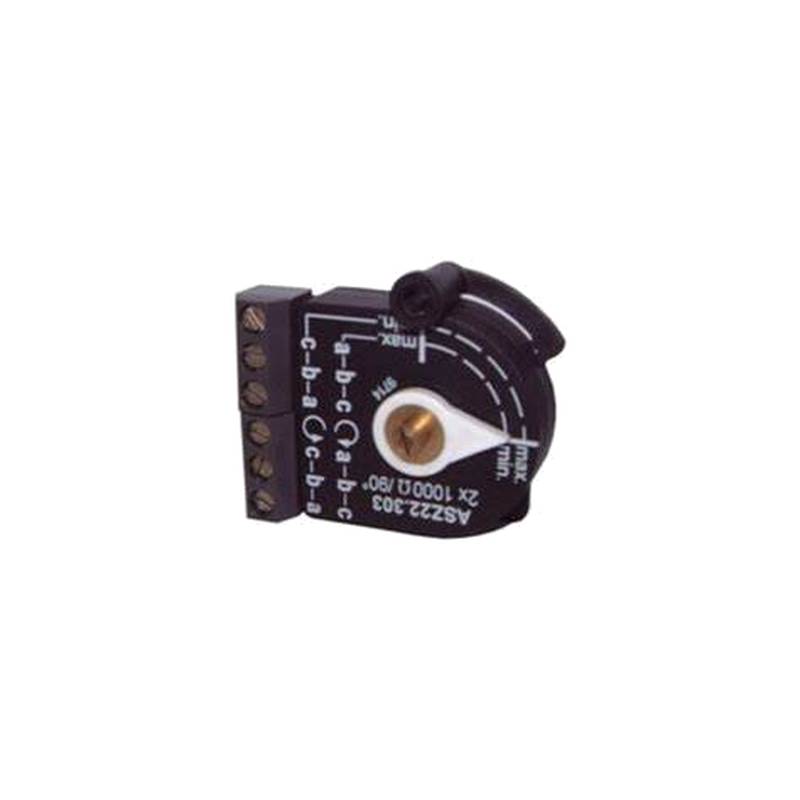
SIEMENS ASZ12.803 Auxiliary Potentiometer 3-Wire Sensor


The SIEMENS ASZ12.803 Auxiliary Potentiometer 3-Wire Sensor stands as a robust component within industrial automation, designed for precise position feedback and control. This sensor excels with its durable construction, offering reliable operation in demanding environments. Key advantages include its high accuracy, versatility in applications, and seamless integration into Siemens control systems. Core features encompass its 3-wire configuration for simplified wiring, inherent resistance to environmental interference, and precise analog output. The technical parameters highlight its operational range and sensitivity, crucial for sophisticated control loops.
SIEMENS ASZ12.803 Auxiliary Potentiometer: Technical Specifications
| Parameter | Specification |
| :------------------ | :----------------------------------------------- |
| Product Type | Auxiliary Potentiometer, 3-Wire Sensor |
| Manufacturer | Siemens |
| Model Number | ASZ12.803 |
| Output Signal | Analog (Potentiometric) |
| Wiring Configuration| 3-Wire |
| Environmental Rating| (Specific rating to be confirmed via datasheet) |
| Operating Temperature| (Specific range to be confirmed via datasheet) |
| Voltage Supply | (Specific voltage to be confirmed via datasheet) |
| Resistance Range | (Specific range to be confirmed via datasheet) |
Core Features & Market Positioning
The SIEMENS ASZ12.803 distinguishes itself through its application-specific design, providing linear and repeatable analog output signals crucial for variable position sensing. Unlike simple on/off switches, this potentiometer offers nuanced control, enabling sophisticated automation strategies. Its market positioning is firmly within the industrial automation sector, particularly for applications demanding precise actuator or valve position feedback. The 3-wire setup simplifies installation compared to more complex multi-wire sensors, reducing potential wiring errors and labor costs. This focus on straightforward integration and reliable performance makes it a favored choice for system integrators and maintenance engineers working within Siemens ecosystems and beyond.
Key Application Scenarios
The versatility of the SIEMENS ASZ12.803 auxiliary potentiometer makes it indispensable across several industrial domains. It is frequently employed in the precise control of industrial valves, ensuring optimal flow rates and process regulation in chemical plants and water treatment facilities. In manufacturing, it serves as a critical feedback element for robotic arm positioning, enhancing assembly accuracy and operational efficiency. Furthermore, its application extends to material handling systems, providing accurate feedback on conveyor belt positions or crane arm articulation, thereby improving safety and throughput. The sensor's ability to provide continuous, analog position data allows for dynamic adjustments in machinery, directly impacting process optimization and product quality.
Practical System Integration Guidance
Integrating the SIEMENS ASZ12.803 auxiliary potentiometer into existing control systems is typically straightforward, especially within Siemens environments. The 3-wire configuration mandates a power supply connection, a ground connection, and an output signal connection to the PLC or control module's analog input. Careful attention must be paid to selecting an appropriate analog input module capable of handling the potentiometer's output range. For optimal performance, ensure the mechanical linkage to the controlled element (e.g., valve stem, actuator rod) allows for the full range of motion of the potentiometer's wiper. Calibration within the PLC software is essential to map the analog input signal to the desired physical position range, ensuring accurate representation and control.
Operation and Risk Mitigation
Proper operation of the SIEMENS ASZ12.803 involves ensuring it is mounted securely and mechanically linked correctly to the moving component it is intended to monitor. Environmental factors such as excessive dust, moisture, or extreme temperatures can impact sensor longevity and accuracy; therefore, compliance with its specified environmental ratings is paramount. Potential risks include electrical issues arising from incorrect wiring, such as reversed polarity or over-voltage, which could damage the sensor or connected control systems. Mechanical stress on the potentiometer shaft or linkage can lead to premature failure or inaccurate readings. Regular visual inspections and functional checks during scheduled maintenance can help mitigate these risks and ensure sustained operational integrity.
Scalability & Long-Term Value
The SIEMENS ASZ12.803 offers significant long-term value through its compatibility with a broad range of Siemens automation platforms, including SIMATIC S7 PLCs. Its standardized analog output ensures straightforward integration with future upgrades or expansions of control systems. While the ASZ12.803 itself is a specific component, its underlying potentiometric sensing principle is widely adopted, facilitating migration strategies if higher performance or digital communication protocols become necessary. For systems embracing the Industrial Internet of Things (IIoT), the analog output can be readily digitized by an appropriate analog-to-digital converter (ADC) and transmitted as part of a broader data acquisition strategy, enabling advanced analytics and predictive maintenance.
FAQs
Q1: What is the primary function of the SIEMENS ASZ12.803?
The SIEMENS ASZ12.803 acts as an auxiliary potentiometer, providing precise analog position feedback. It translates mechanical movement into a variable electrical resistance. This allows control systems to accurately determine the position of a connected component.
This sensor is crucial for applications requiring continuous position monitoring, not just simple on/off states. It offers a nuanced signal for sophisticated control algorithms. Its 3-wire design simplifies wiring for many industrial applications.
The data generated by this potentiometer is vital for closed-loop control systems, enabling adjustments for optimal process performance. It ensures that actuators, valves, or other machinery operate at their intended positions.
Q2: How is the SIEMENS ASZ12.803 wired?
The SIEMENS ASZ12.803 features a 3-wire configuration for its electrical connections. Two wires are used for the power supply to the potentiometer element. The third wire serves as the output, connected to the wiper arm.
This setup allows the control system to read the varying resistance as the wiper moves along the resistive track. It is important to consult the specific datasheet for correct terminal assignments for power and output.
Always ensure the power supply voltage is within the sensor's specified operating range to prevent damage. Proper grounding is also essential for signal integrity and safety.
Q3: What are the key advantages of using a 3-wire potentiometer sensor like the ASZ12.803?
A 3-wire configuration offers a balance between simplicity and functionality for position sensing. It requires fewer connections than more complex sensor types, reducing installation time and potential wiring errors.
This design provides a direct analog output proportional to the wiper's position. This allows for precise and continuous monitoring of mechanical movement within a system.
The 3-wire setup also allows for the detection of open-circuit conditions on the output line, which can be a useful diagnostic feature. It is a cost-effective solution for many feedback applications.
Q4: In which industries is the SIEMENS ASZ12.803 commonly applied?
This auxiliary potentiometer finds widespread use in process automation, particularly in chemical and water treatment plants. It is used for precise control of industrial valves, ensuring accurate fluid regulation.
Manufacturing and assembly lines benefit from its application in robotics and automated machinery for exact component positioning and movement feedback. This enhances precision and efficiency.
It is also valuable in material handling systems, such as controlling the position of cranes, lifts, or automated guided vehicles (AGVs) for improved operational safety and throughput.
Q5: What technical parameters are critical when specifying the SIEMENS ASZ12.803?
Crucial parameters include the sensor's resistance range and the corresponding output voltage or current signal. Understanding the operating temperature limits and environmental protection rating (e.g., IP rating) is vital for durability.
The linearity and repeatability of the analog output signal are key performance indicators for precise control applications. The mechanical stroke or rotational angle of the potentiometer also defines its usable range.
The specified power supply voltage and current draw are essential for correct integration with the control system's power source and input modules.
Q6: How does the ASZ12.803 contribute to system scalability?
Its standardized analog output makes it compatible with a wide array of PLCs and control systems. This facilitates integration into existing or future automation architectures.
As automation strategies evolve towards digital solutions, the analog signal can be easily digitized via an ADC. This enables data acquisition for IIoT platforms and advanced analytics.
The component's integration within the broader Siemens ecosystem ensures compatibility with other Siemens automation products, supporting seamless system expansion.
Q7: What are common troubleshooting issues with potentiometric sensors?
A primary issue is mechanical wear on the resistive element or wiper, leading to intermittent signals or increased noise. This is often due to excessive cycling or harsh operating conditions.
Electrical problems, such as loose connections or incorrect wiring, can cause a complete loss of signal or erratic readings. Signal drift due to temperature fluctuations can also occur.
Ensuring proper mechanical linkage and avoiding over-travel or excessive force on the potentiometer shaft are key to preventing many common faults.
Q8: Does the SIEMENS ASZ12.803 offer digital communication capabilities?
No, the SIEMENS ASZ12.803 is an analog sensor that provides a variable resistance output. It does not inherently support digital communication protocols like PROFINET or IO-Link.
To integrate its position data into a digital network, an analog-to-digital converter (ADC) is required. This converts the analog signal into a digital format usable by modern control systems.
Its value lies in its simplicity and direct analog feedback, which can be readily digitized for IIoT applications.
Q9: What is the importance of mechanical linkage to the ASZ12.803?
The mechanical linkage directly translates the position of the controlled component (e.g., valve stem) to the potentiometer's wiper. Accurate and smooth linkage is critical for precise feedback.
Any binding, excessive play, or misalignment in the linkage will result in inaccurate or jerky position signals being sent to the control system. This directly impacts control performance.
The linkage must also ensure the potentiometer operates within its designed stroke or angle to prevent mechanical damage and ensure signal linearity.
Q10: Can the SIEMENS ASZ12.803 be used in hazardous environments?
The suitability of the SIEMENS ASZ12.803 for hazardous environments depends on its specific certifications and environmental ratings. These details are found in the product's technical datasheet.
Standard versions may not be intrinsically safe or explosion-proof. For hazardous areas, specialized industrial sensors with appropriate ATEX or IECEx certifications are typically required.
Always verify the sensor's environmental protection (IP rating) and temperature range against the conditions of the intended installation site.