











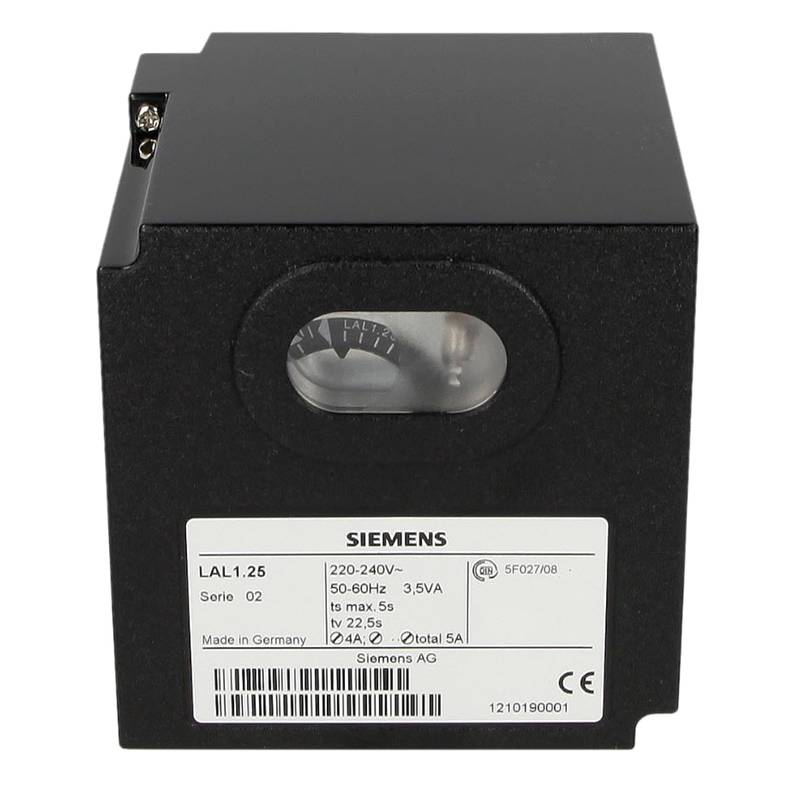
SIEMENS LFL1.635 Multi-Stage Burner Control LFL1.635


The Siemens LFL1.635 multi-stage burner control is a sophisticated safety device engineered for controlling and monitoring gas and oil burners across a wide range of industrial applications. This unit offers robust flame detection capabilities, ensuring safe and efficient combustion processes. Key advantages include its multi-stage operation, allowing for precise control over burner output, and its comprehensive safety interlocks that prevent hazardous conditions. Essential technical parameters include its supply voltage of 220 to 240 V AC, a power consumption of approximately 10 VA, and operating temperatures ranging from -20 to +60 °C. The LFL1.635 is designed for continuous operation, providing reliable performance in demanding industrial environments.
Product Specifications
| Specification | Value |
| :--------------------- | :---------------------------- |
| Supply Voltage | 220 to 240 V AC |
| Frequency | 50/60 Hz |
| Power Consumption | Approx. 10 VA |
| Ambient Temperature | -20 to +60 °C |
| Humidity | Max. 95% relative humidity |
| Protection Class | IP40 |
| Relay Contacts Rating | 250 V AC, 5 A (resistive load) |
| Flame Detection | UV, Ionization, or Blue-flame |
| Number of Stages | Multi-stage (up to 2 stages) |
| Recirculation Time | Adjustable |
| Purge Time | Adjustable |
Core Features & Market Positioning
The Siemens LFL1.635 distinguishes itself through its advanced multi-stage control logic, enabling precise modulation of burner output to match heating demands, thereby optimizing fuel efficiency and reducing emissions. Its market positioning is that of a high-reliability safety component, critical for preventing hazardous situations such as flame failure or incomplete combustion. The unit’s robust design and adherence to stringent safety standards make it a preferred choice for engineers prioritizing operational integrity and long-term performance in challenging industrial settings. Its compatibility with various flame detection methods, including UV, ionization, and blue-flame sensors, provides flexibility for diverse burner types and fuel sources.
Key Application Scenarios
The Siemens LFL1.635 is integral to the safe and efficient operation of industrial heating systems. It is commonly deployed in boiler applications, controlling burners that provide heat for manufacturing processes, building climate control, and steam generation. Its multi-stage capability is particularly valuable in systems requiring variable heat output, such as large commercial HVAC systems or industrial furnaces. Furthermore, it finds application in process heating where consistent temperature control is paramount, ensuring product quality and operational stability. The LFL1.635's reliability makes it suitable for critical infrastructure where downtime is unacceptable.
Practical System Integration Guidance
Integrating the Siemens LFL1.635 burner control into an industrial system requires careful attention to wiring and parameter configuration. The unit typically interfaces with a flame detector, ignition transformer, and various fuel valves and fan motors via its relay outputs. Proper grounding and electrical isolation are essential for safe operation and to prevent electromagnetic interference. The adjustable purge and recirculation times are configured to meet specific burner and boiler characteristics, ensuring safe startup and shutdown sequences. For detailed wiring diagrams and recommended settings, consulting the manufacturer's installation manual is crucial, often involving terminal assignments for safety interlocks and control signals.
Operation and Risk Mitigation
Safe operation of the Siemens LFL1.635 hinges on understanding its safety interlocks and flame monitoring functions. The burner control continuously monitors the flame signal; if the flame is lost during operation or fails to establish within the designated trial-for-ignition period, the LFL1.635 will initiate an immediate shutdown sequence, closing all fuel valves and preventing re-ignition until the fault is cleared and the system is reset. Common troubleshooting may involve checking flame sensor cleanliness and wiring integrity, verifying fuel supply, and ensuring correct parameter settings. Understanding specific error codes indicated by LED status lights is vital for rapid diagnosis and resolution of operational issues, minimizing downtime and potential hazards.
Scalability & Long-Term Value
The Siemens LFL1.635 offers significant long-term value due to its robust construction and the inherent reliability of Siemens industrial automation components. While not a direct "upgrade path" in terms of software features like modern PLC-based systems, its modular design allows for integration into larger control architectures. It can be incorporated into systems managed by PLCs for advanced monitoring and data logging. Its compatibility with established safety standards ensures continued compliance and operational relevance. For facilities seeking to enhance their control capabilities, the LFL1.635 can be part of a broader automation strategy, working alongside other industrial control devices to achieve greater efficiency and connectivity, potentially towards IIoT integration if interfaced with appropriate gateway devices.
Frequently Asked Questions
What is the primary function of the Siemens LFL1.635?
The Siemens LFL1.635 acts as a safety-oriented burner control unit. It manages the ignition and combustion process for gas or oil burners, ensuring safe startup and operation. It also continuously monitors the flame, shutting down fuel supply if the flame is lost.
This burner control is designed for multi-stage operation, offering more precise fuel regulation than single-stage systems. Its core role is to prevent hazardous conditions by interposing safety checks at critical operational points.
The device provides essential safety interlocks, preventing burner operation if safety parameters are not met. This robust safety feature is critical in industrial heating applications where uncontrolled combustion poses significant risks.
How does the LFL1.635 detect flame failure?
The LFL1.635 utilizes a flame detector, such as a UV scanner or ionization probe, to monitor the presence of a flame. This detector sends a signal to the burner control unit.
If the signal from the flame detector drops below a set threshold, or if no signal is received within a specified period, the LFL1.635 interprets this as flame failure. This triggers an immediate safety shutdown sequence.
Upon detecting flame failure, the LFL1.635 will shut off the fuel supply to the burner and prevent any further ignition attempts until the issue is resolved and the unit is manually reset.
What are the typical applications for the Siemens LFL1.635?
This burner control is widely used in industrial boilers for heating and steam generation in commercial buildings and manufacturing plants. It ensures safe and efficient combustion in these critical systems.
It is also applied in process heating equipment, such as industrial furnaces and ovens, where maintaining precise temperature control is essential for product quality and operational consistency.
The LFL1.635's multi-stage capability makes it suitable for applications requiring variable heat output, adapting to fluctuating demand in diverse industrial settings.
Can the LFL1.635 be used with different types of fuel?
Yes, the Siemens LFL1.635 is designed to control burners that operate on various fuels, including natural gas, propane, and light oil. Its versatility allows it to be adapted to different fuel sources.
The specific flame detection method used in conjunction with the LFL1.635 will often depend on the fuel type. For example, UV sensors are common for gas flames, while ionization or blue-flame sensors can be used for various fuels.
Proper selection of the flame detector and configuration of the burner control are crucial to ensure safe and effective operation with the intended fuel type.
What are the electrical specifications for the LFL1.635?
The Siemens LFL1.635 operates on a standard industrial supply voltage of 220 to 240 volts AC, at a frequency of 50 or 60 Hz. This makes it compatible with most industrial power grids.
Its power consumption is relatively low, approximately 10 VA, contributing to energy efficiency within the overall heating system. This low consumption ensures it doesn't significantly add to the system's electrical load.
The relay contacts are rated for 250 volts AC and 5 amps resistive load, which is adequate for controlling most burner components like fuel valves and fans.
How do I set the purge time on the LFL1.635?
The purge time on the Siemens LFL1.635 is an adjustable parameter critical for safe burner operation. It ensures that any residual combustible gases are safely removed from the combustion chamber before ignition.
Adjustment of the purge time is typically done via potentiometers or dip switches located on the burner control unit itself. Referencing the product manual is essential for accurate settings.
The optimal purge time will vary depending on the burner's size and design, and the combustion chamber volume. Incorrect settings can lead to unsafe conditions or inefficient operation.
What safety standards does the LFL1.635 comply with?
The Siemens LFL1.635 adheres to stringent international safety standards for burner control systems. These standards ensure reliable performance and protection against hazardous operational conditions.
Key European standards often include EN 676 for automatic gas burners and EN 230 for automatic oil burners. Compliance ensures the device meets rigorous safety requirements.
Adherence to these standards provides users with confidence in the unit's ability to protect personnel and equipment, a critical aspect of industrial safety management.
How is the LFL1.635 wired into a system?
The wiring of the LFL1.635 involves connecting it to the power supply, flame detector, ignition transformer, and various actuators such as fuel valves and fan motors. Specific terminal designations are provided in the product's technical documentation.
It is crucial to follow the wiring diagrams precisely to ensure correct functionality and safety. This includes proper grounding and ensuring all safety interlock circuits are correctly wired to prevent unauthorized operation.
Connections are typically made via screw terminals on the unit. For complex installations, consulting with a qualified electrician or automation engineer is highly recommended to ensure compliance and safety.
What is the operating temperature range for the LFL1.635?
The Siemens LFL1.635 is designed to operate reliably within a broad ambient temperature range of -20 to +60 degrees Celsius. This wide range allows for deployment in diverse environmental conditions.
This temperature tolerance ensures that the burner control can function effectively in both very cold and moderately hot industrial settings without compromising its safety or performance characteristics.
However, prolonged exposure to temperatures outside this range, or extreme thermal cycling, could potentially affect the longevity or reliability of the electronic components within the unit.
Where can I find the LFL1.635 manual?
The official Siemens LFL1.635 manual can typically be found on the Siemens Industry Online Support (SIOS) portal. This is the primary resource for technical documentation for Siemens products.
You may need to search for the exact product number (LFL1.635) on the SIOS website to access the relevant PDF manual, which will contain installation, operation, and troubleshooting information.
Alternatively, authorized Siemens distributors or system integrators may be able to provide a copy of the manual upon request. Always ensure you are using the most current version of the documentation.