











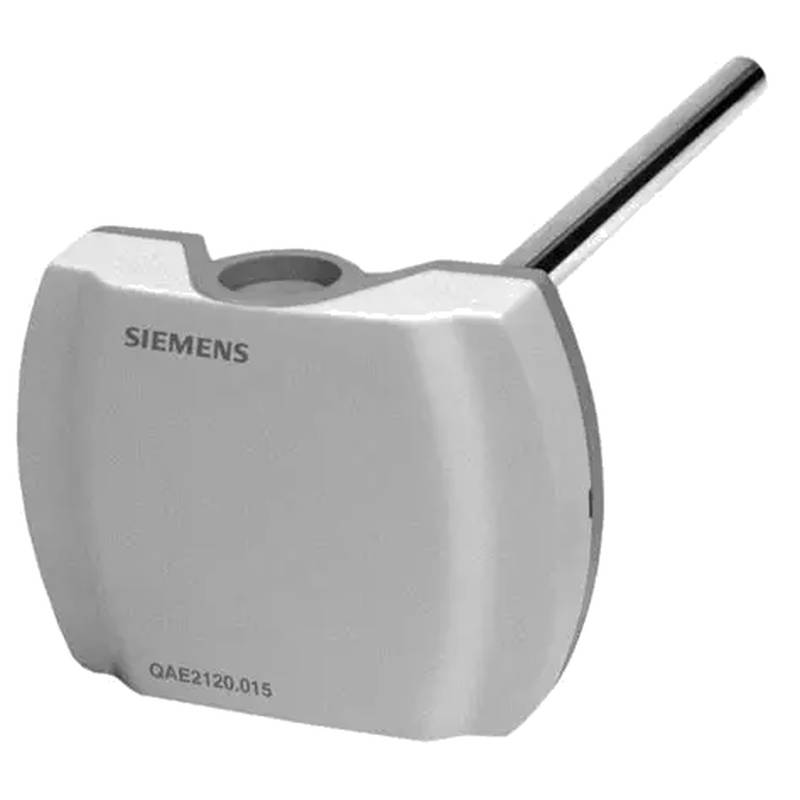
SIEMENS QAE2115.015 Immersion Temperature Sensor 1.5m Passive


The SIEMENS QAE2115.015 Immersion Temperature Sensor, a 1.5m passive sensor, stands as a robust solution for precise temperature monitoring in diverse industrial applications. Its key advantages lie in its reliable accuracy, durable construction, and straightforward integration into existing building automation and control systems. Core features include a broad measuring range, rapid response time, and a passive design that simplifies wiring and reduces potential points of failure. Technically, the QAE2115.015 boasts a measuring range of -50 to +150 °C, an accuracy of ±0.5 K at 25 °C, and utilizes a Pt1000 sensing element. Its ingress protection rating of IP67 ensures resilience against dust and water ingress, making it suitable for demanding environments.
Product Specifications
| Specification | Value |
| :----------------------- | :---------------------------------- |
| Product Type | Immersion Temperature Sensor |
| Model Number | QAE2115.015 |
| Manufacturer | Siemens |
| Cable Length | 1.5 meters |
| Sensing Element | Pt1000 |
| Measuring Range | -50 … +150 °C |
| Accuracy | ±0.5 K (at 25 °C) |
| Ingress Protection | IP67 |
| Connection Type | Passive |
| Response Time (t63) | Approx. 30 s (in water) |
| Pressure Rating | Max. 6 bar |
| Material | Stainless steel (immersion sleeve) |
Core Features & Market Positioning
The SIEMENS QAE2115.015 distinguishes itself through its inherent reliability and Siemens' established reputation for quality in industrial automation. Its passive nature is a significant differentiator, reducing the complexity of installation and maintenance compared to active sensors. This design choice also contributes to lower power consumption and inherent safety in certain hazardous environments. The sensor is positioned as a cost-effective yet highly accurate component for critical temperature monitoring tasks, offering a compelling balance of performance and value for HVAC systems, industrial process control, and utility networks. Its robust stainless-steel construction and IP67 rating underscore its suitability for environments where durability is paramount.
Key Application Scenarios
This immersion temperature sensor finds extensive use in hydronic heating and cooling systems, monitoring return and supply water temperatures to optimize energy efficiency and system performance. It is integral to industrial process loops where precise temperature control is vital for product quality and operational safety, such as in manufacturing, chemical processing, and food and beverage production. Furthermore, the QAE2115.015 is frequently deployed in building services for monitoring temperatures in pipelines, tanks, and heat exchangers, contributing to the overall management of HVAC and utility infrastructure. Its suitability for up to 6 bar pressure applications opens avenues in various closed-loop systems.
Practical System Integration Guidance
Integrating the SIEMENS QAE2115.015 involves straightforward physical installation and electrical connection. The sensor is designed to be inserted into a standard immersion sleeve or directly into a process line via a threaded connection, ensuring good thermal contact. As a passive Pt1000 sensor, it requires connection to a compatible temperature transmitter or a control system input module capable of measuring resistance. Typical wiring involves connecting the two leads of the sensor to the appropriate input terminals. For systems utilizing a dedicated temperature transmitter, refer to the transmitter's documentation for signal scaling and configuration. The 1.5-meter cable length offers flexibility in placement.
Operation and Risk Mitigation
Proper operation of the SIEMENS QAE2115.015 relies on correct installation to ensure accurate temperature readings and prevent premature failure. Users should avoid exposing the sensor to temperatures outside its specified range of -50 to +150 °C, as this can lead to damage or inaccurate measurements. The IP67 rating provides protection against dust and temporary immersion in water, but prolonged submersion or exposure to high-pressure water jets should be avoided. Regular visual inspection for physical damage to the immersion sleeve or cable can mitigate risks. In case of suspected malfunction, recalibration or replacement should be considered, with troubleshooting often starting with checking the electrical connection and the integrity of the sensing element.
Scalability & Long-Term Value
The passive nature and standard Pt1000 interface of the SIEMENS QAE2115.015 ensure excellent scalability and long-term value. It is compatible with a wide array of Siemens building management systems (BMS) and third-party control platforms that support Pt1000 inputs, allowing for seamless integration into both new and existing installations. This broad compatibility future-proofs the investment, as the sensor can be easily migrated or used in different applications as system requirements evolve. Its robust construction is designed for longevity, minimizing the need for frequent replacements and contributing to a lower total cost of ownership, aligning with the trend towards integrated digital solutions in industrial environments.
Frequently Asked Questions
What is the accuracy of the SIEMENS QAE2115.015?
The SIEMENS QAE2115.015 offers a high level of precision, rated at ±0.5 K at 25 °C. This accuracy is crucial for applications demanding tight temperature control. It ensures that system responses are based on reliable temperature data.
This accuracy ensures that critical processes are maintained within specified parameters. It minimizes deviations that could impact product quality or energy efficiency. The sensor's performance is consistent across its operational range.
For optimal accuracy, ensure the sensor is properly installed and calibrated as per Siemens guidelines. Proper thermal contact with the medium is vital for achieving the rated performance.
How do I connect the SIEMENS QAE2115.015 sensor?
This sensor is a passive Pt1000 type and requires connection to a compatible input module or transmitter. Typically, two wires from the sensor connect to the designated input terminals. Ensure correct polarity if your system requires it.
Refer to your control system's documentation for specific wiring diagrams and terminal assignments. The 1.5-meter cable offers flexibility in routing the connections.
Always de-energize the system before making any electrical connections to ensure safety. Verify the connection integrity after installation to prevent intermittent readings.
What is the temperature range for the SIEMENS QAE2115.015?
The SIEMENS QAE2115.015 is designed to operate within a wide temperature range, from -50 °C to +150 °C. This broad scope makes it suitable for diverse industrial and HVAC applications. It can monitor both extremely cold and moderately hot media.
Operating the sensor outside this specified range may lead to inaccurate readings or permanent damage. Ensure the application's temperature profile aligns with the sensor's capabilities.
This extensive range allows for flexible deployment in various heating, cooling, and process control scenarios. It covers applications from chilled water loops to hot water systems.
Can the SIEMENS QAE2115.015 be used in wet environments?
Yes, the SIEMENS QAE2115.015 features an IP67 ingress protection rating. This means it is protected against dust ingress and can withstand temporary immersion in water. This makes it suitable for many industrial and building services environments.
The IP67 rating ensures operational reliability even in conditions with high humidity or potential splashing. However, avoid prolonged submersion beyond what is specified by the IP67 standard.
Care should be taken during installation to ensure the cable gland and any other sealing points are properly secured to maintain the ingress protection. Regular checks can ensure continued protection.
What is the purpose of the Pt1000 sensing element in the QAE2115.015?
The Pt1000 element is a type of resistance temperature detector (RTD). Its electrical resistance changes predictably with temperature, allowing it to accurately measure thermal variations. This resistance change is what the connected control system interprets as a temperature reading.
Pt1000 sensors are known for their stability and accuracy over a wide temperature range. They offer a good balance between performance and cost compared to other sensor types. The "1000" indicates its resistance in ohms at 0 °C.
This element's properties make it ideal for precise industrial measurement tasks. It provides the raw data that enables effective automation and control of temperature-dependent processes.
What are the main applications for the SIEMENS QAE2115.015?
This immersion sensor is primarily used in HVAC systems for monitoring water temperatures in heating and cooling circuits. It is also deployed in industrial processes for precise temperature control in pipelines and tanks. Applications include manufacturing, chemical processing, and utility management.
It plays a critical role in optimizing energy efficiency by providing accurate feedback for control loops. Monitoring supply and return temperatures in hydronic systems is a common use case.
Its robust design and pressure rating make it suitable for closed-loop systems operating under moderate pressure. It ensures reliable temperature data acquisition in demanding operational settings.
Does the SIEMENS QAE2115.015 require external power?
No, the SIEMENS QAE2115.015 is a passive sensor. It does not require its own internal power supply to operate. Its output signal is based on the change in its internal resistance.
The sensor generates a resistance signal that is then measured and converted into a temperature reading by a connected transmitter or control system. This passive design simplifies wiring and reduces power-related failure points.
This characteristic contributes to easier installation and lower operational costs, as no dedicated power wiring is needed for the sensor itself. It is powered indirectly by the measurement circuitry.
What is the maximum pressure the SIEMENS QAE2115.015 can withstand?
The SIEMENS QAE2115.015 immersion temperature sensor has a maximum pressure rating of 6 bar. This allows it to be used in various closed-loop systems where moderate pressure is present. It is suitable for many standard industrial and building services applications.
Exceeding this pressure limit could compromise the sensor's integrity and lead to leaks or mechanical failure. Always ensure your system's operating pressure remains within this specified limit.
This pressure capability makes it a reliable choice for applications like heating circuits, cooling loops, and certain process water lines. Proper installation is key to maintaining this rating.
How does the 1.5m cable length affect installation?
The 1.5-meter cable provides flexibility in placing the sensor relative to the control panel or transmitter. This length is often sufficient for many standard industrial and HVAC applications, allowing the sensor to be mounted in hard-to-reach pipes or tanks while keeping the control interface accessible.
This standard length simplifies installation by reducing the need for custom cable lengths in many scenarios. It strikes a balance between offering reach and avoiding excessive cable management.
Consider the required distance between the measurement point and the connected equipment. The 1.5m cable should be adequate for most common direct-mount or short-run applications.
What is the response time of the SIEMENS QAE2115.015?
The response time (t63) for the SIEMENS QAE2115.015 is approximately 30 seconds in water. This indicates how quickly the sensor's output changes to reflect a new temperature. A faster response time means the system can react more promptly to temperature fluctuations.
This relatively quick response ensures that control systems receive timely data for accurate regulation of heating, cooling, or process temperatures. It is important for dynamic temperature control scenarios.
The response time can vary slightly depending on the medium and installation conditions. However, 30 seconds in water is a good benchmark for its typical performance.