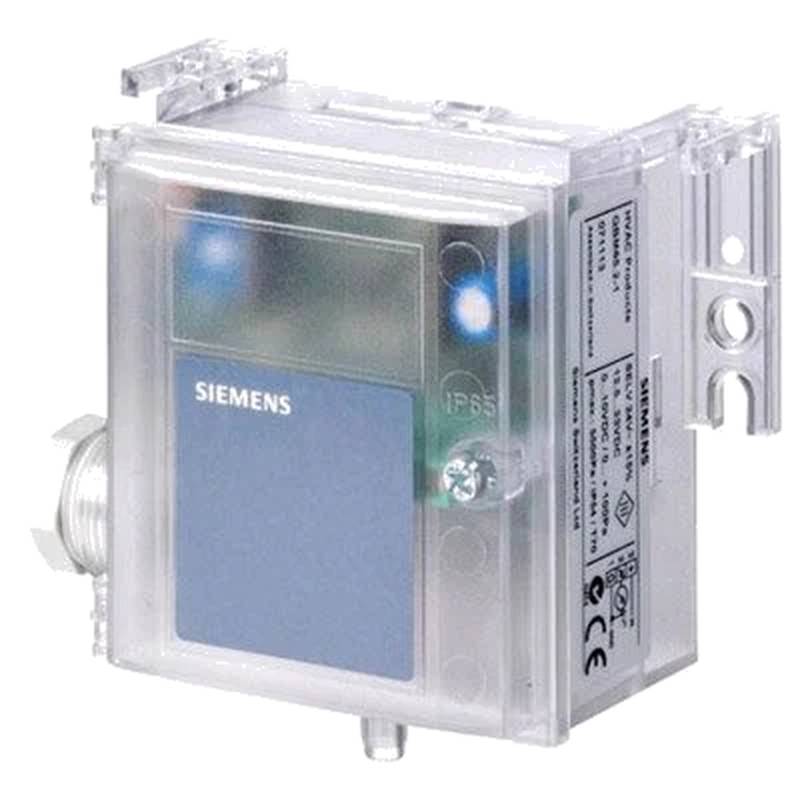
SIEMENS QBM2030-30 Air Differential Pressure Sensor 3000 Pa


The SIEMENS QBM2030-30 Air Differential Pressure Sensor is a highly accurate and reliable device engineered for precise air pressure monitoring in demanding industrial environments. Its robust design and advanced sensor technology deliver critical data for optimizing HVAC systems, ensuring process control, and maintaining safety standards. With a measurement range of 0 to 3000 Pascals (Pa), this sensor is adept at detecting subtle pressure variations essential for building automation, cleanroom applications, and industrial ventilation systems. Key advantages include its exceptional accuracy, long-term stability, and straightforward integration into existing Siemens control platforms, making it a preferred choice for engineers and system integrators seeking dependable performance and operational efficiency.
Product Specifications
| Parameter | Value |
| :------------------------------ | :------------------------------------- |
| Product Type | Air Differential Pressure Sensor |
| Model | QBM2030-30 |
| Measurement Range | 0 to 3000 Pa |
| Output Signal | 0…10 V DC |
| Power Supply | 24 V AC / DC |
| Operating Temperature | -20 to 50 °C (-4 to 122 °F) |
| Accuracy | ±5 % of full scale |
| Ingress Protection | IP65 |
| Connection Type | Screw terminals |
| Dimensions (W x H x D) | 76 x 91 x 42 mm (approx.) |
| Manufacturer | Siemens |
Core Features & Market Positioning
The SIEMENS QBM2030-30 distinguishes itself through its superior accuracy and robust construction, positioning it as a premium solution for critical pressure monitoring applications. Its ability to provide a linear 0-10 V DC output signal ensures seamless compatibility with a wide array of Building Management Systems (BMS) and direct digital control (DDC) systems. This sensor leverages advanced silicon sensing technology, offering excellent long-term stability and resistance to environmental influences, a crucial differentiator in harsh industrial settings. Compared to lower-tier alternatives, the QBM2030-30 provides a higher level of precision and reliability, reducing the need for frequent recalibration and minimizing downtime, thereby offering significant total cost of ownership advantages.
Key Application Scenarios
Engineers frequently deploy the SIEMENS QBM2030-30 for precise airflow control in Variable Air Volume (VAV) boxes, ensuring optimal comfort and energy efficiency in commercial buildings. Its high ingress protection rating (IP65) makes it ideal for use in demanding environments such as industrial ventilation systems, exhaust duct monitoring, and fume hood control, where dust and moisture are prevalent. Furthermore, this differential pressure sensor is indispensable in cleanroom applications, maintaining critical pressure differentials required to prevent contamination and ensure product integrity. It also finds application in filter monitoring, alerting operators to clogged filters and enabling timely maintenance to prevent system degradation.
Practical System Integration Guidance
Integrating the SIEMENS QBM2030-30 is streamlined due to its standard 0-10 V DC output and 24 V AC/DC power requirement, facilitating easy connection to most control systems. For installation, ensure the sensor is mounted in a location free from excessive vibration and direct exposure to environmental contaminants. The pressure ports should be connected to the high-pressure (HP) and low-pressure (LP) sides of the system being monitored using appropriate tubing. Typically, the HP port connects to the higher pressure source, and the LP port to the lower pressure source. Wiring involves connecting the power supply (24 V AC/DC) to the designated terminals and the output signal to the analog input of the controller. Careful attention to polarity and secure terminal connections is vital for reliable operation.
Operation and Risk Mitigation
Proper operation of the SIEMENS QBM2030-30 hinges on correct installation and calibration. Users should avoid exposing the sensor to pressures exceeding its 3000 Pa range, as this can lead to inaccurate readings or permanent damage. Regular checks of the pressure tubing for leaks or blockages are essential for maintaining measurement accuracy. In case of erratic readings, verify power supply voltage, signal wiring, and the integrity of the pressure connections. The sensor is designed for continuous operation within its specified temperature range of -20 to 50 °C; exceeding these limits can affect performance and lifespan. Faulty readings often stem from improper zero-point calibration or air ingress into the sensing diaphragm.
Scalability & Long-Term Value
The SIEMENS QBM2030-30 offers excellent long-term value through its compatibility with the broader Siemens Desigo™ building automation platform and other open-system controllers. Its standardized analog output ensures it can be readily integrated into new installations or retrofitted into existing HVAC control strategies without requiring proprietary gateways. This sensor's robust design and Siemens' reputation for quality manufacturing translate into extended service life and reduced maintenance costs. For facilities looking to embrace the Industrial Internet of Things (IIoT), the QBM2030-30's data can be easily digitized and transmitted to cloud-based analytics platforms for advanced performance monitoring, predictive maintenance, and energy optimization strategies, enhancing operational intelligence.
FAQs
What is the primary function of the SIEMENS QBM2030-30 sensor?
Its main purpose is to measure and monitor differential air pressure. This is crucial for HVAC systems.
It provides accurate data for airflow control and system balancing. This ensures comfort and efficiency.
The sensor helps detect issues like clogged filters or duct leaks. This prevents system failures and improves air quality.
What are the key technical specifications of the QBM2030-30?
It measures pressure from 0 to 3000 Pascals. It outputs a 0-10 V DC signal.
The sensor requires a 24 V AC or DC power supply. It operates between -20 and 50 °C.
Its accuracy is within ±5% of full scale. It has an IP65 protection rating.
Where is the SIEMENS QBM2030-30 commonly applied?
It is widely used in VAV box airflow control applications. It ensures precise air delivery.
Industrial ventilation and cleanroom pressure monitoring benefit greatly. It maintains strict environmental control.
It also serves in filter status monitoring. This helps schedule essential maintenance.
How is the QBM2030-30 sensor installed?
Mount it in a stable location, avoiding vibrations. Connect pressure ports to HP and LP sides.
Ensure proper tubing for accurate differential readings. Secure all connections.
Wire the 24V power and 0-10V signal to the controller. Follow wiring diagrams closely.
What kind of output signal does this sensor provide?
The sensor generates a linear 0-10 V DC analog output. This is a standard signal for many controllers.
This voltage output directly corresponds to the measured pressure. Higher pressure differences yield higher voltage.
This allows for easy integration with BMS and DDC systems. It simplifies data acquisition.
What is the operating temperature range for this sensor?
The sensor operates reliably between -20°C and 50°C. This covers most indoor environments.
Operating outside this range can impact accuracy and longevity. Extreme temperatures are detrimental.
Ensure the installation location respects these limits for optimal performance. Check system schematics.
Can this sensor be used outdoors?
Its IP65 rating offers protection against dust and low-pressure water jets. This allows for some outdoor use.
However, direct exposure to harsh weather should be avoided. Consider supplementary shielding.
It's best suited for protected outdoor locations or indoor applications. Always consult installation manuals.
What does the 0-3000 Pa measurement range signify?
It means the sensor can accurately detect pressure differences from 0 to 3000 Pascals. This is a common range for HVAC.
This range is suitable for typical building ventilation and pressure control needs. It's not for extremely high pressures.
Higher values indicate greater pressure differences. This helps in monitoring airflow restrictions.
How accurate is the SIEMENS QBM2030-30 sensor?
The accuracy is rated at ±5% of its full measurement scale. This is a good level for many applications.
For highly critical, ultra-precise measurements, calibration may be needed. Recalibration ensures ongoing accuracy.
This specification ensures reliable performance for most building automation tasks. It's a dependable choice.
Is this sensor compatible with non-Siemens systems?
Yes, its standard 0-10 V DC output makes it highly compatible. It integrates with various control platforms.
You can connect it to any controller accepting this analog signal. This offers system flexibility.
It's a versatile component for retrofits or mixed-vendor installations. It avoids vendor lock-in.