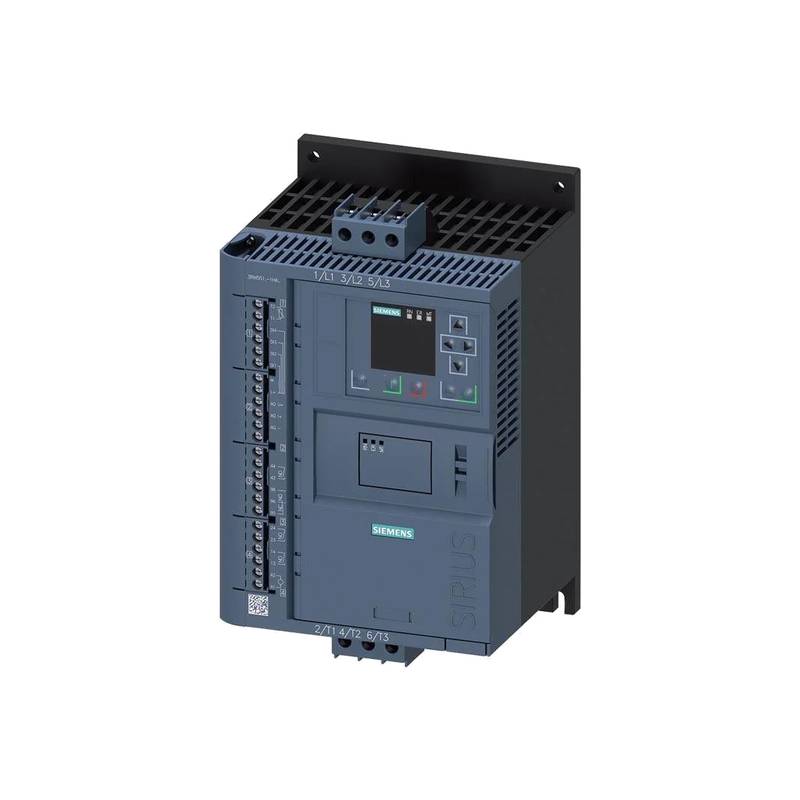













SIEMENS 6SL3735-7TE36-1LA3 SINAMICS S120 Active Line Connection Module 380kW 605A Liquid Cooled including AIM 400V


The SIEMENS 6SL3735-7TE36-1LA3 SINAMICS S120 Active Line Connection Module is a powerhouse of modern industrial automation, engineered for demanding applications requiring high-performance motor control. This liquid-cooled module, boasting a 380kW power rating and 605A current capacity, integrates seamlessly with a 400V supply via its Active Line Module (AIM). Its primary advantages lie in its superior energy efficiency, robust heat dissipation capabilities thanks to liquid cooling, and precise, dynamic motor control. This unit is designed to deliver exceptional performance and reliability in critical industrial processes.
Product Specifications
| Feature | Specification |
| :------------------------- | :------------------------------------------ |
| Product Type | SINAMICS S120 Active Line Connection Module |
| Model Number | 6SL3735-7TE36-1LA3 |
| Rated Power Output | 380 kW |
| Rated Current | 605 A |
| Cooling Method | Liquid Cooled |
| Input Voltage | 400V (with AIM) |
| Integration | Active Line Module (AIM) |
| System | SINAMICS S120 |
Core Features & Market Positioning
The SIEMENS 6SL3735-7TE36-1LA3 stands out in the industrial drive market due to its advanced Active Line Module (AIM) technology. Unlike passive filters or traditional infeed systems, the AIM ensures a near-unity power factor, significantly reducing reactive power consumption and harmonic distortion injected back into the grid. This translates to substantial energy savings and compliance with stringent power quality standards, positioning the SINAMICS S120 as a premium, future-proof solution for energy-conscious industries. The liquid-cooled design further enhances its marketability for high-density installations and environments with limited airflow, offering superior thermal management and extended operational lifespan compared to air-cooled alternatives.
Key Application Scenarios
This high-performance module is engineered for a wide array of demanding industrial applications. It excels in sectors such as manufacturing, where precise control of large machinery like extruders, injection molding machines, and complex conveyor systems is paramount. In the metals industry, it’s crucial for driving rolling mills and processing lines requiring high torque and dynamic response. The automotive sector benefits from its application in automated assembly lines and robotic systems demanding consistent and reliable motor performance. Furthermore, its robust design and efficient cooling make it ideal for heavy-duty applications in the chemical and pharmaceutical industries where continuous operation and precise process control are non-negotiable.
Practical System Integration Guidance
Integrating the SIEMENS 6SL3735-7TE36-1LA3 SINAMICS S120 module requires careful attention to its liquid-cooling circuit and power connections. The liquid cooling system necessitates a dedicated, closed-loop coolant circuit, typically utilizing a mixture of water and a corrosion inhibitor. Proper routing of coolant lines, ensuring no kinks and adequate flow rate, is critical for preventing thermal overload. Power integration involves connecting the 400V supply to the Active Line Module (AIM) and subsequently to the line connection module. Configuration is typically managed via Siemens' TIA Portal software, allowing for detailed parameterization of motor data, control modes, and safety functions to match specific application requirements. Ensuring correct grounding and shielding practices is essential to minimize electromagnetic interference.
Operation and Risk Mitigation
Effective operation of the SIEMENS 6SL3735-7TE36-1LA3 SINAMICS S120 module hinges on adherence to operational parameters and proactive risk mitigation. Regular monitoring of coolant temperature and flow rates is vital; deviations can lead to performance degradation or system shutdown. Users must implement a robust maintenance schedule, including periodic checks of coolant quality and connection integrity. Common fault codes often relate to thermal limits (e.g., F7800) or communication errors. Mitigating risks involves ensuring the drive is operated within its specified ambient temperature and humidity range, utilizing appropriate surge protection for the power supply, and ensuring all safety interlocks are correctly configured and functional. Proper training for personnel operating and maintaining the equipment is also a key risk mitigation strategy.
Scalability & Long-Term Value
The SINAMICS S120 platform, with modules like the 6SL3735-7TE36-1LA3, offers significant scalability and long-term value. Its modular design allows for the expansion of motor control capabilities by paralleling additional drive units or incorporating different types of SINAMICS S120 components, such as servo modules or safety integrated functions. This future-proofing ensures that the system can adapt to evolving production demands without requiring a complete overhaul. Furthermore, its compatibility with Siemens' Industrial Internet of Things (IIoT) ecosystem, including platforms like MindSphere, enables advanced diagnostics, predictive maintenance, and remote monitoring, maximizing uptime and optimizing operational efficiency throughout the system's lifecycle.
Frequently Asked Questions
Q1: What are the primary benefits of liquid cooling for this Siemens drive module?
Liquid cooling offers superior heat dissipation compared to air cooling. This enables higher power density and continuous operation under heavy loads. It also extends the operational lifespan of the module by maintaining optimal component temperatures.
This advanced thermal management reduces the risk of thermal runaway events. It's ideal for enclosed cabinets or high-ambient temperature environments. This ensures consistent performance and reliability.
The liquid-cooled design can lead to quieter operation and less reliance on large ventilation systems. It contributes to a more efficient overall plant infrastructure. This enhances the operational environment.
Q2: How does the Active Line Module (AIM) improve power quality?
The AIM actively controls the current waveform drawn from the supply. It maintains a power factor very close to unity (1.0). This significantly reduces reactive power consumption by the drive.
By actively managing the input current, the AIM minimizes harmonic distortion. This prevents the injection of unwanted frequencies back into the power grid. It helps comply with grid codes.
This active infeed technology results in substantial energy savings. It reduces utility bills and enhances overall grid stability. It is a key differentiator for this drive.
Q3: What are typical applications for the SINAMICS S120 6SL3735-7TE36-1LA3?
This module is suited for heavy-duty industrial applications. Think of large extruders in plastics manufacturing. It's also used in demanding metal processing lines and large pump/fan control.
It is ideal for applications requiring precise speed and torque control. This includes automated production lines and robotics. Its robustness is key for continuous operation.
Sectors benefiting include automotive, chemical, and general manufacturing. Anywhere high power and dynamic performance are needed, this drive excels.
Q4: What is the role of the Active Line Connection Module?
The Active Line Connection Module is a key part of the SINAMICS S120 system. It interfaces the Active Line Module (AIM) with the motor. It provides the controlled power output to the motor.
It enables regenerative energy feedback to the supply. This means energy generated during deceleration can be reused. This further boosts efficiency.
This component is crucial for the drive’s dynamic response and controllability. It allows for precise motor operation in demanding cycles.
Q5: Can this module be integrated into existing Siemens automation systems?
Yes, the SINAMICS S120 platform is designed for seamless integration. It works with Siemens' TIA Portal engineering framework. This allows for unified control and diagnostics.
It can communicate with various Siemens PLCs like SIMATIC S7. Standard industrial communication protocols are supported. This ensures compatibility with existing control architectures.
The modular design facilitates upgrades and expansion. It can be incorporated into existing or new automation setups with relative ease.
Q6: What are the safety considerations when installing this liquid-cooled drive?
Proper grounding of all components is essential. Liquid cooling systems must be leak-tested before energizing the drive. Ensure the coolant is electrically non-conductive.
Follow all local electrical codes and Siemens installation guidelines. Ensure adequate clearance for maintenance and heat dissipation. Safety interlocks must be correctly wired and tested.
Personnel must be trained in high-voltage safety and drive operation. Emergency stop functionality should be readily accessible and verified.
Q7: How does the liquid cooling system work in this module?
A dedicated coolant circulates through internal channels. This coolant absorbs heat generated by power electronics. The heated coolant then flows to an external heat exchanger.
The heat exchanger dissipates the heat to the environment or a central cooling system. Cooled coolant is then returned to the module. This creates a continuous cooling loop.
The efficiency of this system is paramount. It ensures the drive operates within safe thermal limits. This allows for its high power rating.
Q8: What is the typical efficiency rating of a SINAMICS S120 with an Active Line Module?
Drives with an Active Line Module boast very high efficiencies. They typically operate with a power factor near unity. This minimizes energy loss in the supply.
The overall system efficiency is enhanced by regenerative capability. Energy can be fed back to the grid during deceleration. This improves energy utilization significantly.
Specific efficiency figures depend on the motor and load profile. However, they are among the most efficient drive solutions available.
Q9: How can I troubleshoot common issues with the 6SL3735-7TE36-1LA3?
Begin by checking the fault codes displayed on the control unit. Consult the SINAMICS S120 system manuals for code explanations. Review alarm logs for recurring issues.
Verify power supply and coolant flow parameters. Ensure motor connections and parameters are correctly set in the software. Check for any loose wiring or external interferences.
If issues persist, consult Siemens support or a certified technician. Document all troubleshooting steps taken. This aids in faster resolution.
Q10: What is the advantage of an Active Line Connection Module over a standard infeed?
An Active Line Connection Module, paired with an AIM, offers superior grid compatibility. It minimizes harmonic distortion and provides a high power factor. This reduces grid impact and energy costs.
Standard infeed units may require bulky line filters. Active connection modules are more compact and efficient. They offer better dynamic performance and control.
The active nature allows for features like regenerative energy feedback. This is often not possible with simpler, passive infeed solutions.