











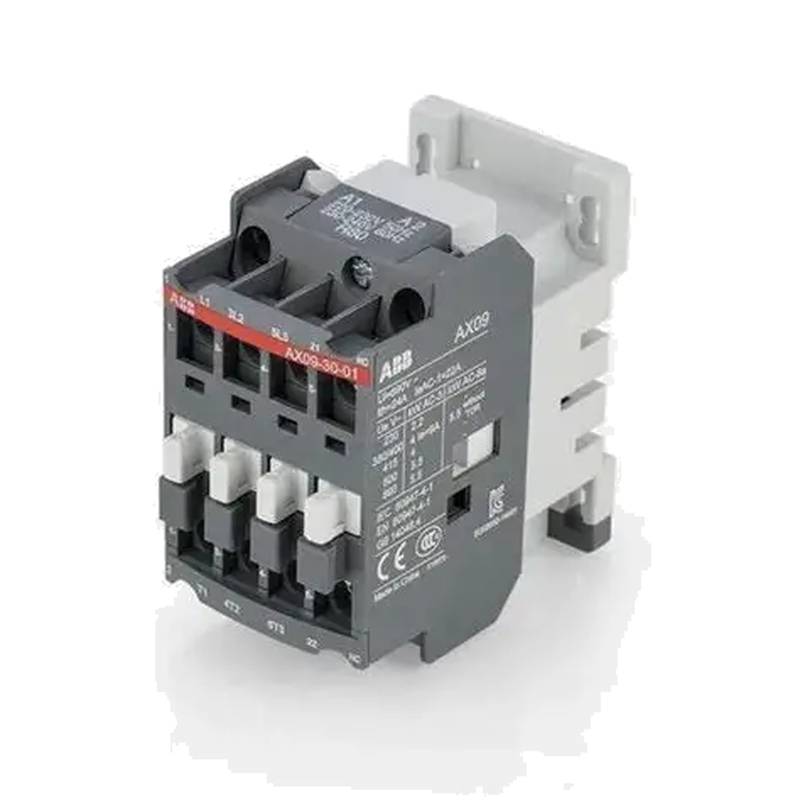
ABB AX185-30-11-84 Contactor 3P 185A 110V AC Control


The ABB AX185-30-11-84 Contactor is a robust, three-pole, 185-amp AC contactor designed for reliable power control in demanding industrial applications. Featuring a 110V AC control circuit, this contactor offers superior operational efficiency, enhanced safety, and a compact design, making it a preferred choice for motor control, power distribution, and various switching tasks. Its key advantages lie in its high switching capacity, extended electrical life, and seamless integration into automated systems. Critical technical parameters include a rated operational voltage of up to 1000V, a rated operational current of 185A at AC-3 utilization category, and a coil voltage of 110V AC.
| Parameter | Specification |
| :-------------------- | :------------------------------------------ |
| Product Type | Contactor |
| Manufacturer | ABB |
| Model Number | AX185-30-11-84 |
| Poles | 3-Pole |
| Rated Operational Current (AC-3) | 185 A |
| Coil Voltage | 110 V AC |
| Rated Operational Voltage | Up to 1000 V AC |
| Auxiliary Contacts | 1 Normally Open (NO), 1 Normally Closed (NC) |
| Terminal Type | Screw Terminals |
| Mounting | DIN Rail or Panel Mount |
Core Features & Market Positioning
The ABB AX185-30-11-84 distinguishes itself through its advanced contact design, which ensures minimal contact bounce and extended durability, leading to a significantly longer electrical lifespan compared to conventional contactors. This durability is crucial for applications requiring frequent switching cycles, such as in pump stations or conveyor systems. Its robust construction and adherence to international standards like IEC 60947-4-1 and IEC 60947-5-1 underscore its reliability in harsh industrial environments, positioning it as a premium solution for critical power management. The integrated auxiliary contacts simplify control circuit design, further enhancing its value proposition in the competitive market for industrial switching devices.
Key Application Scenarios
This ABB AX185-30-11-84 contactor is engineered for a wide array of heavy-duty applications. It is ideally suited for direct-on-line (DOL) starting of three-phase motors up to 90 kW at 400V, commonly found in manufacturing plants, processing facilities, and water treatment systems. Additionally, it serves effectively in power distribution panels, capacitor bank switching for power factor correction, and as a main switch for machinery and equipment. The 110V AC control voltage is a standard in many industrial control systems, ensuring straightforward integration into existing infrastructure.
Practical System Integration Guidance
Integrating the ABB AX185-30-11-84 into your system is streamlined due to its versatile mounting options, including standard 35mm DIN rail or direct panel mounting. Wiring the power terminals requires adherence to proper torque specifications to ensure secure connections and prevent overheating. The coil is connected to the 110V AC control circuit, with the auxiliary contacts (1 NO, 1 NC) available for interlocking, signaling, or control logic integration. Ensure that the main circuit voltage and current ratings do not exceed the contactor's specifications to prevent premature failure or safety hazards.
Operation and Risk Mitigation
Safe operation of the AX185-30-11-84 contactor mandates adherence to all electrical safety protocols, including proper lockout/tagout procedures during maintenance. The contactor is designed with inherent arc-quenching capabilities, minimizing the risk of electrical fires. Key troubleshooting steps involve checking the control voltage supply to the coil for consistency, verifying the integrity of the power and control wiring, and inspecting the main contacts for signs of wear or welding. Overloading the contactor beyond its rated capacity is a primary cause of failure and must be strictly avoided.
Scalability & Long-Term Value
The ABB AX185-30-11-84 offers significant long-term value through its compatibility with ABB's broader range of control and automation components. Its robust design ensures a prolonged service life, reducing the total cost of ownership. While direct upgrade paths for contactors are less common, their inherent reliability and adherence to industry standards mean they can remain operational for many years, seamlessly supporting evolving industrial processes. For integration into modern digital solutions, it can be paired with intelligent devices for remote monitoring and control, aligning with Industry 4.0 principles.
Frequently Asked Questions
What is the typical lifespan of an ABB AX185-30-11-84 contactor?
The electrical lifespan of this contactor is rated for a significant number of switching operations, often in the hundreds of thousands, depending on the load and operating conditions. Factors like frequent switching, high inrush currents, and environmental conditions can influence its actual service life. Proper installation and avoiding overloads are key to maximizing its durability and performance over time.
This contactor is built with robust materials and advanced contact technology to ensure reliability and longevity in demanding industrial settings. ABB is known for producing high-quality components designed for extended operational periods, making this unit a dependable choice for critical applications. Its design minimizes wear and tear associated with electrical switching, contributing to its overall longevity and reducing the need for frequent replacements.
Regular maintenance, including periodic inspection of the main and auxiliary contacts for signs of wear or damage, can further extend the operational life of the AX185-30-11-84. Ensuring that the control voltage remains stable and within the specified limits also contributes to preventing premature coil failure. By adhering to the operational guidelines and performing necessary checks, users can achieve optimal service life from this contactor.
How do I wire the auxiliary contacts on the AX185-30-11-84?
The AX185-30-11-84 comes with one normally open (NO) and one normally closed (NC) auxiliary contact block. These are typically mounted on the front of the contactor and can be easily snapped into place. The NO contact will close when the main contactor coil is energized, and the NC contact will open.
To wire the NO auxiliary contact, connect one wire to the terminal marked with a leading '1' (e.g., 13) and the other wire to the terminal marked with a trailing '3' (e.g., 14). For the NC auxiliary contact, connect one wire to the terminal marked with a leading '2' (e.g., 21) and the other to the terminal marked with a trailing '1' (e.g., 22). Refer to the product's wiring diagram for precise terminal numbering.
These auxiliary contacts are useful for signaling the status of the main contactor (e.g., to a PLC or indicator light), for interlocking purposes with other devices, or for implementing control logic that requires feedback on the contactor's state. Always ensure power is disconnected before making any wiring changes.
What are the primary applications for the ABB AX185-30-11-84?
The AX185-30-11-84 is primarily used for direct-on-line (DOL) starting of three-phase induction motors, particularly in applications requiring high current switching capabilities. It is also widely employed in power distribution systems for switching power circuits and in industrial automation for controlling various types of machinery.
This contactor is well-suited for heavy-duty applications such as those found in manufacturing plants, material handling systems, pumping stations, and HVAC systems where reliable motor control is paramount. Its 185A rating makes it suitable for motors up to approximately 90 kW at 400V AC-3 duty.
Beyond motor control, it can be utilized for switching resistive loads, capacitor banks for power factor correction, and in general power switching applications within industrial electrical installations. Its robust design ensures performance even under challenging industrial operating conditions.
Can the AX185-30-11-84 be used with DC loads?
The ABB AX185-30-11-84 is specifically designed and rated for AC (Alternating Current) applications and should not be used for switching DC (Direct Current) loads. AC contactors have different arc-quenching characteristics compared to DC contactors, and using this unit for DC loads can lead to improper operation, premature failure, and significant safety hazards.
Switching DC loads requires contactors specifically designed with appropriate DC utilization categories (e.g., DC-1, DC-3, DC-13) and often incorporate stronger magnetic blow-out coils to effectively extinguish the DC arc. Attempting to use an AC contactor on DC circuits can result in the arc not being extinguished, leading to contact welding or burning.
For DC switching applications, it is essential to select a contactor explicitly rated for DC voltage and current, adhering to the relevant IEC or NEMA standards for DC utilization categories. Always consult the manufacturer's datasheet to confirm the suitability of a contactor for the intended load type.
What is the significance of the "30" in AX185-30-11-84?
The "30" in the ABB AX185-30-11-84 product code typically refers to the number of main poles and the configuration of auxiliary contacts. In this specific model, the "30" indicates that it is a 3-pole contactor (as opposed to a 2-pole or 4-pole configuration) and includes standard auxiliary contacts.
More precisely, the "30" designation often implies a standard configuration for the auxiliary contacts. For the AX series, the first digit of the auxiliary contact code (in this case, implied by "30") usually signifies the number of normally open (NO) contacts, and the second digit signifies the number of normally closed (NC) contacts. Thus, "30" in some ABB contactor series might mean 3 NO and 0 NC, but for the AX185-30-11-84 specifically, the "11" part of the model number clarifies the auxiliary contacts.
In the context of AX185-30-11-84, the "30" part primarily denotes the 3-pole configuration. The subsequent "11" indicates the auxiliary contacts: one normally open (NO) and one normally closed (NC). Therefore, the "30" part of the model number is crucial for identifying the main power switching poles.
What does "110V AC Control" mean for this contactor?
"110V AC Control" signifies the voltage required to energize the coil of the AX185-30-11-84 contactor, causing its main power contacts to close and establish the circuit. This is the "command" signal voltage that activates the switching mechanism.
The control circuit of the contactor is designed to operate at a nominal voltage of 110 volts and is powered by an AC source. This voltage level is common in many industrial control panels, allowing for safe and standardized integration into automation systems and electrical switchgear.
When this 110V AC voltage is applied to the contactor's coil terminals, it creates a magnetic field that pulls the armature, thereby closing the main power contacts and enabling current flow through the load, and also actuating the auxiliary contacts. Removing this voltage de-energizes the coil, and the contacts return to their normal state.
How do I select the correct contactor for my motor application?
Selecting the correct contactor involves matching its ratings to the motor's requirements. You need to consider the motor's full load current (FLC), voltage, horsepower (HP) or kilowatt (kW) rating, and the duty cycle of the application (e.g., AC-3 for motor starting). The AX185-30-11-84 is rated for 185A at AC-3, making it suitable for motors up to around 90kW at 400V.
Ensure the contactor's control coil voltage matches your available control power. For instance, this model uses 110V AC. Also, verify that the number of poles (3 for a three-phase motor) and the expected number of switching cycles align with your application's demands.
Always consult the motor nameplate and the contactor's datasheet. The contactor's breaking capacity and short-circuit withstand capability should also be considered to ensure safety and reliability in case of fault conditions. Over-specifying slightly can provide a safety margin and extend the contactor's life.
What is the difference between AC-1 and AC-3 utilization categories?
The AC-1 utilization category refers to the switching of resistive loads, such as heaters, where the current is relatively stable and there is no significant inrush. Contactors rated for AC-1 can handle higher currents for purely resistive loads compared to motor loads.
The AC-3 utilization category is specifically for starting squirrel cage motors and switching them off. This category accounts for the high inrush current when a motor starts (typically 5-8 times the rated current) and the current during normal running. The AX185-30-11-84 is rated at 185A for AC-3, which is a more stringent requirement than AC-1 for the same contactor size.
When selecting a contactor for motor control, it is crucial to use the AC-3 rating, as the starting current is much higher than the running current. Using an AC-1 rating for a motor application could lead to contact damage or premature failure due to the excessive starting current.
Can I add more auxiliary contacts to the AX185-30-11-84?
Yes, the ABB AX185-30-11-84 contactor is designed to accept additional auxiliary contact blocks, allowing you to expand its signaling and control capabilities. These blocks are typically modular and can be easily attached to the front or side of the main contactor body.
You can purchase and install additional normally open (NO) or normally closed (NC) auxiliary contacts to meet the specific requirements of your control system. This is useful for applications that require multiple feedback signals or more complex interlocking logic. Always ensure that any added auxiliary contacts are compatible with the AX185 series.
When installing additional auxiliary contacts, ensure they are securely attached and correctly wired according to ABB's documentation. The total number of auxiliary contacts that can be added may be limited by the contactor's physical space and the manufacturer's specifications, so it's advisable to check the product manual.
What safety precautions should be taken when installing or maintaining this contactor?
Always ensure that the power supply to both the main circuit and the control circuit is completely disconnected and properly locked out and tagged out before beginning any installation or maintenance work. This prevents accidental energization and potential electrical shock hazards.
Wear appropriate personal protective equipment (PPE), including safety glasses, insulated gloves, and non-conductive footwear, when working with electrical equipment. Ensure that the installation environment is dry and that all connections are made securely to the correct terminals with the specified torque settings to prevent loose connections and overheating.
After installation or maintenance, perform a thorough visual inspection and a functional test with the power supply safely restored. Verify that the contactor operates correctly and that all associated safety interlocks and protective devices are functioning as intended before returning the equipment to service.