











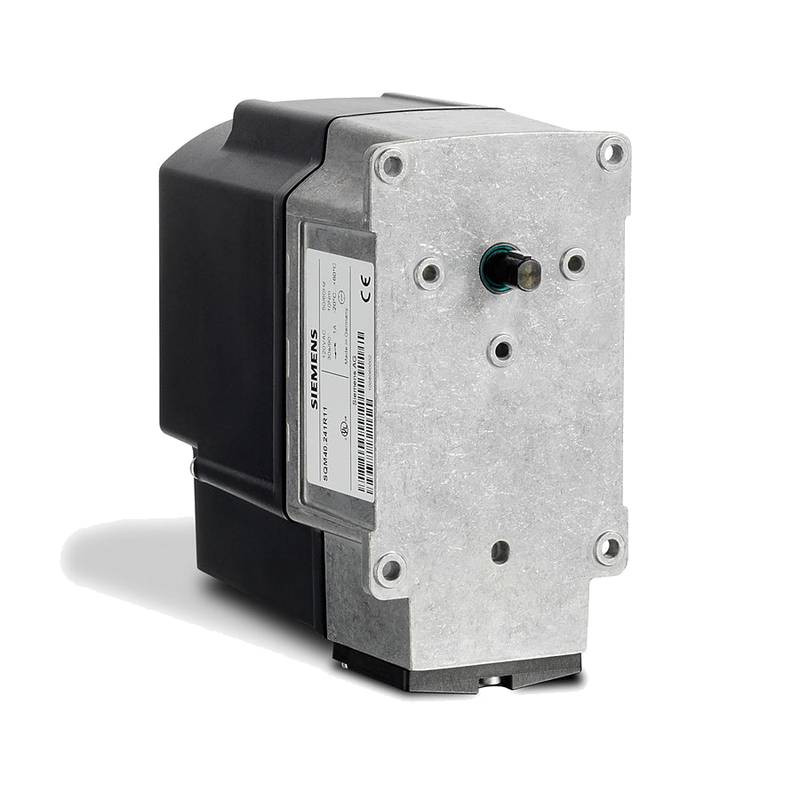
Siemens SQM41.245A21 Spring Return Burner Actuator


The Siemens SQM41.245A21 Spring Return Burner Actuator is a robust and precise control component engineered for demanding industrial combustion applications. Its core advantages lie in its reliable spring return functionality, ensuring safe shutdown in power loss scenarios, and its high-resolution positioning capabilities, critical for optimal burner performance and fuel efficiency. With a fast response time and a durable design, this actuator is an indispensable part of modern burner management systems, offering precise control over fuel and air dampers.
Product Specifications
| Feature | Specification |
| :--------------------- | :--------------------------------------------- |
| Actuator Type | Spring Return |
| Torque | 5 Nm |
| Voltage | 230 V AC |
| Rotational Angle | 90° (adjustable) |
| Control Signal | 3-point |
| Running Time | 20 seconds (for 90° rotation) |
| Auxiliary Switches | Integrated |
| Protection Class | IP54 |
| Operating Temperature | -20°C to +60°C |
| Connection Type | Screw terminals |
| Mounting | Direct mounting on butterfly damper shaft |
| Application | Gas, oil, and dual-fuel burners |
Core Features & Market Positioning
The Siemens SQM41.245A21 distinguishes itself through its superior build quality and intelligent design, making it a preferred choice for applications demanding utmost reliability. Its spring return mechanism is a critical safety feature, guaranteeing the actuator returns to a safe position during power interruptions, thereby preventing hazardous conditions. Furthermore, the actuator's precise control, driven by its 3-point positioning system and adjustable rotational angle, allows for fine-tuning of the air-fuel mixture. This leads to significant improvements in combustion efficiency, reduced emissions, and extended equipment lifespan, positioning it as a high-value component in competitive burner control markets. Its compatibility with various burner types, from gas to oil and dual-fuel systems, further enhances its market appeal.
Key Application Scenarios
The Siemens SQM41.245A21 Spring Return Burner Actuator finds its primary applications in commercial and industrial heating systems where precise combustion control is paramount. This includes its use in industrial boilers, process heaters, and large-scale furnaces within manufacturing plants, power generation facilities, and commercial buildings. Its ability to accurately modulate fuel and air flow makes it ideal for applications requiring stable temperature control, such as in the chemical processing industry, food and beverage production, and metal fabrication. The actuator is also a critical component in systems where safety interlocks are essential, ensuring a controlled shutdown in the event of operational anomalies.
Practical System Integration Guidance
Integrating the Siemens SQM41.245A21 into existing or new burner control systems is facilitated by its straightforward design. Direct mounting onto the butterfly damper shaft simplifies mechanical installation. Electrical connections are made via screw terminals, with clear labeling for power, control signals, and auxiliary switch outputs. The 3-point control signal (typically ON/OFF with intermediate positioning) requires appropriate wiring from the burner management controller. The auxiliary switches, integrated within the actuator, can be wired to provide feedback on the actuator's position (e.g., fully open, fully closed, or intermediate) to the controller, enhancing system monitoring and safety. Proper grounding and adherence to local electrical codes are essential during installation.
Operation and Risk Mitigation
Operating the Siemens SQM41.245A21 involves ensuring it receives the correct control signals from the burner management system. The actuator's internal gearing and motor drive the output shaft to achieve the desired damper position, while the spring mechanism provides the fail-safe return. Risk mitigation is primarily addressed through the inherent spring return feature, which ensures a safe state upon power loss. Regular maintenance, including checking for free movement of the damper and actuator linkage, and verifying the functionality of auxiliary switches, is crucial. While specific fault codes are typically managed by the burner management controller, common issues can include a failure to reach a commanded position, which might indicate mechanical obstruction, insufficient control signal, or internal actuator malfunction.
Scalability & Long-Term Value
The Siemens SQM41.245A21 offers excellent long-term value due to its robust construction and compatibility with Siemens' broader industrial automation portfolio. While not directly an IIoT device, its integration into modern burner management systems allows for data acquisition and analysis through connected controllers, contributing to smart factory initiatives. Its standardized mounting and control interface ensure compatibility with a wide range of burner systems and controllers, providing flexibility for system upgrades or expansions. The durability of the SQM41.245A21 minimizes the need for premature replacement, contributing to lower total cost of ownership over the lifecycle of the combustion equipment.
*
Frequently Asked Questions (FAQs)
Q1: What is the primary function of the Siemens SQM41.245A21?
The SQM41.245A21 is a spring return actuator for burner control. It precisely positions air and fuel dampers. Its spring action ensures a safe shutdown position during power loss.
This function is critical for safe burner operation and system integrity. It guarantees a predefined safe state when control power is interrupted. This prevents hazardous conditions in combustion systems.
The actuator allows for optimized air-fuel ratios, enhancing combustion efficiency. This leads to reduced fuel consumption and lower emissions. It is vital for reliable and economical industrial heating.
Q2: What torque and voltage specifications does the SQM41.245A21 have?
This actuator provides a torque of 5 Nm. It operates on a standard 230 V AC power supply. This makes it suitable for many industrial electrical systems.
The 5 Nm torque is sufficient for actuating typical butterfly dampers in gas, oil, and dual-fuel burners. The 230 V AC requirement is common in industrial settings worldwide.
Users must ensure their power source matches these specifications for proper operation. Incorrect voltage can lead to damage or malfunction. Always consult system schematics.
Q3: Can the SQM41.245A21 be used with different types of burners?
Yes, the SQM41.245A21 is designed for versatile application. It works with gas, oil, and dual-fuel burners. This flexibility is a key advantage for system integrators.
Its precise modulation capabilities are beneficial for maintaining optimal combustion across various fuel types. This ensures efficiency and emission compliance regardless of fuel source.
The actuator's robust design ensures reliability in demanding industrial environments. It is a staple in many different combustion control setups.
Q4: How is the SQM41.245A21 installed and wired?
Installation is typically direct onto the butterfly damper shaft. Wiring uses screw terminals for power and control signals. Auxiliary switches are also wired via terminals.
The 3-point control signal requires proper connection from a burner management controller. Ensuring correct wiring prevents operational errors and ensures safety interlocks function.
Always follow the manufacturer's wiring diagrams and local electrical codes for safe and compliant installation. Proper grounding is essential.
Q5: What does "spring return" mean in the context of this actuator?
"Spring return" signifies a fail-safe mechanism. In case of power loss, an internal spring forces the actuator to a predefined safe position. This is usually a closed or low-fire position.
This feature is paramount for safety in combustion systems. It prevents uncontrolled fuel flow if the actuator loses power. It ensures a safe shutdown state.
The spring return function is a critical safety interlock. It complements the control logic of the burner management system for enhanced operational security.
Q6: What are the key technical parameters for the SQM41.245A21?
Key parameters include 5 Nm torque, 230 V AC voltage, and 90° maximum rotation. It has a running time of 20 seconds for 90° rotation. It features a 3-point control signal.
The IP54 protection class indicates good resistance to dust and water splashes. The operating temperature range is -20°C to +60°C, suitable for many industrial environments.
These specifications define its operational envelope and suitability for specific applications. Always verify these against your system requirements.
Q7: How does the SQM41.245A21 contribute to energy efficiency?
Precise modulation of air and fuel by the SQM41.245A21 ensures optimal combustion. This minimizes wasted fuel and maximizes heat output. Efficient combustion directly translates to reduced energy consumption.
By maintaining the ideal air-fuel ratio, it prevents incomplete combustion and excess air, both of which reduce efficiency. This precise control leads to better thermal performance of the burner.
Over time, improved efficiency leads to significant cost savings on fuel expenses. It also helps in meeting stricter environmental regulations due to lower emissions.
Q8: What is the role of auxiliary switches in the SQM41.245A21?
Auxiliary switches provide feedback on the actuator's position. They signal to the burner management system when the damper is fully open, closed, or at an intermediate position. This enables more sophisticated control and safety monitoring.
These switches are essential for interlocking functions. For example, they can confirm damper closure before ignition sequence starts, or confirm full open for maximum air supply. This enhances system safety and automation.
By providing positional feedback, they allow the control system to make informed decisions, optimizing burner startup, operation, and shutdown sequences. This improves overall system reliability.
Q9: What is the typical lifespan or durability of this actuator?
The SQM41.245A21 is built for industrial durability. Its robust construction ensures a long operational life under demanding conditions. Regular maintenance will maximize its lifespan.
While specific lifespans vary with application and duty cycle, Siemens components are known for their reliability. This reduces downtime and replacement costs over the equipment's lifecycle.
The sealed design and quality components contribute to its resilience against environmental factors common in industrial settings.
Q10: Can the SQM41.245A21 be integrated with IIoT or digital solutions?
The SQM41.245A21 itself is not an IIoT device. However, it integrates seamlessly with modern burner management controllers. These controllers can then transmit data to IIoT platforms.
By connecting the controller to a network, data on actuator position, operation, and system status can be collected. This enables remote monitoring, diagnostics, and predictive maintenance.
This integration allows for advanced analytics and optimization within a broader digital industrial ecosystem. It enhances the value of existing combustion hardware.