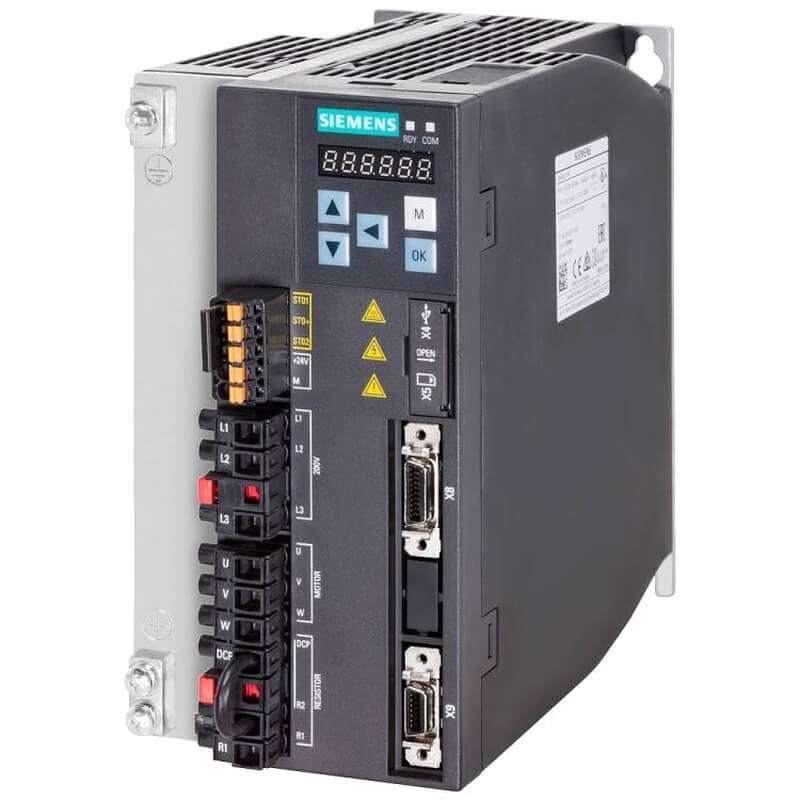
SIEMENS SQL321B50 Electric Actuator 50Nm HVAC Control


The SIEMENS SQL321B50 Electric Actuator is a robust solution for HVAC control, delivering 50 Nm of torque with advanced features designed for reliable and efficient system operation. Key advantages include its precise control capabilities, long operational lifespan, and seamless integration into modern building management systems. Its core features encompass a high-efficiency motor, integrated spring return functionality for fail-safe operation, and adjustable angle of rotation, ensuring adaptability to various damper configurations. Technical parameters such as an operating voltage of AC/DC 24 V, a nominal torque of 50 Nm, and an IP54 protection rating underscore its suitability for demanding industrial environments.
Product Specifications
| Feature | Specification |
| :------------------- | :---------------------------------------- |
| Product Type | Electric Actuator |
| Manufacturer | SIEMENS |
| Model Number | SQL321B50 |
| Torque Rating | 50 Nm |
| Operating Voltage | AC/DC 24 V |
| Protection Class | IP54 |
| Control Signal | 0...10 V DC, 4...20 mA (configurable) |
| Spring Return | Yes |
| Rotation Angle | Adjustable (up to 95°) |
| Ambient Temperature | -20...+50 °C |
| Connection Type | Screw terminals |
| Dimensions (W x H x D) | 160 x 290 x 115 mm (approx.) |
| Weight | 3.5 kg (approx.) |
Core Features & Market Positioning
The SIEMENS SQL321B50 distinguishes itself through its superior build quality and intelligent control algorithms, positioning it as a premium choice for HVAC applications demanding accuracy and durability. Its integrated spring return mechanism provides critical fail-safe functionality, ensuring dampers revert to a safe position in the event of power loss, a feature highly valued in safety-conscious installations. Furthermore, the actuator's ability to accept both analog voltage and current control signals, coupled with adjustable rotation limits, offers exceptional flexibility for system designers and integrators, setting it apart from simpler, less adaptable actuators.
Key Application Scenarios
This electric actuator is ideally suited for modulating control of air dampers in commercial and industrial HVAC systems, including applications in large office buildings, hospitals, and data centers where precise temperature and airflow management is paramount. Its 50 Nm torque rating makes it capable of operating medium to large dampers, ensuring effective zone control and energy efficiency. The SQL321B50 is frequently deployed in VAV (Variable Air Volume) systems to maintain desired airflow rates, as well as in economizer dampers to optimize the use of fresh outside air for cooling.
Practical System Integration Guidance
Integrating the SIEMENS SQL321B50 into an HVAC control system is streamlined by its user-friendly design and versatile connectivity. The actuator connects via screw terminals, supporting a standard AC/DC 24 V power supply. Its control input can be configured to accept a 0-10 V DC or 4-20 mA signal, allowing for direct interfacing with most modern Building Automation Systems (BAS) or controllers. For wiring, ensure the power supply is correctly polarized if using DC, and connect the control signal to the designated input terminals. The adjustable rotation stops are set using simple mechanical limiters, enabling precise calibration to the required damper travel without complex programming.
Operation and Risk Mitigation
Proper operation of the SIEMENS SQL321B50 involves ensuring it receives a stable power supply within its specified voltage range and that the control signal is within the configured parameters. Risk mitigation is enhanced by the actuator's IP54 rating, offering protection against dust and splashing water, making it suitable for varied environmental conditions. The integrated spring return function acts as a primary safety feature, preventing uncontrolled air movement during power interruptions. Regular visual inspections for any signs of physical damage or excessive wear, along with ensuring proper ventilation around the unit, will contribute to its longevity and safe operation.
Scalability & Long-Term Value
The SIEMENS SQL321B50 offers significant long-term value through its compatibility with Siemens' broader Desigo™ building automation platform, enabling seamless integration into larger, more complex control strategies. This interoperability facilitates future upgrades and expansion of HVAC control capabilities, including the potential for advanced diagnostics and predictive maintenance when networked with IIoT solutions. Its robust construction and high-quality components ensure a prolonged service life, reducing the total cost of ownership over the system's lifecycle and providing a reliable foundation for evolving building management needs.
Frequently Asked Questions
Q1: What is the primary function of the SIEMENS SQL321B50?
This electric actuator is engineered for precise, modulating control of air dampers within HVAC systems. It provides a consistent torque output to accurately position dampers for optimal airflow management and temperature regulation. Its design facilitates integration into automated building control strategies, enhancing energy efficiency.
The actuator's primary role is to translate control signals from a building management system into mechanical movement of an air damper. This allows for fine-tuned adjustments to airflow, which is crucial for maintaining desired environmental conditions and optimizing energy consumption in commercial and industrial settings.
Its robust construction and specific torque rating (50 Nm) make it suitable for medium to large dampers, ensuring reliable operation in demanding HVAC applications where precise and responsive control is essential.
Q2: What type of control signals can the SIEMENS SQL321B50 accept?
The SIEMENS SQL321B50 is versatile, accepting both 0-10 V DC and 4-20 mA current loop control signals. This flexibility allows it to interface with a wide array of modern building automation and control systems. Configuration between voltage and current modes is typically achieved through internal DIP switches or software settings.
This dual-signal capability ensures compatibility with diverse control strategies and existing infrastructure, simplifying integration projects. Users can select the signal type that best suits their system architecture and controller capabilities.
The actuator's ability to interpret these standard analog signals enables precise positioning proportional to the command input, facilitating advanced control algorithms like PID loops for enhanced system performance.
Q3: Is the SIEMENS SQL321B50 suitable for outdoor installations?
The SIEMENS SQL321B50 carries an IP54 protection rating, which signifies it is protected against dust ingress and splashing water from any direction. While it offers a degree of environmental resilience, it is generally intended for protected indoor or semi-outdoor applications where direct, heavy exposure to the elements is not expected.
For installations where the actuator might be exposed to more severe weather conditions, such as direct rain, snow, or extreme temperatures beyond its specified operating range, additional protective measures or enclosures may be necessary. Always consult the product's detailed installation manual for specific environmental limitations.
The IP54 rating ensures reliable operation in typical HVAC plant rooms or under ventilation hoods, where dust and occasional moisture might be present, but not in fully exposed outdoor environments without further safeguarding.
Q4: What is the torque rating of the SIEMENS SQL321B50, and what does it mean for damper control?
The SIEMENS SQL321B50 provides a nominal torque output of 50 Newton-meters (Nm). This torque rating indicates the rotational force the actuator can consistently exert to move and hold an air damper in position, even against resistance from airflow or friction.
A 50 Nm torque is sufficient for operating medium to large-sized air dampers commonly found in commercial HVAC systems. It ensures that the actuator can effectively overcome the forces acting on the damper blade, allowing for smooth and accurate positioning.
When selecting an actuator, matching the torque requirement of the damper to the actuator's rating is critical. The 50 Nm of the SQL321B50 makes it a robust choice for applications where higher torque is needed compared to smaller actuators.
Q5: Does the SIEMENS SQL321B50 have a spring return function, and why is it important?
Yes, the SIEMENS SQL321B50 features an integrated spring return mechanism. This is a crucial safety and operational feature that automatically moves the damper to a predefined fail-safe position (typically closed or open, depending on configuration) when power is lost or the control signal is removed.
The spring return ensures that in the event of a power outage or system malfunction, the damper does not remain in an arbitrary position. This predictability is vital for maintaining building safety, preventing unwanted air leakage, and ensuring essential ventilation or fire damper functions remain operational.
This fail-safe capability adds significant value by preventing potential damage, maintaining occupant comfort, and complying with stringent building codes and safety regulations, making it a preferred choice for critical HVAC applications.
Q6: How is the angle of rotation adjusted on the SIEMENS SQL321B50?
The angle of rotation for the SIEMENS SQL321B50 is adjustable, typically up to 95 degrees, and can be set using mechanical limit stops or internal adjustments. These adjustments allow for precise calibration to match the specific requirements of the damper it is controlling.
Users can configure the actuator's full range of motion to correspond exactly to the physical travel needed for the damper blade. This prevents over-rotation, reduces mechanical stress, and ensures that the actuator operates efficiently within its optimal range.
Fine-tuning the rotation ensures accurate airflow control and prevents potential damage to the damper or the actuator itself due to excessive movement, contributing to the overall longevity and performance of the HVAC system.
Q7: What are the typical installation considerations for this actuator?
Installation requires a stable AC/DC 24 V power supply and proper wiring to the screw terminals for both power and control signals. It's essential to ensure the actuator is mounted securely to the damper shaft, typically using a suitable coupling or adapter.
Ensure the control signal wiring is correct for the chosen input type (0-10 V DC or 4-20 mA) and that the actuator's internal configuration matches the signal being sent by the controller. Mechanical limit adjustments should be set before or during commissioning to define the full range of damper travel.
The actuator's IP54 rating means it can be installed in environments with dust and splashing water, but avoid direct exposure to heavy rain or submersion. Adequate ventilation around the unit is also recommended to prevent overheating during prolonged operation.
Q8: How does the SQL321B50 integrate with Building Automation Systems (BAS)?
The SQL321B50 integrates seamlessly with BAS through its standard analog control inputs (0-10 V DC or 4-20 mA). These signals are interpreted by the actuator to modulate damper position proportionally to the commands issued by the BAS controller.
Most modern BAS platforms are equipped to generate these standard analog output signals, allowing for direct connection to the actuator's terminals. The actuator's feedback signal (if available and configured) can also be used by the BAS to monitor damper position in real-time.
This straightforward integration facilitates centralized control and monitoring of HVAC components, enabling sophisticated energy management strategies, performance analysis, and fault detection within the overall building management environment.
Q9: What maintenance is required for the SIEMENS SQL321B50?
Generally, the SIEMENS SQL321B50 requires minimal maintenance due to its robust design and sealed components. Periodic visual inspections to check for physical damage, loose connections, or excessive dust accumulation are recommended.
Ensure the electrical connections remain clean and secure. If installed in a particularly dusty environment, cleaning the exterior of the actuator with a dry or slightly damp cloth may be necessary to prevent internal dust buildup, although the IP54 rating offers significant protection.
Lubrication is typically not required for the internal motor or gears. The primary focus should be on ensuring the correct power supply and control signals are maintained, and that the mechanical linkage to the damper operates freely.
Q10: What are the benefits of using a SIEMENS electric actuator for HVAC control?
SIEMENS electric actuators offer high reliability and precision in controlling airflow, leading to improved indoor air quality and energy efficiency. Their robust construction ensures a long operational lifespan, reducing replacement costs and system downtime.
They provide advanced control capabilities, including precise positioning and integration with digital building management systems. Features like spring return and configurable rotation limits enhance safety and adaptability to various HVAC system designs.
By leveraging SIEMENS technology, building operators can achieve better performance, lower operating expenses, and maintain compliance with environmental and safety standards through sophisticated and dependable HVAC automation.