











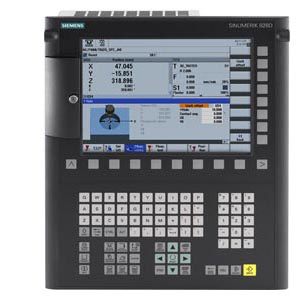
SIEMENS 6FC5370-6AA30-0AA0 SINUMERIK 828D Numeric Control Unit


The Siemens 6FC5370-6AA30-0AA0 is a SINUMERIK 828D numeric control unit engineered for advanced machine tool automation. This unit provides robust digital control capabilities for complex manufacturing operations.
This product is a CNC (Computer Numerical Control) system, specifically an advanced control unit within the SINUMERIK 828D family. It is positioned as a high-performance solution for mid-range to high-end machine tool applications demanding precision and efficiency.
Key Specifications
Number of axes: Up to 6 axes
Number of controlled axes: Up to 4 axes
Digital inputs: 24
Digital outputs: 16
Analog inputs: 2
Analog outputs: 1
Data storage: 4 GB internal, expandable via USB
Operating voltage: 24 V DC
Communication interfaces: Ethernet, Profibus DP, Profinet, USB, serial interface
Operating temperature: 0 °C to 55 °C
Dimensions: 440 mm x 254 mm x 167 mm
Weight: Approximately 5.5 kg
Technical Highlights & System Integration
Integrated PLC Functionality: The control unit incorporates a powerful PLC (Programmable Logic Controller) that supports standard IEC 61131-3 programming languages, enabling seamless integration of machine logic and control functions. This reduces the need for separate PLC hardware, streamlining system design and reducing complexity.
High-Performance Processing: It features a multi-core processor capable of executing complex NC (Numerical Control) programs and PLC tasks simultaneously with minimal latency. This ensures precise motion control and rapid response times essential for high-speed machining operations.
Advanced Motion Control Algorithms: The SINUMERIK 828D leverages sophisticated motion control algorithms, including look-ahead functions and dynamic look-ahead, to optimize tool paths and ensure smooth, accurate machining. These algorithms are crucial for achieving superior surface finish and extending tool life. How does the system handle complex contouring? The system's advanced processing and motion control algorithms enable it to execute complex 3D contours with high precision by analyzing and optimizing tool paths in real-time.
Connectivity and Network Integration: The unit supports a wide range of industrial communication protocols such as Profibus DP, Profinet, and Ethernet/IP, facilitating easy integration into existing factory networks and automation architectures. This ensures efficient data exchange with other automation components, including sensors, actuators, and higher-level supervisory systems.
User Interface and Operation: It is equipped with a user-friendly touch screen interface and intuitive graphical programming capabilities, simplifying machine operation, setup, and maintenance. The consistent operating philosophy across the SINUMERIK family reduces operator training time and improves overall productivity.
Key Application Scenarios
High-Precision Machining: Enables the production of components with tight tolerances, often in the micron range, critical for industries like aerospace and medical device manufacturing.
Complex Part Manufacturing: Facilitates the creation of intricate geometries and free-form surfaces, commonly required for automotive components and intricate molds.
High-Volume Production: Supports high-speed machining cycles and efficient tool management, leading to increased throughput and reduced production costs in mass production environments.
Multi-Axis Machining: Allows for simultaneous control of up to six axes, enabling the machining of complex parts with fewer setups and improved efficiency on machines like 5-axis milling centers.
Selection Guidance & Operation
Machine Capability Matching: Evaluate the number of axes and controlled axes required for your specific machining operations to ensure the control unit's capacity aligns with the machine tool's configuration.
Integration Requirements: Assess the existing plant network and automation infrastructure to confirm compatibility with the unit's communication interfaces such as Profinet and Profibus DP.
Performance Demands: Consider the complexity of part geometries, required surface finish, and machining speeds to determine if the unit's processing power and motion control capabilities meet operational demands.
Operator Familiarity: Factor in the training needs of your operators by considering the user-friendliness of the interface and the availability of relevant training resources for the SINUMERIK platform.
System Scalability: Plan for future production needs by considering if the control unit offers options for expansion or upgrade to accommodate increasing complexity or volume in manufacturing tasks.
FAQ
What are the primary advantages of the SINUMERIK 828D?
The SINUMERIK 828D offers high-performance control for demanding machining tasks. Its integrated PLC functionality simplifies system design and reduces component count. The unit boasts advanced motion control for superior accuracy and surface finish.
What types of industrial machines are best suited for this control unit?
This control unit is ideal for a wide range of machine tools including milling machines and machining centers. It excels in applications requiring precision, speed, and complex contouring capabilities. The unit is well-suited for both mid-range and high-end automation solutions.
How does the SINUMERIK 828D handle data storage and connectivity?
It provides 4 GB of internal data storage, expandable via USB for larger projects. The unit supports essential industrial communication protocols like Ethernet, Profibus DP, and Profinet. This ensures seamless integration into automated manufacturing environments.
What is the typical power requirement for operating this CNC unit?
The Siemens 6FC5370-6AA30-0AA0 operates on a 24 V DC power supply. This standard voltage requirement facilitates straightforward integration into most industrial power systems. Ensure stable power delivery for optimal performance.
Can this control unit be programmed using standard PLC languages?
Yes, it supports standard IEC 61131-3 PLC programming languages. This allows for flexible and efficient integration of custom machine logic. Operators familiar with these languages will find programming straightforward.