











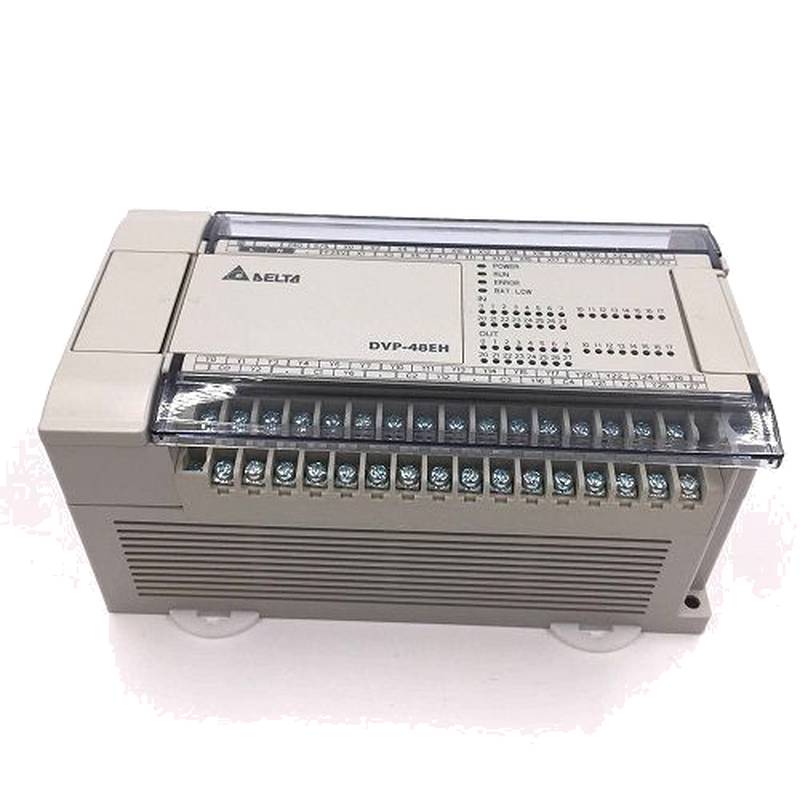
Delta DVP80EH00R3 Industrial Grade 80-point Relay Output PLC Controller


The Delta DVP80EH00R3 stands as a robust and versatile industrial-grade PLC controller, engineered to meet the demanding requirements of modern automation. This 80-point relay output unit excels in delivering high-speed processing, extensive I/O capabilities, and reliable performance across a myriad of industrial applications. Its core advantages lie in its powerful execution speed, comprehensive digital and analog I/O options, and robust hardware design, making it a go-to solution for complex control tasks. Key technical parameters include a program capacity of 16K steps, data register capacity of 10K words, and support for up to 8 expansion modules, ensuring significant flexibility for system expansion.
Product Specifications
| Feature | Specification |
| :------------------------- | :------------------------------------------------ |
| Model | DVP80EH00R3 |
| Program Capacity | 16K Steps |
| Data Register Capacity | 10K Words |
| Max. I/O Points | 80 Points (built-in + expansion) |
| Digital Output Type | Relay Output |
| Input/Output Points | 40 Digital Inputs, 40 Digital Outputs |
| Power Supply | 100-240V AC, 50/60Hz |
| Communication Ports | RS-232, RS-485 (built-in) |
| Expansion Capability | Supports up to 8 expansion modules |
| High-Speed Counters | Supports up to 6 axes of high-speed pulse output |
| Operating Temperature | 0°C to 55°C |
| Dimensions (W x H x D) | 210mm x 150mm x 84mm |
Core Features & Market Positioning
The Delta DVP80EH00R3 distinguishes itself through its exceptional processing speed and comprehensive feature set, positioning it as a premium choice for complex automation challenges. Its high-speed pulse output capabilities, supporting up to 6 axes, are particularly advantageous for motion control applications, setting it apart from many competitors in its class. Furthermore, the inherent flexibility afforded by its support for up to eight expansion modules allows for significant I/O customization, a critical factor for industries requiring tailored solutions. This adaptability, coupled with Delta's reputation for reliability and cost-effectiveness in industrial automation, solidifies the DVP80EH00R3's strong market presence.
Key Application Scenarios
Engineers frequently search for PLC solutions capable of handling intricate control logic and substantial I/O requirements. The DVP80EH00R3 excels in discrete manufacturing, where precise control of machinery and production lines is paramount. Its capacity for high-speed pulse outputs makes it ideal for automated assembly lines, packaging machinery, and robotics, ensuring seamless synchronization and accurate positioning. Industries such as food and beverage processing, material handling, and printing also benefit from its robust relay outputs and extensive I/O, enabling efficient management of diverse operational sequences and safety interlocks.
Practical System Integration Guidance
Integrating the Delta DVP80EH00R3 into existing or new systems requires careful planning, particularly concerning power distribution and wiring. Ensure the power supply meets the specified 100-240V AC range and consider transient voltage protection for industrial environments. When wiring the 80 relay outputs, adhere strictly to load current limits to prevent premature failure. For programming, Delta's ISPSoft software is the standard tool, offering a ladder logic environment familiar to many automation engineers. Connecting to HMIs or SCADA systems is typically achieved via the built-in RS-232 or RS-485 ports, requiring proper communication protocol configuration.
Operation and Risk Mitigation
Safe operation of the Delta DVP80EH00R3 hinges on proper installation and adherence to electrical safety standards. Always ensure the unit is de-energized before performing any wiring or maintenance. Grounding should be robust to prevent electrical noise and potential hazards. Common operational issues can arise from incorrect wiring or programming errors; meticulously review schematics and logic before energizing the system. While specific error codes are detailed in the user manual, general troubleshooting often involves checking input power, verifying I/O wiring continuity, and stepping through program logic to identify anomalies.
Scalability & Long-Term Value
The DVP80EH00R3 offers significant scalability, a crucial aspect for businesses planning for future growth or system upgrades. Its ability to accommodate up to eight expansion modules allows for a substantial increase in digital and analog I/O points without requiring a complete system overhaul. This modular approach ensures that the PLC can adapt to evolving production demands and technological advancements. Integration with Industry 4.0 initiatives is facilitated through communication options, enabling connectivity to higher-level systems for data acquisition, remote monitoring, and advanced analytics, thus maximizing the long-term value and operational efficiency of the automated system.
Frequently Asked Questions
What are the primary communication protocols supported by the DVP80EH00R3?
The DVP80EH00R3 features built-in RS-232 and RS-485 communication ports. These are essential for interfacing with human-machine interfaces (HMIs), programmable logic controllers (PLCs), and supervisory control and data acquisition (SCADA) systems. Correct configuration of serial communication parameters, such as baud rate, data bits, parity, and stop bits, is critical for successful data exchange.
How many digital inputs and outputs does the DVP80EH00R3 offer in total?
This model is equipped with 40 digital inputs and 40 digital outputs, totaling 80 points. This generous I/O count can be further expanded through the addition of Delta's compatible expansion modules. The modular design allows users to tailor the I/O configuration precisely to their application's needs.
What is the maximum program memory capacity of the Delta DVP80EH00R3?
The DVP80EH00R3 boasts a substantial program memory capacity of 16K steps. This ample space allows for the development and implementation of complex control algorithms and sophisticated automation logic. It provides sufficient room for intricate sequencing, advanced calculations, and comprehensive data management within the PLC's program.