











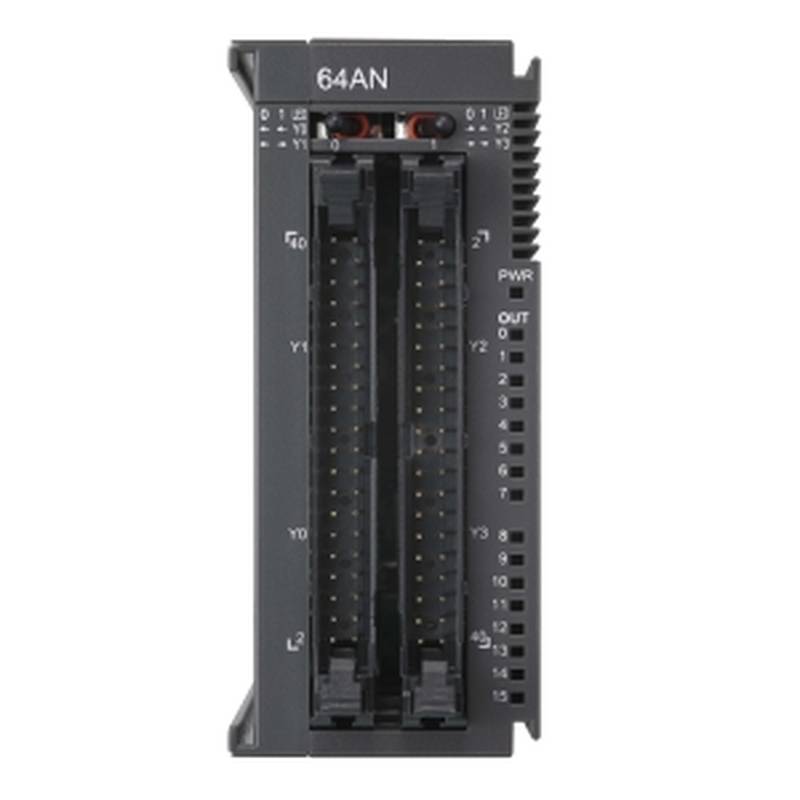
Delta AS64AN02T-A High-density 64-point DC Transistor Output Module


The Delta AS64AN02T-A is a high-density 64-point DC transistor output module designed to expand the capabilities of Delta's AS Series PLCs. This module offers robust performance and significant I/O expansion, making it suitable for a wide range of automated equipment. Key advantages include its high point count, NPN transistor output type, and seamless integration within the Delta AS Series ecosystem. Technical parameters such as a 5-30 VDC operating voltage and 0.1 A per output current rating highlight its application suitability for controlling various loads.
Product Specifications
| Feature | Specification |
| :---------------------- | :--------------------------------------------- |
| Compatible Series | AS Series |
| Classification | Digital Output Module |
| I/O Points | 64 outputs |
| Output Type | NPN Transistor Output |
| Voltage Rating | 5 to 30 VDC |
| Current Rating (per output) | 0.1 A |
| Current Rating (per COM) | 3.2 A |
| Termination Style | MIL Connector (2x IDC-40) |
| Mounting Type | Chassis Mount, DIN Rail |
| Operating Temperature | -20 to 60 °C |
| Ingress Protection | IP20 |
| Power Consumption | 1.44 W (Internal) |
Core Features & Market Positioning
The Delta AS64AN02T-A stands out in the industrial automation market due to its high output density, offering 64 individual transistor outputs within a compact module. This allows for significant space savings on control panels compared to using multiple lower-density modules. Its NPN transistor output configuration is a common requirement in many industrial applications, simplifying integration with various actuators, solenoids, and indicator lights. As part of the Delta AS Series, it benefits from the platform's high-speed execution capabilities and advanced CPU performance, positioning it as a reliable and efficient choice for demanding automation tasks. The module's design emphasizes ease of installation and maintenance, aligning with Delta's commitment to user-friendly industrial solutions.
Key Application Scenarios
The Delta AS64AN02T-A is ideally suited for applications requiring extensive output control. This includes intricate packaging machinery, high-speed labeling systems, complex electronics manufacturing equipment, and textile machinery where precise control of numerous outputs is critical. Its ability to manage 64 distinct output points makes it invaluable in assembly lines, material handling systems, and any automated process demanding sequential or parallel activation of multiple devices such as motors, valves, relays, or indicator lamps.
Practical System Integration Guidance
Integrating the Delta AS64AN02T-A into an existing or new AS Series PLC system is straightforward, leveraging the platform's modular design. The module connects via IDC-40 MIL connectors, typically requiring compatible wiring modules for external connections. It is designed for DIN rail mounting, facilitating quick installation within control cabinets. The AS Series software, such as ISPSoft, provides tools for hardware configuration and programming, enabling users to easily assign I/O addresses and develop control logic for the 64 output points. Referencing the AS Series Hardware Manual is recommended for detailed wiring diagrams and connection procedures to ensure proper setup and prevent damage.
Operation and Risk Mitigation
Proper operation of the Delta AS64AN02T-A involves ensuring it is installed within its specified operating temperature range and environmental conditions (IP20). Each output is rated for 0.1A, and the total COM current is 3.2A; exceeding these limits can lead to module failure or damage to connected devices. Overcurrent protection should be implemented at the application level or through external protective devices. Regular inspection, as outlined in the Delta AS Series Hardware Manual, using basic tools like screwdrivers and clean cloths, is advised for periodic maintenance to identify any potential issues and ensure long-term reliability.
Scalability & Long-Term Value
The Delta AS64AN02T-A enhances the scalability of the AS Series PLC system. The AS Series itself supports up to 32 extension modules and a total of 1,024 I/O points, allowing for significant system expansion. This 64-point output module contributes to this high I/O capacity, enabling users to build more complex and sophisticated automation solutions without needing to replace their existing PLC hardware. Compatibility with Delta's broader ecosystem, including motion control and various communication modules, ensures that systems can be upgraded and integrated with emerging IIoT and digital manufacturing technologies, providing long-term value and adaptability.
Frequently Asked Questions (FAQs)
1. What is the primary function of the Delta AS64AN02T-A module?
The Delta AS64AN02T-A serves as a high-density digital output expansion module for the Delta AS Series PLC. It provides 64 individual NPN transistor outputs, allowing automation systems to control a large number of external devices like actuators, solenoids, and indicator lights. This significantly increases the output capacity of the PLC.
Its core purpose is to enable more complex control strategies and manage a greater number of output devices from a single PLC chassis. This is crucial for machines with numerous operational components requiring coordinated activation.
This module is essential for applications where the base PLC's output count is insufficient, offering a cost-effective and space-saving solution for system expansion.
2. What are the key technical specifications of the AS64AN02T-A module?
This module features 64 NPN transistor outputs, each capable of handling 0.1A, with a total COM current limit of 3.2A. It operates within a 5 to 30 VDC voltage range. The module uses MIL connectors for termination, typically requiring specific wiring modules.
It is designed for DIN rail or chassis mounting and has an operating temperature range of -20 to 60 degrees Celsius. Its IP20 ingress protection rating indicates suitability for industrial environments when properly enclosed.
The module's specifications are optimized for integration within the Delta AS Series, ensuring compatibility and performance with compatible Delta CPU modules and other expansion units.
3. How does the AS64AN02T-A integrate with other Delta AS Series modules?
The AS64AN02T-A is designed to be a direct expansion module within the Delta AS Series PLC system. It connects to the PLC's backplane or a dedicated expansion rack, communicating seamlessly with the CPU module. The AS Series supports up to 32 extension modules, allowing for extensive system growth.
Its modular, rackless design, combined with specialized wiring modules and DIN rail clips, simplifies physical installation and connection. Configuration and programming are managed through Delta's ISPSoft software, which recognizes the module and its I/O points.
This seamless integration ensures that the AS64AN02T-A functions as a natural extension of the PLC's native I/O, maintaining consistent performance and simplifying system design.
4. What types of devices can be controlled by the Delta AS64AN02T-A module's outputs?
The NPN transistor outputs of the AS64AN02T-A are suitable for driving low-power DC devices. This commonly includes solenoids for pneumatic or hydraulic valves, small DC motors, relays (via interposing relays if necessary), LED indicator lights, and various types of actuators.
Given the 0.1A per-output rating, it is ideal for devices that do not draw significant current. For higher current loads or AC-powered devices, external relays or solid-state relays controlled by the AS64AN02T-A's outputs would be required.
It's crucial to ensure that the voltage and current requirements of the connected devices fall within the specified operating parameters of the module to prevent damage or malfunction.
5. What are the benefits of using a 64-point output module compared to smaller modules?
Using a 64-point module like the AS64AN02T-A offers significant advantages in terms of space and wiring consolidation. It reduces the physical footprint within a control cabinet compared to using multiple 8, 16, or 32-point modules to achieve the same I/O count.
This consolidation also leads to simplified wiring, as fewer modules mean fewer cables and termination points to manage, which can reduce installation time and the potential for wiring errors.
Economically, a single high-density module can sometimes be more cost-effective than purchasing and installing several smaller modules, especially when considering the total cost of ownership including cabinet space and labor.
6. What is the voltage and current handling capability of each output on the AS64AN02T-A?
Each of the 64 individual outputs on the Delta AS64AN02T-A module is rated for a maximum current of 0.1 Amperes (100 mA). The output voltage range is between 5 and 30 VDC. Additionally, the common (COM) terminal for these outputs has a total current handling capability of 3.2 Amperes.
It is critical to adhere to these specifications to ensure the longevity and reliable operation of the module and connected devices. Exceeding the 0.1A per-output limit can cause damage to the transistor output.
The 3.2A limit for the shared COM terminal means that the sum of the currents drawn by all active outputs should not exceed this value at any given time.
7. How is the Delta AS64AN02T-A module physically installed in a control panel?
The AS64AN02T-A module is designed for easy installation, typically using DIN rail mounting clips, which are a standard in industrial control panels. It can also be chassis mounted. The module's robust design ensures secure attachment.
Wiring to the external devices is achieved through two 40-pin MIL connectors. Users will often employ specialized wiring terminal modules that connect to these MIL connectors, providing screw terminals or other easily accessible connection points for field wiring.
Referencing the Delta AS Series Hardware Manual is crucial for understanding the specific wiring requirements and recommended installation practices to ensure proper function and safety.
8. Can the AS64AN02T-A module be used with PLC systems other than Delta's AS Series?
No, the Delta AS64AN02T-A is specifically designed as an expansion module for the Delta AS Series PLC platform. It relies on the proprietary communication protocol and backplane architecture of the AS Series to function correctly with the CPU module.
Using this module with a PLC from a different manufacturer would not be possible due to incompatible communication interfaces, addressing schemes, and electrical signaling.
For other PLC brands, equivalent expansion modules would need to be sourced from those respective manufacturers to ensure compatibility and system integrity.
9. What kind of software is used to program and configure the AS64AN02T-A module?
The Delta AS64AN02T-A module is configured and programmed using Delta's integrated engineering software, typically ISPSoft. This software suite allows engineers to set up the PLC hardware, define network configurations, develop control logic using ladder diagrams or other supported languages, and manage system diagnostics.
Within ISPSoft, the AS64AN02T-A module is added to the hardware configuration, and its 64 output points are assigned I/O addresses that can then be used in the PLC program for controlling external devices.
The software also facilitates downloading the program to the PLC, online monitoring of I/O status, and troubleshooting, providing a comprehensive environment for managing the automation system.
10. Are there any specific maintenance or troubleshooting tips for this output module?
Periodic visual inspection of the module and its wiring is recommended to check for any signs of damage, loose connections, or environmental contaminants. Ensuring the module operates within its specified temperature and humidity limits is key to preventing premature failure.
If an output fails to activate or deactivate as expected, verify that the output is correctly addressed in the PLC program and that the output signal from the CPU is being sent. Check the load connected to the output to ensure it is functional and within the module's current and voltage ratings.
Troubleshooting often involves checking the PLC program logic, verifying wiring integrity using a multimeter, and ensuring that the module itself is receiving power correctly. Consulting the AS Series Hardware Manual for specific error codes or diagnostic procedures is also advised.